Introduction
"3D printed clear aligners" sounds like a single product. In practice, it covers at least three different things happening in a dental lab or manufacturing facility.
Some aligners are thermoformed over 3D-printed models. Others are printed directly from a digital file. Still others use printed retainers, study models, or bonding trays as supporting pieces rather than the aligner itself.
That overlap creates real confusion for patients and dental teams trying to compare options.
Common questions include:
- How does this technology actually work?
- Is it safe?
- How does it stack up against Invisalign or traditional braces?
- What drives the cost?
This article walks through the professional workflow behind printed aligners, weighs the benefits against the limitations, and explains where the risks lie.
One point stays constant throughout: no printer, resin, or digital file replaces a licensed dental professional's diagnosis and ongoing monitoring. Treatment suitability requires an in-person evaluation by a qualified provider, not a manufacturing decision.
Key Takeaways
- 3D printing is only one step: scanning, planning, manufacturing, finishing, and clinical review all matter.
- Most clear aligners are thermoformed over printed models; direct-printed aligners are newer and less proven.
- Digital precision speeds production but does not automatically make an appliance safer or more effective.
- Skip DIY aligner kits—professional diagnosis, validated materials, and supervised monitoring are required.
What Are 3D Printed Clear Aligners?
Clear aligners are removable plastic trays that apply controlled pressure to shift teeth toward a planned position. Each tray in a series moves teeth a fraction of a millimeter, following stages a clinician designs and approves before production.
Three Ways "3D Printed" Gets Used
The term describes three distinct processes:
- Thermoformed over a printed model. Print a stage model, then heat and vacuum- or pressure-form a clear sheet over it (still the most common method).
- Directly printed from a digital file. Build the aligner layer by layer from biocompatible resin—no model or thermoforming step.
- Printed supporting components. Study models, indirect bonding trays, retainers, and surgical guides, even when the aligner itself is not printed.
The Printer Isn't the Whole System
A 3D printer is one tool inside a much longer chain: intraoral scanning, CAD or treatment-planning software, validated materials, post-processing, quality inspection, and clinician sign-off. Skip any link in that chain and fit or effectiveness can suffer, regardless of how advanced the printer is.
Direct-print aligners are still a developing category. The FDA's 510(k) record for the LuxCreo Clear Aligner System shows a substantial-equivalence clearance from April 2025. That filing shows regulators are reviewing this approach; it does not mean direct print has replaced thermoforming.
Manufacturing method alone never determines treatment quality. Diagnosis, tooth-movement planning, appliance fit, and follow-up care do.
How Are 3D Printed Clear Aligners Made?
Diagnosis, Scanning, and Digital Planning
Every legitimate aligner case starts with an exam, not a scan. A clinician checks teeth, gums, bite relationship, existing restorations, and any condition — active decay, periodontal disease, bone loss — that could change the treatment approach.
Once cleared, digital data capture begins:
- Intraoral scanning (or scanning a physical impression) builds a 3D model of the mouth.
- The clinician or lab checks the scan for missing data, distortions, or gaps that could affect fit.
- Treatment-planning software breaks the total tooth movement into individual stages, and the clinician reviews and approves the sequence before production starts.
Model-Based Thermoforming vs. Direct Printing
After the plan is approved, production follows one of two paths. Both aim for the same staged tooth movement; they differ in how each aligner is manufactured.

Thermoforming route:
- Print an accurate dental model for each stage.
- Heat and form approved aligner material over each model.
- Trim, smooth, clean, and inspect every aligner for fit, sharp edges, and defects before it ships.
Direct-print route:
- Send staged digital geometry to a printer calibrated for a validated biocompatible resin.
- Wash and post-cure the printed part according to the resin manufacturer's protocol.
- Finish and inspect the piece before delivery.
What Both Routes Require
Neither workflow is safe on a generic desktop printer or an unvalidated resin. Dental production depends on systems and materials built for the mouth, not general prototyping.
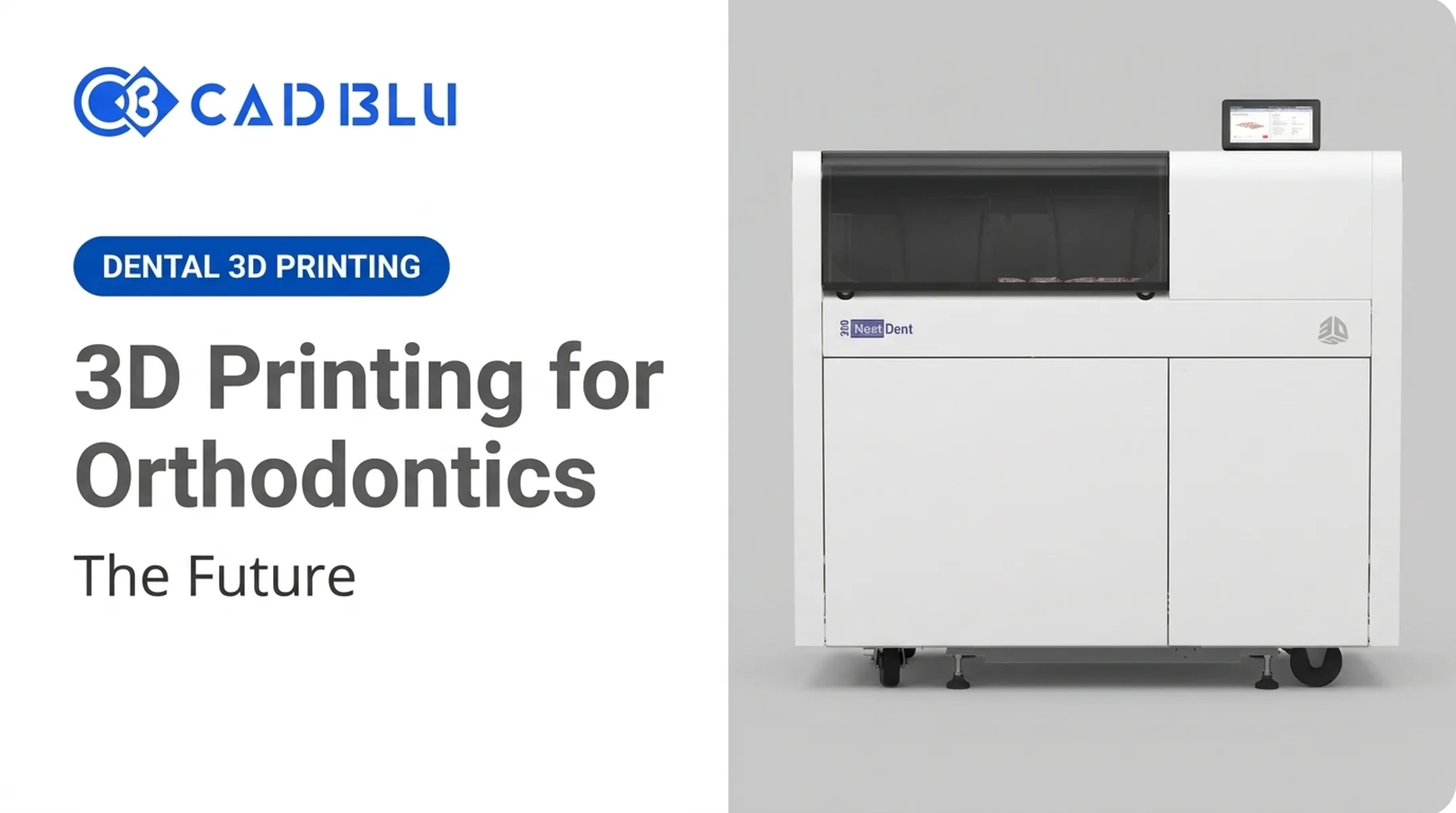
- Validated hardware — Dental-specific DLP systems such as the NextDent 5100
- Cleared materials — Resins with CE certification and FDA listing for orthodontic use
- Clinical finish standards — Wash, post-cure, trim, and inspect before delivery
A resin made for jewelry casting patterns has no place in a patient's mouth.
Benefits, Limitations, and Safety Considerations
What the Digital Workflow Offers
A digital manufacturing chain brings real operational advantages:
- Customization for each patient's specific staged movements.
- Repeatability: stored scan data lets a lab reprint any stage's model on demand.
- Faster reproduction of a lost or damaged appliance without a new physical impression.
- Smoother communication between clinicians and labs through shared digital files.
These are workflow benefits. They don't automatically translate into better clinical outcomes, and results still vary by system, case complexity, and clinician skill.
Where Aligners Fall Short
Aligners aren't the right tool for every case. Significant rotations, root torquing, and certain bite corrections are harder to achieve predictably with aligners than with fixed appliances.
Some patients still need adjuncts or a mid-treatment change, such as:
- Attachments
- Elastics
- Interproximal reduction
- A switch to braces
Safety also depends on quality control that has nothing to do with the printer's marketing specs. Key checks include:
- Biocompatibility documentation
- Dimensional accuracy
- Proper resin handling and correct post-curing
- Edge finishing
- Traceability from file to finished appliance
A 2025 systematic review found research on directly printed aligners is still limited: only nine eligible in-vitro studies were identified, with mixed results and reported UDMA leaching across the included studies. That is not a reason to panic, but it is a reason to ask any provider what validation their specific resin and process have undergone.

Why DIY Aligners Are Dangerous
Mail-order and self-directed aligner kits skip the diagnostic step entirely. The American Association of Orthodontists warns that treatment without an in-person exam and imaging can cause permanent tooth or gum damage, bite changes, and other complications that go unnoticed until they're serious. An undiagnosed gum condition, an incorrect force direction, or a poorly fitting tray can do real harm, and by the time it's obvious, the damage is often already done.
3D Printed Aligners Compared With Other Orthodontic Options
| Factor | Clear Aligners | Metal/Ceramic Braces |
|---|---|---|
| Visibility | Nearly invisible when worn | Metal is visible; ceramic is less noticeable |
| Removability | Removable for eating and cleaning | Fixed in place for the full treatment |
| Compliance dependency | Requires roughly 20-22 hours of daily wear to stay on track | No daily wear decision: the appliance works continuously |
| Force control | Effective for many cases; harder for complex rotations or root movement | Handles a broader range of movement types |
| Best suited for | Mild to moderate cases, motivated patients | Complex cases, patients needing continuous control |
The right choice depends on the movements required, the patient's habits, and the treating clinician's judgment.
Custom-printed brackets
Digitally designed, lab-produced brackets sit between traditional braces and aligners. They are fixed like braces, but customized to each patient's anatomy through the same scanning and CAD process used for aligners. They still require an orthodontist's adjustment visits and don't offer the removability aligners do.
Cost
There's no single number that applies to "3D printed aligners." Price depends on case complexity, provider fees, aligner stages, refinement trays, retainers, follow-up visits, and insurance coverage. A printed manufacturing step doesn't inherently make treatment cheaper. Clinical work and materials still drive most of the cost.
What Dental Practices and Labs Should Evaluate
Adding a 3D aligner workflow means evaluating a system, not shopping for a printer. Before committing, practices and labs should ask:
- What throughput does our case volume actually require?
- Does the printer's resolution and layer thickness match our accuracy needs?
- Which materials are validated for this specific machine, and what's their regulatory status?
- Does the software integrate with our existing scanner and CAD pipeline?
- Do we need model-based, direct-print, or both capabilities?
- What post-processing equipment, training, and floor space does this add?
Evaluate the Whole Workflow, Not Just the Printer
A printer purchased in isolation solves almost nothing. Day-to-day results depend on the full stack around it:
- Scanner and treatment-planning software integration
- Production documentation and quality assurance steps
- Waste handling, staff training, and floor space
- Service coverage and repair response times This is where a full-service partner earns its place. CAD BLU supplies commercial 3D printers, dental-grade materials, CAD and scanning software, installation, workflow optimization, and OEM-certified repair support for dental labs and practices building digital orthodontic capacity. That includes model production for thermoformed aligners, indirect bonding trays, and surgical guides. CAD BLU does not diagnose patients or guarantee a particular aligner outcome; that responsibility stays with the treating clinician. What it provides is the equipment, materials, and technical backing to run a validated, well-documented production workflow. Before any system goes into patient use, verify manufacturer claims, collect biocompatibility and regulatory documentation, confirm service and maintenance terms, and run a controlled validation process. Labs that skip validation usually pay for it later in remakes, rework, and downtime.

Frequently Asked Questions
Is Invisalign 3D printed?
3D printing is part of Align Technology's digital workflow, along with scanning and CAD treatment planning. Official materials do not clearly state that every aligner shell is directly printed, so confirm details with current manufacturer information.
What are the differences between 3D printed braces and metal braces?
Clear aligners are removable and less visible, but they only work if worn as directed. Fixed metal braces stay on the teeth and apply continuous force. A dental professional should decide which option fits the case.
How much do 3D aligners cost?
Cost varies by case complexity, provider fees, number of stages, refinements, retainers, and insurance coverage. There is no fixed universal price. Ask your provider for a case-specific quote.
What is the 30-minute rule with Invisalign?
It means you should not leave aligners out for long after eating or drinking, or you risk losing treatment time. Exact wear rules can vary, so confirm guidance with your provider or Invisalign's official materials.
Are 3D printed clear aligners safe?
Safety depends on diagnosis, validated materials, accurate manufacturing, proper fit, and clinical monitoring—not the printing method alone. Self-made or unsupervised aligners carry real risk and should be avoided.
How are 3D printed clear aligners made?
Treatment starts with a dental exam and digital scan, followed by staged treatment planning. Aligners are then either thermoformed over printed models or printed directly from validated resin, finished, inspected, and delivered under a clinician's supervision.