Many practices struggle with denture failures at the tooth-to-base junction, unpredictable turnaround times, and inconsistent aesthetic results from case to case. A monolithic approach addresses the first problem structurally. A digital workflow addresses the second and third.
This article covers what monolithic digital dentures actually are, how milling and 3D printing produce them, the benefits and trade-offs supported by current research, and what practices and labs need to evaluate before adopting the technology — including cost factors specific to the U.S. market.
Key Takeaways
- Monolithic dentures fuse teeth and base into one continuous restoration, cutting reliance on separately bonded denture teeth.
- Digital design improves repeatability and record-keeping, but outcomes still hinge on clinical records and quality control.
- Monolithic designs suit many cases, but case selection and clinical judgment still decide fit.
- Pricing swings widely based on material, production method, lab fees, and geography.
What Are Monolithic Digital Dentures?
A monolithic denture is one continuous piece: teeth and base form a single, uninterrupted structure — not separate parts bonded after fabrication.
Conventional dentures typically involve prefabricated teeth bonded or set into a separately processed base. That bonded interface is a known weak point. A monolithic denture removes that seam entirely.
The Digital Half of the Equation
"Digital" refers to how clinicians design and record the restoration, not the material itself. That workflow typically includes:
- Digital impressions or intraoral scans instead of (or alongside) physical impressions
- CAD software for virtual tooth arrangement and occlusal design
- CAM production via milling or 3D printing
- Digitally stored case files for future reference or remakes
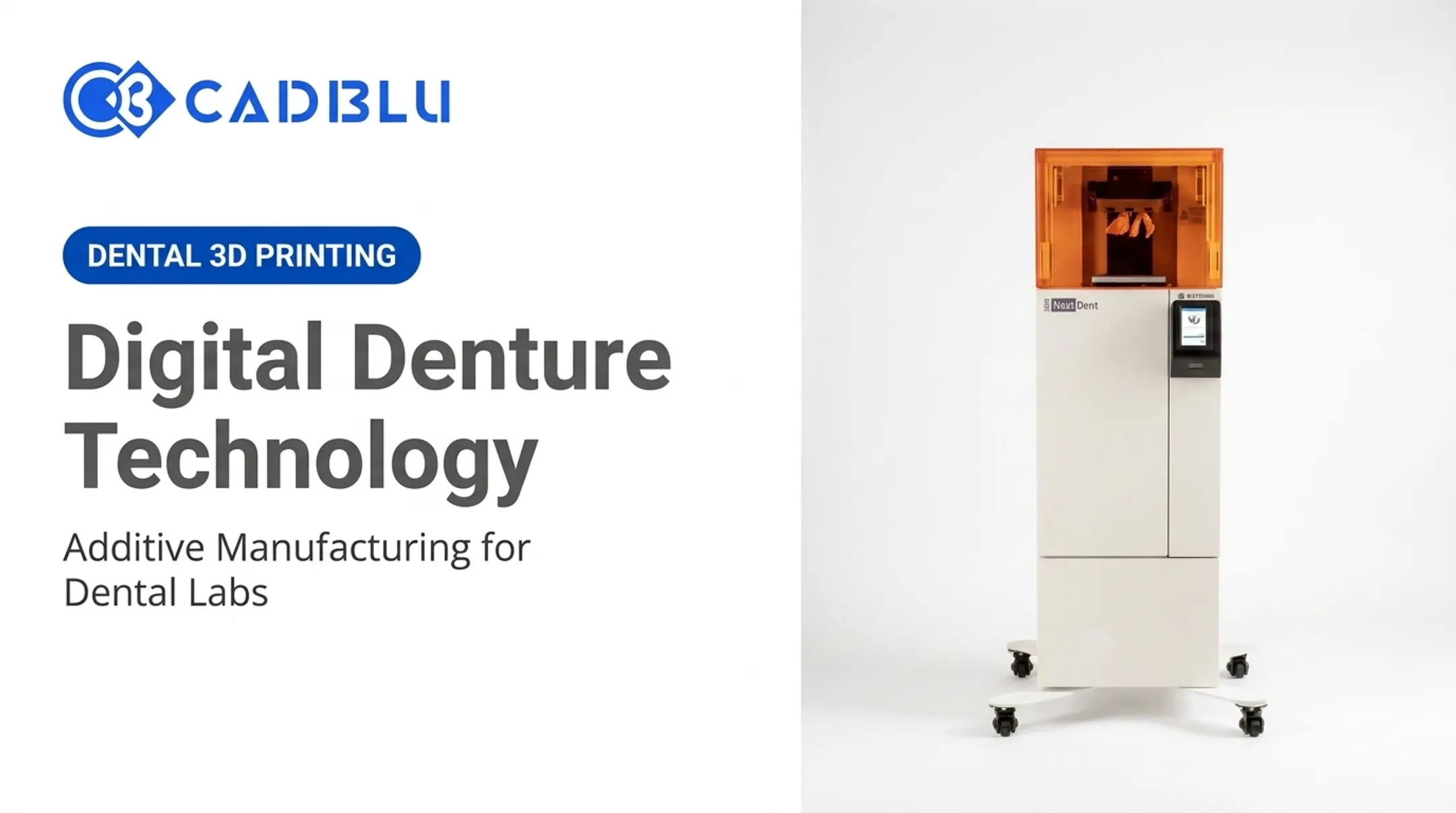
A denture can be digital without being monolithic — some digital workflows still produce a base and separate teeth. The reverse is also true: some milled monolithic systems, like Ivoclar's Ivotion, use a two-color disc with distinct tooth and base zones. NextDent's MultiJet-printed dentures print teeth and base together in one continuous build, no assembly required.
Materials and What to Verify
Common materials include pre-polymerized, high-density PMMA discs and validated dental resins for printing. Before committing to a system, confirm:
- The specific material's FDA clearance status and indicated use
- Manufacturer documentation on biocompatibility
- Whether the "monolithic" construction is a true integrated material or a layered blank
No single product defines the category. Disc formulation, resin chemistry, mill or printer hardware, and finishing protocols all differ by manufacturer — so verify the full stack, not just the label.
Design Flexibility and Candidacy
Digitally, clinicians can adjust tooth position, arch form, occlusion, tooth and gingival shade, and base contour — often with faster iteration than analog wax-ups allow.
Typical candidate cases include:
- Complete removable dentures
- Immediate or transitional dentures
- Overdentures
- Select implant-supported applications
Final candidacy still rests on a qualified clinician's exam — fit, occlusion, and tissue condition decide the case more than any material or workflow claim.
How Are Monolithic Digital Dentures Made?
The process moves through a defined sequence, whether the final piece is milled or printed:
- Examination and records — clinical exam, definitive impressions or intraoral scans, and jaw-relation records
- Digital design (CAD) — teeth positioned, occlusion set, base contoured in software
- Clinician review — design approved before production begins
- Production (CAM) — milling or 3D printing
- Finishing and quality control — polishing, margin and fit inspection, disinfection
- Delivery and follow-up — insertion, adjustment, and documentation for future reference

Milling vs. 3D Printing
Both are valid CAM approaches, but they work differently:
| Factor | Milling (subtractive) | 3D Printing (additive) |
|---|---|---|
| Process | Carves from a solid pre-polymerized disc | Builds layer by layer from liquid resin |
| Material consistency | High — factory-processed puck | Depends on curing and post-processing |
| Production flexibility | Established, less flexible geometry | Higher flexibility, more variables to manage |
| Key sensitivity | Disc size and bur wear | Orientation, layer height, post-cure timing |
A five-center accuracy study found milled try-in dentures more consistent than printed ones, though printed results still fell within a clinically acceptable range for try-ins ((Herpel et al., 2021).
Combined Materials and Design Approval
Some systems integrate tooth-colored and gingiva-colored material in a single disc or print job; others use a layered blank. Verify which construction method a given system actually uses. The label "monolithic" does not mean every brand builds the same way.
Before production, clinicians should confirm the digital design against:
- Vertical dimension and occlusion
- Lip support and phonetics
- Midline and aesthetics
- Tissue adaptation
A Practical Workflow Example
Once the design is approved, production speed depends on the CAM setup. A lab running a MultiJet system such as the NextDent 300 can print about 15 arches in a single 9-hour build, with print, post-processing, and shipment often completed within 24 hours.
Files move from CAD software to the printer, then through cleaning, polishing, and QC before delivery. CAD BLU supplies this class of printers, dental materials, and workflow support for labs building out monolithic denture production. Confirm the specific denture system, material indications, and service scope with the provider before purchase.
What Are the Benefits and Limitations of Monolithic Digital Dentures?
Structural and Durability Considerations
Removing the tooth-to-base bond eliminates one common failure point. That removes a real failure mode — it is not a fracture-proof guarantee. A monolithic denture can still fracture, wear, or chip under enough force — the material and design still matter.
A 2024 systematic review and meta-analysis found CAD/CAM dentures showed better retention than conventional dentures, and digital workflows required fewer appointments — one analysis noted roughly five fewer working hours per case (Zandinejad et al., Journal of Prosthodontics, 2024). Certainty of evidence was rated low, and patient satisfaction scores didn't differ significantly from conventional dentures.
Repeatability, Hygiene, and Aesthetics
Digital planning improves consistency between design and outcome, but scan accuracy, edentulous anatomy, and clinician verification still shape the final fit. A perfect digital file doesn't override a poor scan.
On hygiene: surface polish and material porosity affect plaque retention and stain resistance. No denture material eliminates infection risk or guarantees superior oral health outcomes — daily cleaning still matters regardless of how the prosthesis was made.
Aesthetically, digital shade-blending and gingival characterization let technicians fine-tune:
- Tooth morphology and arrangement
- Shade and translucency
- Gingival contour and texture
- Overall smile design
A natural-looking result still depends on clinician-technician collaboration more than on the manufacturing method.
Trade-Offs Worth Knowing
- Higher upfront cost depending on material and case complexity
- Lab dependence on compatible software and hardware systems
- Learning curve for teams new to digital workflows
- Limited repair options for some fully integrated materials
- Ongoing relines as oral anatomy changes over time
Fewer adjustment visits and easier file-based remakes are realistic upsides. Remake speed still hinges on the provider, saved records, and material availability.

Monolithic vs. Traditional and 3D-Printed Dentures
| Type | Construction | Notable Strengths | Notable Limits |
|---|---|---|---|
| Conventional (separate teeth) | Prefabricated teeth bonded to a separately processed base | Familiar, widely available | Bonding interface is a documented failure point |
| Monolithic milled | Carved from a single pre-polymerized disc | Strong mechanical properties, consistent accuracy | Disc size limits, material waste from carving |
| Monolithic 3D-printed | Teeth and base printed together in one build | Faster turnaround, flexible shade combinations | Requires validated resin and precise post-curing |
A digitally designed denture isn't automatically monolithic. Plenty of digital workflows still assemble a base and separate teeth. And a monolithic restoration can be either milled or printed, depending on the manufacturer's system.
A 2025 meta-analysis of 38 in-vitro studies found milled denture bases generally had the strongest flexural strength and surface hardness. Printed bases showed lower flexural strength than both conventional and milled materials (Azab et al., Scientific Reports, 2025). That's a mechanical comparison, though. It doesn't settle which approach fits a given patient's clinical picture best.
Choosing between them depends on:
- Case complexity and edentulous anatomy
- Aesthetic demands
- Turnaround requirements
- Lab equipment and technician familiarity
- Budget and material cost
Avoid claims of "perfect fit," "permanent," or "failure-proof" for any of these options. Clinical examination and professional treatment planning remain the deciding factor, not the manufacturing label.
Clinical, Patient, and Practice Considerations
Before Treatment
Review these factors before recommending a monolithic digital denture:
- Edentulous ridge anatomy and resorption level
- Mucosal health
- Occlusion and, where relevant, implant support
- Patient dexterity and ability to follow care instructions
- Realistic patient expectations
Patient Care Instructions
- Remove dentures as directed so oral tissues can rest
- Clean daily with a soft brush and a non-abrasive denture cleanser
- Avoid hot water, bleach, or abrasive household cleaners
- Attend scheduled follow-up visits
The American College of Prosthodontists advises removing dentures at night so gums and supporting bone can recover from daytime pressure, with cleaning and water storage overnight (ACP Dentures FAQ).
Cost Factors
Denture pricing in the U.S. varies enormously by case. Published national estimates show traditional removable dentures averaging around $2,022, with premium removable options averaging $6,703 (CareCredit, 2026 cost study). These figures don't isolate monolithic digital cases specifically. Request a treatment-specific estimate rather than relying on averages.
Costs typically include:
- Consultation and diagnostic records
- Digital design and lab production fees
- Materials
- Adjustments, relines, and eventual replacement
Implementation Checklist for Labs and Practices
Once clinical fit and cost are clear, labs and practices still need a workable digital setup:
- Confirm scanner and software compatibility with your chosen denture system
- Validate materials against FDA clearance and manufacturer specs
- Train staff on digital workflow steps and quality checks
- Establish file storage and privacy protocols
- Set production capacity expectations and repair/remake policies
- Line up technical support for equipment issues

A working setup usually includes more than a printer: equipment, validated materials, software, installation, and OEM-trained technical support. CAD BLU supplies that combination for dental labs and clinics, though the denture system and service scope should be confirmed for each case.
Frequently Asked Questions
How much do 3D printed dentures cost?
Costs vary by case complexity, material, provider, and location. Ask your dentist or lab for a treatment-specific quote rather than assuming a flat rate.
What is the newest type of dentures?
Digitally designed, milled, and 3D-printed dentures are among the newest options available. Newer is not automatically better; suitability still depends on your clinical needs and the material evidence behind each approach.
What type of dentures look the most realistic?
Realism depends on tooth arrangement, shade, translucency, and gingival characterization more than the manufacturing method itself. Skilled clinician-technician collaboration matters more than milled versus printed.
Why can't you wear your dentures at night?
Overnight removal gives oral tissues time to rest and makes thorough cleaning easier. Follow your treating dentist's instructions when they differ for your case.
Are monolithic dentures better than traditional dentures?
Monolithic designs remove a common bonding failure point and can improve retention while cutting appointments for many patients. Whether they are "better" still depends on cost, repair options, and your clinical candidacy.
How are monolithic digital dentures made?
Digital records feed a CAD design for clinician approval, then the denture is milled or 3D printed on a validated system. Finishing, quality control, delivery, and follow-up each shape the final fit and function.