For manufacturers and product teams, picking the wrong process gets expensive fast. Tooling investment, cycle time, part durability, and how easily a design can change mid-production all hinge on this decision.
The additive manufacturing industry has become too large to ignore. Global AM revenue grew 11.1% to $20.035 billion in 2023, according to the Wohlers Report 2024. That growth reflects manufacturers rethinking how parts get made, though resin casting hasn't gone anywhere either.
This guide compares direct 3D printing and resin casting across cost, speed, detail, durability, and safety, plus where a hybrid workflow beats picking just one.
Key Takeaways
- Direct 3D printing fits rapid iteration, one-offs, and complex geometries without mold cost
- Resin casting scales copies from a master when finish and repeatability justify mold cost
- Compare full workflow cost—tooling, labor, consumables, and volume—not just printer price
- Hybrid workflows print a master, then cast copies (jewelry, product development, investment casting)
- Part size, detail needs, mechanical performance, and design-change frequency decide the method
3D Printing vs Resin Casting: Quick Comparison
Here's how the two processes stack up across the factors that actually drive a purchasing decision.
Cost
3D printing skips the biggest resin-casting expense: tooling.
- Entry commercial 3D printers start around $11,000; industrial systems range up to $360,000+ depending on build volume and technology
- Material costs run per liter or per kilogram, plus support material, failed builds, and finishing labor
- No mold means no minimum batch size: a single part costs roughly the same to produce as the tenth
Resin casting front-loads its cost into the master and mold.
- A master pattern must be built and finished before any mold work begins
- A silicone mold typically yields around 50 casts before quality drops, dividing tooling cost across a finite run
- Casting resin, release agents, mixing or vacuum equipment, and mold upkeep all add up before the first usable copy exists
Once a mold is qualified, per-unit casting cost usually beats per-unit printing cost—but only if the design holds still and volume clears the break-even point.

Production process
3D printing steps:
- CAD file prep and slicing
- Layer-by-layer build
- Support removal
- Washing or curing for photopolymers
- Finishing
Resin casting steps:
- Master preparation
- Mold fabrication
- Resin mixing, then pouring or injection
- Curing and demolding
- Trimming and finishing
Casting adds mold-making as an entire extra phase that printing doesn't need. Printing adds slicing and often support removal that casting doesn't need. Neither shortcut is free.
Resolution and surface finish
Detail depends on the specific machine and process, not the category label.
- SLA and DLP resin printers commonly hit layer thicknesses in the 25–200 micron range, with jewelry-focused systems like Figure 4 Jewelry running at 30-micron layer resolution
- FDM systems typically run coarser, often 0.127–0.508 mm per layer on industrial machines
- A quality silicone mold reproduces whatever detail exists on the master pattern; it doesn't add or subtract resolution on its own
Casting is only as good as the master. If the master was printed at high resolution and finished properly, every cast copy carries that detail forward. Direct printing wins when geometry is hard to mold or the design needs frequent digital changes.
Durability and material performance
Compare grades, not categories:
| Material | Tensile strength | Notes |
|---|---|---|
| Formlabs Tough 2000 (printed resin) | — | HDT 70°C (158°F), 79% elongation |
| Formlabs Tough 1500 (printed resin) | 34 MPa (~4,900 psi) | 155% elongation, notched Izod 42 J/m |
| Smooth-Cast 300 (casting polyurethane) | ~3,000 psi | 5% elongation, HDT 120°F |
| PolyPoxy casting epoxy | ~7,800–7,900 psi | Manufacturer data bulletin |
A tougher-sounding process name means nothing if the actual grade wasn't built for the job. Wall thickness, post-curing, reinforcement, and mold defects like trapped bubbles affect real-world performance as much as whether a part was printed or cast.
Speed, volume, and scalability
Printing skips tooling lead time entirely. A Stratasys case study on automotive supplier Solaxis found that switching a door-seal jig to 3D printing cut cycle time from 16–20 weeks to 3–5 weeks. The printed jig also came in more than 100 lb lighter. That kind of lead-time compression only happens when there's no mold to cut first.
Casting scales differently:
- Mold cure can take 16 hours, but casting-resin cure often finishes in 10 minutes
- Once the mold is proven, repeat copies come fast—until it wears out around 50 casts
For prototypes and shifting designs, printing wins on speed. For a stable design at real volume, a qualified mold usually turns out parts faster per unit.
Waste, safety, and quality control
Both processes involve chemicals and PPE, not just clean digital output.
- Uncured photopolymer resin, support material, and cleaning solvents need documented handling and disposal on the printing side
- Casting brings its own hazards: release agents, catalyst fumes, and in polyurethane systems, isocyanates that OSHA links to respiratory irritation
- NIOSH's 2025 guidance for 3D printing recommends ventilation or filtration, gloves rated for acrylates and IPA, and UV eye protection
Quality checks differ too:
- Printed parts: dimensional accuracy, layer adhesion, and warping
- Cast parts: trapped bubbles, incomplete cure, flash at the parting line, and batch-to-batch consistency—every pour is a new event
What Is 3D Printing?
Direct 3D printing is additive manufacturing: it builds a part from a digital model by depositing, extruding, sintering, or curing material in successive layers. No mold, no subtractive machining, just a build platform and a file.
Not all printing technologies work the same way:
- FDM/FFF extrudes melted thermoplastic filament, like ABS or nylon, layer by layer
- SLA uses a laser and galvanometers to cure liquid photopolymer resin
- DLP cures the same type of resin using a digital light projector screen instead of a laser
- MSLA uses a masked light source to cure an entire layer at once
- SLS fuses powder particles, typically nylon or composite blends, with a laser and needs no support structures
Material choice has to follow the part's job, not the other way around. CAD BLU's catalog spans thermoplastic filament, photopolymer resin, powder, wax, elastomeric, and metal systems, each suited to different mechanical and compliance needs.
Where direct printing pulls ahead
Printing shortens the distance between a CAD file and a finished part. That matters most for:
- Prototypes and fit-check models while the design is still changing
- Jigs and fixtures built for one production line, with no machining step
- Jewelry patterns at 30-micron resolution (for example, Figure 4 Jewelry) with no mold
- Patient-specific medical and dental models, surgical guides, and bite guards from scans
- Short-run components when a mold would slow the whole project
One CAD BLU dental example shows the payoff: an LC Magna run delivered 100% of scanned models at under 100 microns of accuracy. A single print produced 46 to more than 80 models—no mold, no master pattern, just scan-to-print.
Printing does have real limits. Build envelope caps part size, layers can create anisotropic weak points, and photopolymer parts need washing or post-curing before use. Support structures and print orientation both affect finish and need planning before the file ever gets sliced.

When you need help matching a printer or material to an in-house workflow, CAD BLU walks customers through that equipment and process decision.
What Is Resin Casting?
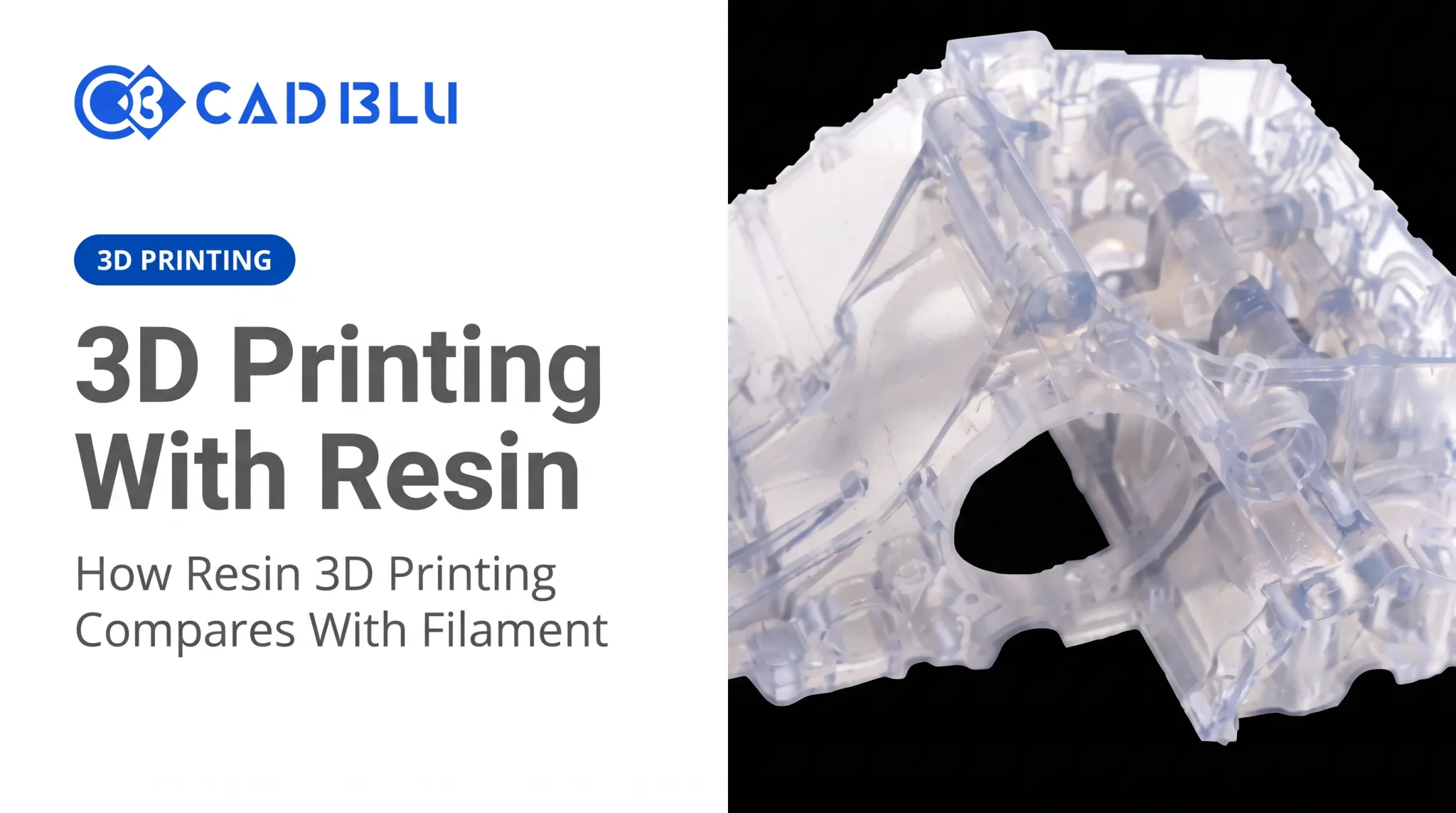
Resin casting is a mold-based process. Liquid resin gets mixed, poured or injected into a mold cavity, cured, and removed as a solid reproduction of whatever pattern created the mold. That sets it apart from resin 3D printing, where UV light cures a photopolymer layer by layer with no mold involved.
The typical workflow
- Build or source a master: the original part the mold will be shaped around
- Finish and seal the master: any flaw here shows up in every single cast copy
- Make a mold, usually silicone, sometimes another rubber or rigid material
- Select and mix the casting resin according to its technical data sheet
- Pour or inject the resin into the mold cavity
- Cure, demold, trim, and finish the resulting part
Casting resins fall into a few major families with very different behavior:
- Polyurethane — fast-curing; common for prototypes and general reproduction
- Epoxy — higher tensile strength; longer cure times
- Polyester — often chosen for heat and water resistance in specific grades
- Silicone-based — used for flexible parts or for mold-making itself
Always check the technical data sheet for the exact grade. "Polyurethane" alone tells you almost nothing about tensile strength or heat resistance.
When casting is the better fit
Once the resin system is chosen, casting pays off when the design is stable and volume justifies the mold:
- Repeatable small-batch parts where every copy must match the last
- Jewelry components cast from a finished master pattern
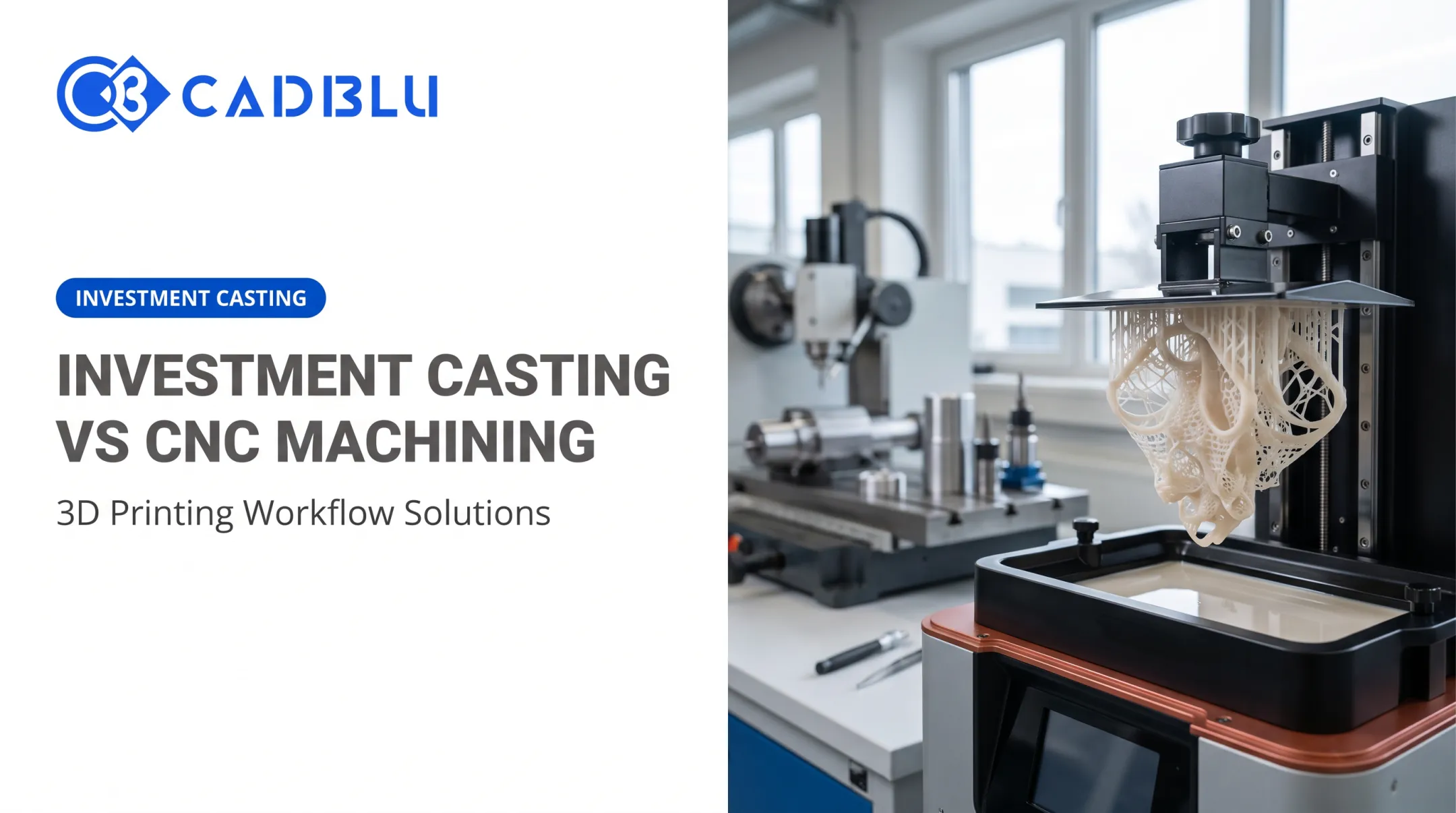
- Investment-casting patterns burned out and replaced with molten metal
- Artistic reproductions and product models that need a smooth, consistent finish across a run
The tradeoff is upfront work: mold-making takes time, molds wear out, and every undercut or draft angle has to be planned before pouring. Designs that keep changing are a poor fit, because each revision means a new mold.
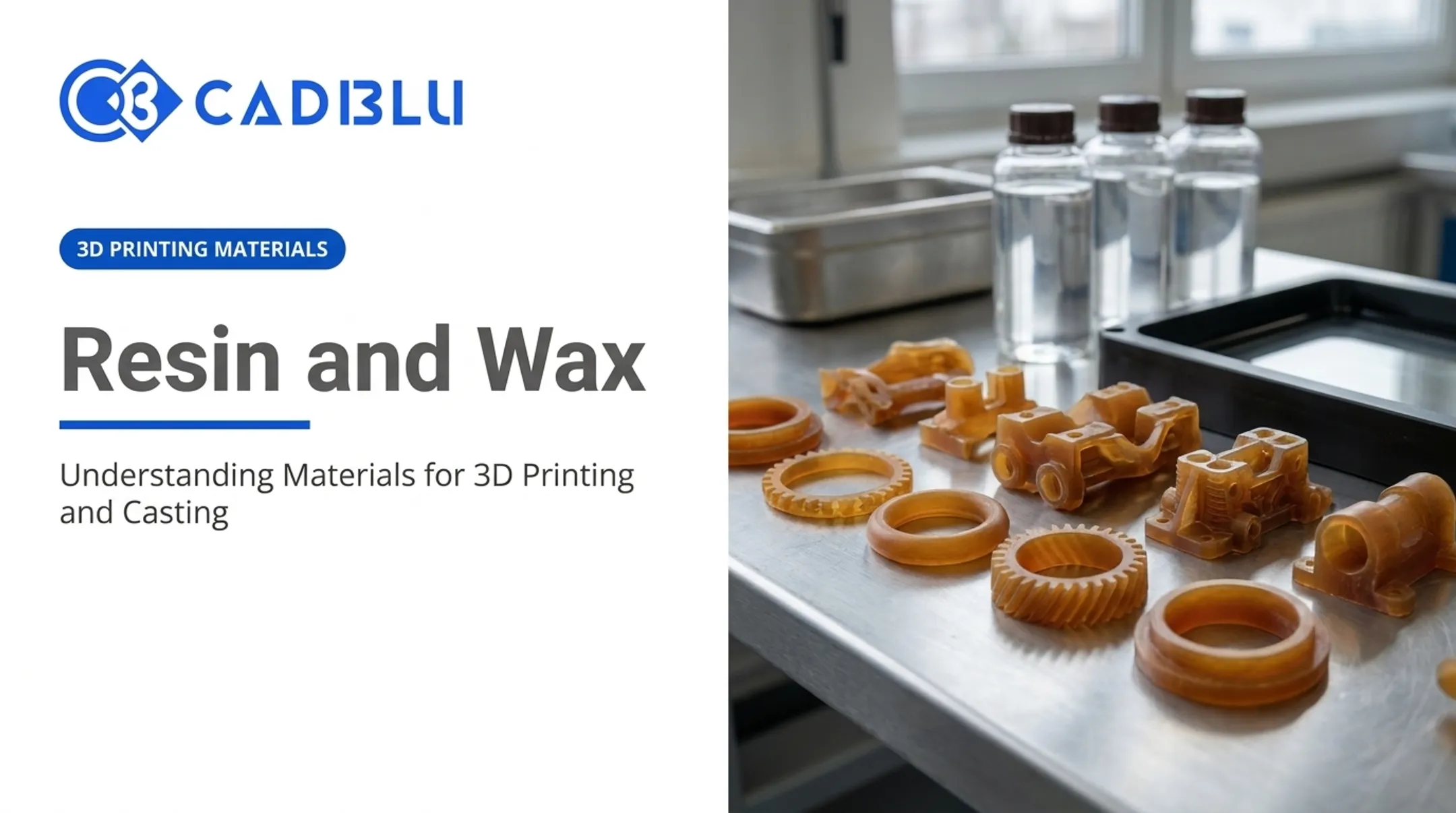
Hybrid production solves a lot of these tradeoffs: print a master on a high-resolution SLA or DLP system, finish it, then use that master to build the mold. Figure 4 JCAST-GRN 10, for example, is built specifically to produce jewelry master patterns for gypsum investment casting. The printed master's surface quality and accuracy carry through to every cast part downstream, which is why the first print sets the ceiling for the full run.

3D Printing vs Resin Casting: What Is Better?
Neither process is universally better. The right call depends on a sequence of practical factors, checked roughly in this order:
- Quantity: one-off or a production run?
- Design stability: locked, or still changing?
- Part size and geometry: does it fit a build plate, or does it have undercuts complicating a mold?
- Tolerances and surface finish: how much detail does the application require?
- Mechanical performance: what load, heat, or chemical exposure will the part see?
- Compliance: does the application need biocompatibility, food safety, or certification?
- Labor and equipment access: in-house team and tools, or outside partners?
Use those answers to narrow the path:
Choose direct 3D printing when:
- The part is one-off or low-volume
- The design is still likely to change
- Geometry includes complex internal features a mold couldn't reach
- Avoiding tooling lead time matters more than shaving the last dollar off per-unit cost
Choose resin casting when:
- The design is stable and won't change mid-run
- Volume is high enough to amortize mold cost
- The geometry is mold-friendly, without severe undercuts
- Reproducing a smooth, qualified finish across every copy matters more than speed on part one
Choose a hybrid workflow when a printed master is faster to build and refine than a machined one, but final parts still need casting-grade finish or material properties. Jewelry manufacturers and investment casters often use this path with wax-pattern systems.
A simple break-even framework
Run the numbers before committing to either path:
- Estimate the quantity needed over the design's expected life
- Add tooling cost (master plus mold) if casting, or $0 if printing
- Add per-part cost: material, labor, post-processing, and expected scrap rate
- Multiply per-part cost by quantity, then add tooling cost for casting
- Compare totals at your expected quantity, then check what changes if volume or revision probability shifts
Example (assumptions, not published pricing): A $2,000 mold at $8 per cast part versus $25 per printed part breaks even near 115 units if the design stays locked. Change volume or revision risk, and the crossover moves with it.

CAD BLU helps teams compare printers, materials, and scanning setups against this break-even math—whether the fit is an in-house printer, a casting workflow, or both.
Real-World Example: Printed Patterns for Investment Casting
Formlabs published a benchmark on two separate 50-part investment-casting runs. The study compared traditional pattern tooling with 3D-printed patterns, as detailed in its investment casting case study.
The challenge: conventional pattern tooling for these runs would have cost $60,000 and $11,000 respectively, with lead times stretching well past the production schedule.
The decision: rather than commissioning hard tooling for a 50-part quantity, both projects used 3D-printed patterns in place of machined masters.
The outcome, as reported by Formlabs:
- Printed-pattern cost came to $78 and $30 per part, far below tooling cost at that volume
- Lead time dropped by 14 weeks on one project and 8 weeks on the other
- Both runs still fed into standard investment-casting steps: pattern, invest, burnout, pour metal

Situational takeaway: at 50 parts with tight lead times, a printed pattern beat hard tooling on both cost and schedule. At higher quantities, or once the design stops changing, the math usually shifts back toward mold-based tooling.
Weighing a similar printer, casting workflow, or hybrid line for your own production? CAD BLU supports installation, materials selection, repair, and CAD/scanning setup for printed-pattern and investment-casting decisions like these.
Conclusion
3D printing and resin casting solve different problems. Printing wins when designs are still changing, quantities are low, or geometry won't release cleanly from a mold. Casting wins once a design is locked and volume justifies the tooling investment.
Before you commit to a printer or a mold, compare the full picture:
- Total workflow cost, not just machine or tool price
- Production risk if a part fails mid-run
- Post-processing time and labor
- Safety and handling requirements
- Quality control consistency at your target volume
- How well the choice scales if volume or design changes later
Most manufacturing programs eventually use both—printing while things are still in flux, casting once they're not. Match the method to the stage of the work, and the choice gets clearer.
Frequently Asked Questions
Can you drink out of a PLA 3D printed cup?
Not reliably. PLA filament alone isn't certified as food-contact safe, and nozzle cleanliness, layer gaps, porosity, and heat exposure all affect safety. Check manufacturer-specific food-contact guidance before using any printed vessel for beverages.
Is 3D printing cheaper than resin casting?
It depends on quantity. Printing usually wins for prototypes and low volumes since there's no mold cost, while casting often gets cheaper per unit once a mold is qualified and volume climbs. Compare full workflow cost, not just material price.
Which produces more detail, 3D printing or resin casting?
Neither wins automatically. Detail depends on the specific printer, resin, orientation, and finishing, or the mold quality and master pattern used for casting. A high-quality cast reproduces a well-finished master faithfully.
Is resin casting stronger than 3D printing?
That comparison only makes sense grade-by-grade. Some casting resins outperform some printed materials, and vice versa. Wall thickness, curing, reinforcement, and geometry affect real-world strength as much as the process itself.
Can you use a 3D print as a pattern for resin casting?
Yes, this is a common hybrid workflow. Print the pattern, inspect it, finish or seal the surface, build the mold, then cast and finish copies. Any surface defect in the printed pattern carries through to every cast part.
Which method is better for small-batch production?
Direct printing suits small batches with changing or customized designs, since there's no mold to recut. Resin casting suits small batches only when the design is locked and the batch size justifies mold preparation.