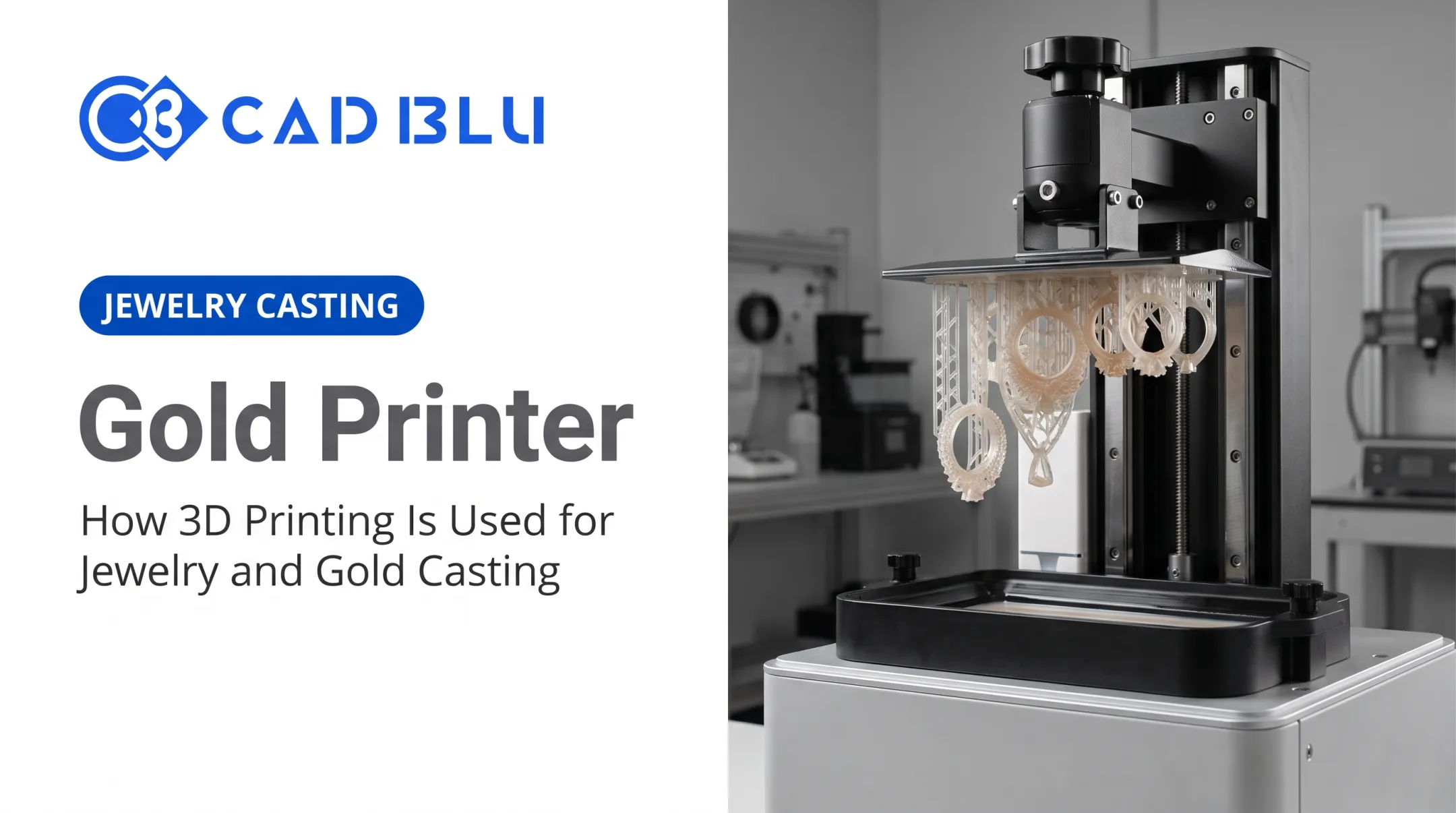
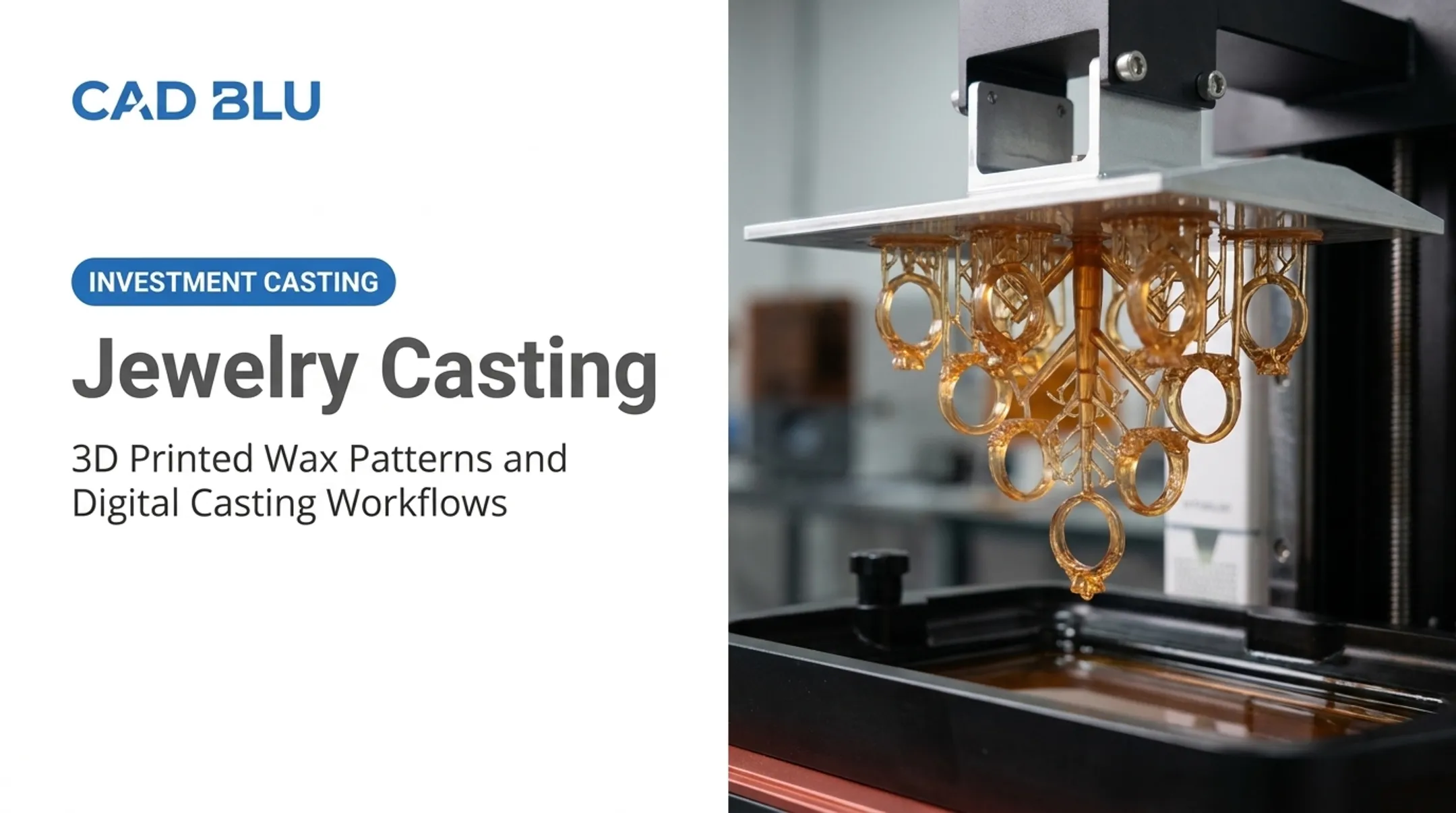
Almost every jewelry business using 3D printing is printing a castable pattern, not gold itself. The printer produces a detailed wax or resin model. That model gets invested, burned out, and replaced by molten gold through traditional casting. Direct precious-metal printing exists, but it's an entirely separate industrial process with its own equipment, costs, and skill requirements.
This article breaks down how the real workflow operates, which printing technologies and materials jewelers actually use, and how to decide what setup fits your business. We'll also cover where direct metal printing fits in, and why it's not the default path for most jewelry manufacturers.
Key Takeaways
- 3D printing supports real gold jewelry production primarily by creating castable patterns, not final gold pieces
- CAD design, print resolution, burnout quality, and casting method all shape the finished result
- Castable-pattern workflows and direct metal printing solve different problems at different price points
- The right setup depends on design complexity, volume, and your team's casting expertise
What Does Gold 3D Printing for Jewelry Actually Mean?
The phrase "gold 3D printing" gets used loosely for two different processes. Know which one you mean before you buy a printer, resin, or metal powder.
Route 1: Castable pattern printing. A printer builds a wax or resin pattern layer by layer. That pattern goes into an investment mold, burns out, and molten gold fills the cavity. Formlabs has tested gold, silver, and bronze castings from its castable patterns; results depend mostly on the investment material.
Route 2: Direct metal additive manufacturing. A high-energy laser fuses gold alloy powder layer by layer into a finished metal part—no sacrificial pattern. Cooksongold lists 18K yellow, red, and white gold powders, plus 14K yellow gold, for this kind of additive manufacturing.
Why Castable Patterns Dominate Jewelry Production
Most jewelry businesses use the castable route because it plugs into equipment and skills they already have. Investment casting, burnout ovens, and finishing benches are already standard in most workshops. Adding a printer for patterns doesn't require rebuilding your entire production line.
Here's a quick comparison:
| Factor | Castable Pattern + Casting | Direct Metal Printing |
|---|---|---|
| What's printed | Wax or resin pattern | Final gold part |
| Equipment needed | Printer + existing casting setup | Metal printer, inert gas system, powder handling |
| Post-processing | Divesting, cutting, polishing | Depowdering, heat treatment, finishing |
| Best fit | Custom orders, prototypes, batch runs | High-volume industrial production |
Naming rule: a printed resin ring is not gold jewelry—it's a sacrificial pattern. Metal poured from that pattern is cast gold, not "3D printed gold." Use that language in quotes and client conversations so expectations stay clear.
How Is Gold Jewelry Made With 3D Printing?
Let's walk through the full digital-to-metal process using a ring as the example.

CAD Preparation
Before anything gets printed, the design needs to account for casting realities, not just aesthetics. Key considerations include:
- Wall thickness — Formlabs recommends 0.7 mm for hollow shells when using Castable Wax Resin
- Section thickness — sections thicker than 3 mm typically need shelling and drain holes to burn out cleanly
- Fine details — mesh wire can go as thin as 0.3 mm, though it becomes fragile during support removal
- Stone settings and prong geometry — must hold up through casting and everyday wear
- File export — formats like STL need to preserve the geometry accurately for the printer's slicing software
Design tolerances vary by resin and printer, so it's worth checking current manufacturer guidance rather than assuming one number applies universally.
Pattern Printing
SLA, DLP, and material-jetting (MJP) systems each build the pattern layer by layer, but they work differently. SLA uses lasers with galvanometers to trace each layer. DLP projects an entire layer at once with a digital light projector, which is generally faster. MJP jets droplets of castable material and cures them layer by layer.
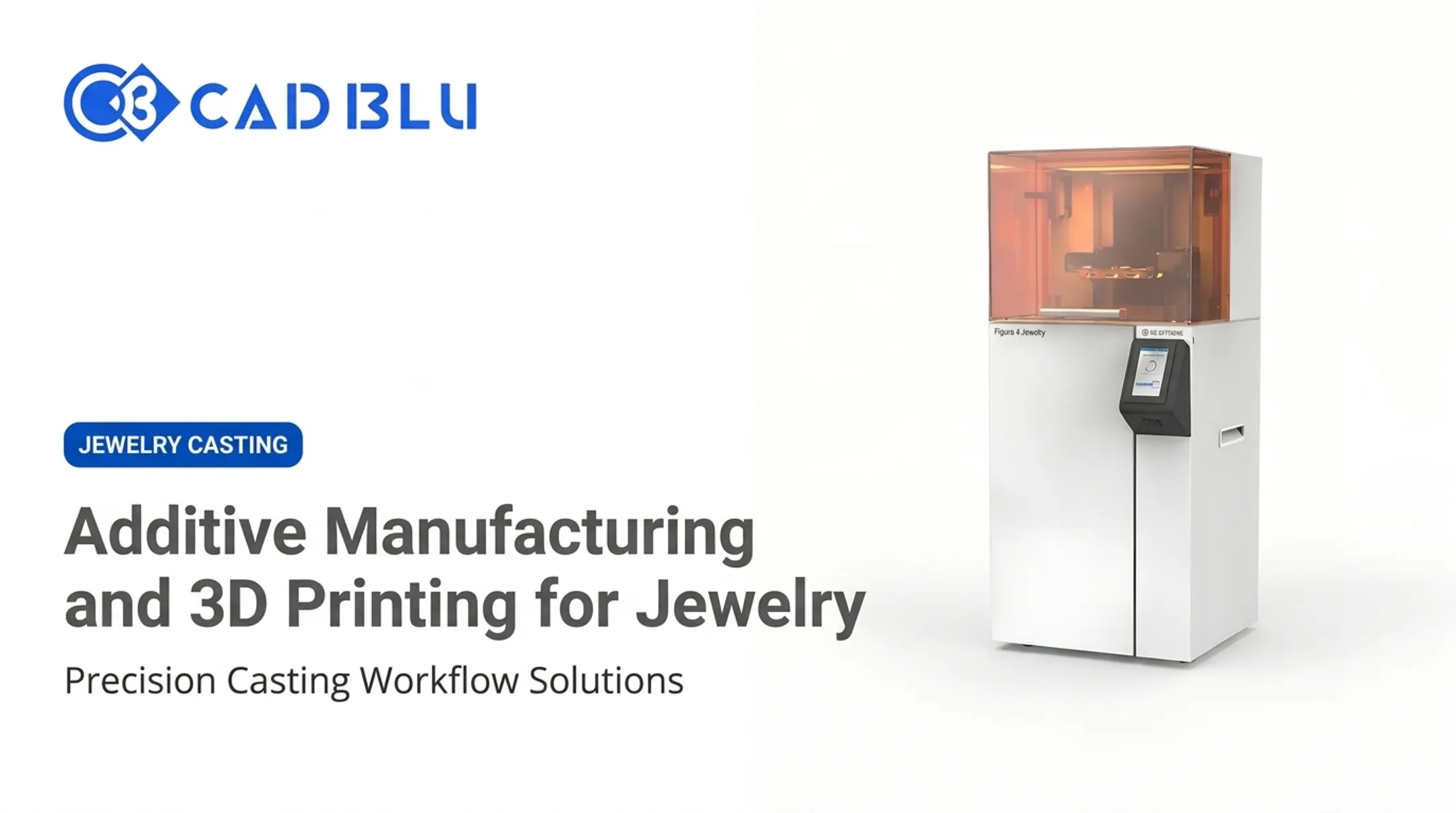
Build orientation and support placement matter more than most first-time users expect. Poor orientation leads to visible support marks in spots that are hard to polish, like inside a ring band. Some systems address this directly. Figure 4 Jewelry, for example, uses MicroPoint ultra-fine-tip supports specifically to reduce polishing work at support intersections.
Washing, Curing, and Cleanup
Once printed, patterns need washing to remove uncured resin, followed by post-curing according to the material manufacturer's specs. This step isn't optional. Skipping or rushing post-cure is one of the most common causes of poor burnout later.
Spruing and Investment
Patterns get attached to a sprue tree, arranged so molten gold can flow in and gases can escape during casting. The tree then goes into a flask, where investment material surrounds it and captures every fine detail of the pattern.
Burnout and Casting
This is where the pattern disappears and gold takes its place. A controlled heating cycle burns out the wax or resin, leaving a clean cavity in the investment.
Burnout schedules aren't one-size-fits-all. Formlabs' schedule for Castable Wax Resin starts at room temperature and ramps to a 480-minute hold at 300°C. It then climbs to a 180-minute hold at 750°C before cooling to casting temperature.
Gold pour temperatures also vary by alloy. Whip Mix's jewelry investment guide lists these as average ranges, not fixed specs:
- 9k yellow gold: 940-1040°C pour, 500-600°C flask
- 18k yellow gold: 940-1040°C pour, 500-600°C flask
- 22k yellow gold: 1000-1150°C pour, 600-700°C flask
Whip Mix is explicit that alloy composition and casting method shift these numbers. Don't transplant a schedule from one alloy or flask size to another without testing.
Finishing and Quality Inspection
Once the gold cools, the tree gets divested, and individual pieces are cut from the sprue. Then comes filing, polishing, stone setting, and inspection for porosity or incomplete fill. This stage still depends heavily on traditional jewelry craftsmanship. Printing shortens the path to a pattern; it doesn't replace the goldsmith's bench.
Which 3D Printing Technologies and Materials Are Used?
Three pattern-printing technologies dominate jewelry production, plus one direct-metal category that operates on entirely different principles.
SLA and DLP Resin Printing
Both technologies cure liquid photopolymer resin, but SLA uses a laser and DLP projects an entire layer using light. DLP tends to run faster for jewelry-scale parts. These systems suit custom one-off pieces and prototyping well, since setup between designs is quick. Compare current resolution and build-volume specs by model generation—those figures shift enough to change which system fits a jewelry workflow.
For higher-resolution resin patterns, Figure 4 Jewelry runs at 16 mm/hr in Jewelry Mode with 30-micron layers, using JCAST-GRN 10 resin formulated for direct gypsum investment casting.
MJP and Material-Jetting Systems
Material-jetting printers, like the ProJet MJP 2500W, jet wax-based material layer by layer using piezo inkjet heads. This category fits batch wax-pattern production, especially when you need multiple lanes in one build.
Specific capabilities of the MJP 2500W include:
- Printing up to 25 rings in less than 3 hours
- Support for 1 to 3 lane printing, with over 65% more build volume than comparable printers
- Use of VisiJet M2 CAST, a 100% wax material with zero ash content
- EasyClean System for removing eco-friendly wax supports
Direct Metal Printing (DMLS/SLM)
Direct metal systems fuse gold alloy powder using a high-power laser, layer by layer, skipping the pattern step entirely. This isn't a drop-in replacement for a resin printer. Nikon SLM notes that fine metal powder particles as small as 6 microns create exposure hazards requiring PPE and careful system design. The build chamber also needs an oxygen-free atmosphere maintained with argon or nitrogen.
Post-processing for direct metal parts includes depowdering, potential heat treatment, and finishing, on top of the specialized safety infrastructure needed just to run the machine.

Castable Resin Selection and Burnout Risk
Standard modeling resin is not the same as certified castable resin. Ordinary resin wasn't formulated for clean burnout.
Substituting it without tested casting data can cause:
- Investment cracking
- Incomplete burnout
- Residue that contaminates the gold
Stick to resins validated for your specific investment and alloy combination. Manufacturer guidance exists for exactly this reason—use it.
What Are the Benefits and Applications of Gold 3D Printing for Jewelry?
The clearest benefit of castable-pattern printing is speed from concept to physical prototype. A designer can hand a client a printed pattern to check fit, scale, and stone placement before committing to a gold pour. That review step catches problems early, when they're cheap to fix.
Design Freedom
Printed patterns can achieve geometries that are genuinely difficult to hand-carve:
- Intricate filigree and repeated symmetrical details
- Organic, non-planar forms
- Interlocking components
- Lightweight hollow structures that reduce gold usage
Each design still has to meet casting and wear requirements—a CAD model that won't burn out cleanly or survive stone-setting isn't production-ready.
Customization and Repeatability
A single CAD file can support multiple ring sizes, quick design revisions, and personalized engraving, all while preserving the approved base geometry. That's a real advantage over hand-carved masters, where each size variant traditionally meant recarving.
Batch Production
Multiple patterns can share a single build when the printer, material, and casting plan support it. The MJP 300W Plus, for instance, produces 78 rings per build in single-lane Hi-Res XHD mode, climbing to 222 rings in a three-lane configuration.
Applications in the Jewelry Studio
Those same strengths show up across day-to-day jewelry work:
- Custom engagement and wedding bands with client-approved fit checks before the gold pour
- One-off or short-run pieces that would be slow to hand-carve
- Reproduction of heirloom or archival designs from scanned masters
- Hollow or filigree forms that cut gold weight without giving up structure
- Size runs and personalized variants from a single approved CAD file
Comparing Pattern Methods
When batch capacity and design complexity matter, it helps to weigh printing against the other pattern options. Printed patterns, hand-carved wax, and CNC milling each solve the problem differently:
- Hand-carved wax offers a tactile, direct approach but scales poorly for repeat or complex designs
- CNC machining works well for certain geometries but faces size, time, and detail constraints on intricate pieces
- 3D printing trades some hands-on control for repeatability and design complexity, particularly for filigree or hollow structures
None of these is universally better. It depends on your design library and volume.
Limitations Worth Planning For
3D printing for jewelry isn't plug-and-play:
- Equipment and material costs are real upfront investments
- There's a learning curve for build orientation, support placement, and resin handling
- Failed prints and failed casts happen, especially early on
- Post-processing still takes skilled labor
- Reliable technical support matters more than most buyers expect going in
How Should a Jewelry Business Choose a Gold 3D Printing Workflow?
Your stage of business should drive the decision, not the other way around. Early-stage or occasional custom work:
- Outsourcing pattern printing may cost less than buying equipment
- Prioritize prototyping access without a heavy upfront investment Established studios with recurring volume:
- Evaluate an in-house printer against operator availability, ventilation, space, and casting capability
- Confirm your team can handle post-processing consistently Larger manufacturers:
- Compare dedicated wax/resin systems against direct-metal equipment
- Weigh automation options and how well the printer integrates with existing CAD and casting lines

Buying a Printer vs. Adopting a Workflow
A printer alone doesn't produce jewelry. The complete workflow includes:
- CAD software and validated pattern materials
- Wash and cure equipment
- Investment, burnout, and casting capability
- Finishing, maintenance, and quality control Missing any piece creates a bottleneck. For shops that need more than a machine, CAD BLU supplies commercial 3D printers, castable materials, installation, and workflow optimization, plus OEM-certified repair support. The focus is connecting printing to the rest of your casting operation—whether you need a partial setup or a full turnkey path.
Questions Worth Asking a Technology Provider
Before committing to equipment, ask:
- Materials: Which options are validated for the gold-casting process you already use?
- Process guidance: What design, burnout, and finishing support comes with the equipment?
- After-sale support: What training, maintenance, and repair coverage is available?
- Proof before purchase: Can they run a representative design from your own catalog? A provider who can't answer these directly isn't ready to support a real production workflow.
Before You Commit
Validate the entire chain—pattern material, burnout schedule, and casting conditions—using a design you actually intend to produce. A demo ring on a marketing site tells you less than a test run with your own alloy and investment. CAD BLU can help run that needs-based evaluation before you buy.
Frequently Asked Questions
Can you 3D print with real gold?
Yes. Specialized direct metal systems fuse gold alloy powder with a laser. Most jewelry businesses instead print a castable wax or resin pattern and cast it in gold through investment casting.
Can gold jewelry be 3D printed?
Yes—usually by printing a pattern, then casting the finished gold piece, not by printing solid gold. Direct gold parts are possible, but they need industrial metal AM equipment most shops do not run in-house.
Can I 3D print metal jewelry?
Yes, through castable-pattern casting or direct metal printing. The better path depends on design complexity, volume, and equipment. Most jewelers use castable patterns because they fit existing casting infrastructure.
Is 3D printed jewelry safe?
Safety depends on the final material and finishing, not the print method. Resin patterns are temporary and never worn. Finished cast gold must meet the same jewelry safety and compliance standards as conventionally made pieces.