Introduction
3D printing used to mean one thing: a prototype you held before the "real" part got made somewhere else. That's no longer true. Manufacturers now use additive processes to build functional parts, production tooling, and customized end-use products, not just proof-of-concept models.
The industry backs this up. The global additive manufacturing market grew 11.1% to $20.035 billion, and metal AM system shipments jumped 24.4% in 2023, according to Wohlers Associates' 2024 report. That's not hobbyist growth. That's production adoption.
The challenge? Dozens of technologies and material families exist, and none of them do the same job. A dental lab needs something completely different from an aerospace supplier.
This guide walks through the terminology, the workflow, the major technology families, material categories, real applications, and what to weigh before you invest.
Key Takeaways
- 3D printing builds objects layer by layer; additive manufacturing spans the full industrial workflow around it.
- Choose technology and materials by strength, flexibility, detail, heat resistance, finish, and volume—not brand.
- AM excels at prototypes, complex geometries, tooling, dental/medical products, and low-to-mid-volume runs.
- Post-processing, software, and operator expertise often matter as much as the printer itself.
What Are 3D Printing and Additive Manufacturing?
3D printing is the layer-by-layer creation of a three-dimensional object from a digital design, scan, or other digital input. The NIST research standard on additive manufacturing treats 3D printing as another name for additive manufacturing (AM), defining it as joining materials from 3D model data, typically layer by layer.
Additive manufacturing covers the full production process: design preparation, material handling, machine operation, post-processing, inspection, and documentation. It's the whole production system, not just the machine running it.
Additive vs. Subtractive vs. Formative Manufacturing
Think of three different ways to make a bracket:
- Additive builds it up, adding material layer by layer until the bracket exists.
- Subtractive starts with a block of aluminum and machines away everything that isn't the bracket.
- Formative shapes material using a mold or die, such as injection molding.
Many shops now combine methods. A part might be 3D printed, then machined for a critical tolerance, then finished by hand. Hybrid production is common, not exotic.
The Digital-to-Physical Workflow
The path from idea to part follows a consistent sequence:
- Create the digital file: CAD modeling, reverse engineering, or 3D scanning.
- Prepare the file: Orient the part, generate supports, and slice it into machine instructions.
- Print or deposit material: The machine builds the part layer by layer.
- Post-process: Curing, washing, depowdering, sintering, heat treatment, support removal, or machining, depending on the technology.
- Inspect and document: Dimensional checks, mechanical testing, or regulatory sign-off for medical and aerospace parts.

Not every part belongs on a printer. Strong AM candidates usually share several of these traits:
- Complex geometry or internal features that are difficult to machine
- Customization needs or frequent design changes
- Low- to medium-volume production rather than mass output
- Mechanical properties that available AM materials can meet
- Tight lead times where tooling would slow the job down
- Access to the finishing steps the chosen process requires
Major 3D Printing Technologies and How They Work
Every AM technology places, cures, binds, or fuses material differently. That difference drives everything downstream: cost, strength, finish, and which applications make sense.
Material Extrusion (FDM/FFF)
Fused deposition modeling heats thermoplastic filament and deposits it through a nozzle, layer by layer. Common materials include ABS and nylon — the same polymer families used in conventional manufacturing.
Strengths:
- Accessible and relatively simple to operate
- Good for functional prototypes, fixtures, and tooling
- Wide material range from rigid to flexible
Limitations:
- Visible layer lines
- Support structures needed for overhangs
- Strength varies by build orientation
Vat Photopolymerization (SLA/DLP)
SLA uses a laser with galvanometers to cure liquid photopolymer resin. DLP uses a digital projector to cure an entire cross-section in one exposure, which is generally faster than SLA. Formlabs' stereolithography guide notes SLA's smooth surfaces and high accuracy.
These processes suit detailed prototypes, dental models, and casting patterns.
Resin parts still need washing, support removal, and often post-curing. Some resins also grow brittle over time or under UV, so match material performance to the real use case.
Powder-Bed Fusion (SLS, SLM, DMLS, EBM)
Powder-bed technologies use thermal energy — a laser or electron beam — to selectively fuse or melt powder, one layer at a time.
- SLS (polymer): Builds engineering-grade nylon with molding-like properties; unfused powder supports the part, so separate supports usually aren't needed.
- SLM/DMLS (metal): Melts thin metal-powder layers into dense parts straight from CAD, with no tooling. Per 3D Systems, depowdering, heat treatment, and finishing can take longer than the print itself.
- EBM: Melts metal powder with an electron beam in a vacuum; sintered powder often serves as support.
These processes handle internal channels, lattice structures, and geometries that would be impossible with conventional tooling.
Material Jetting, Binder Jetting, and Directed Energy Deposition
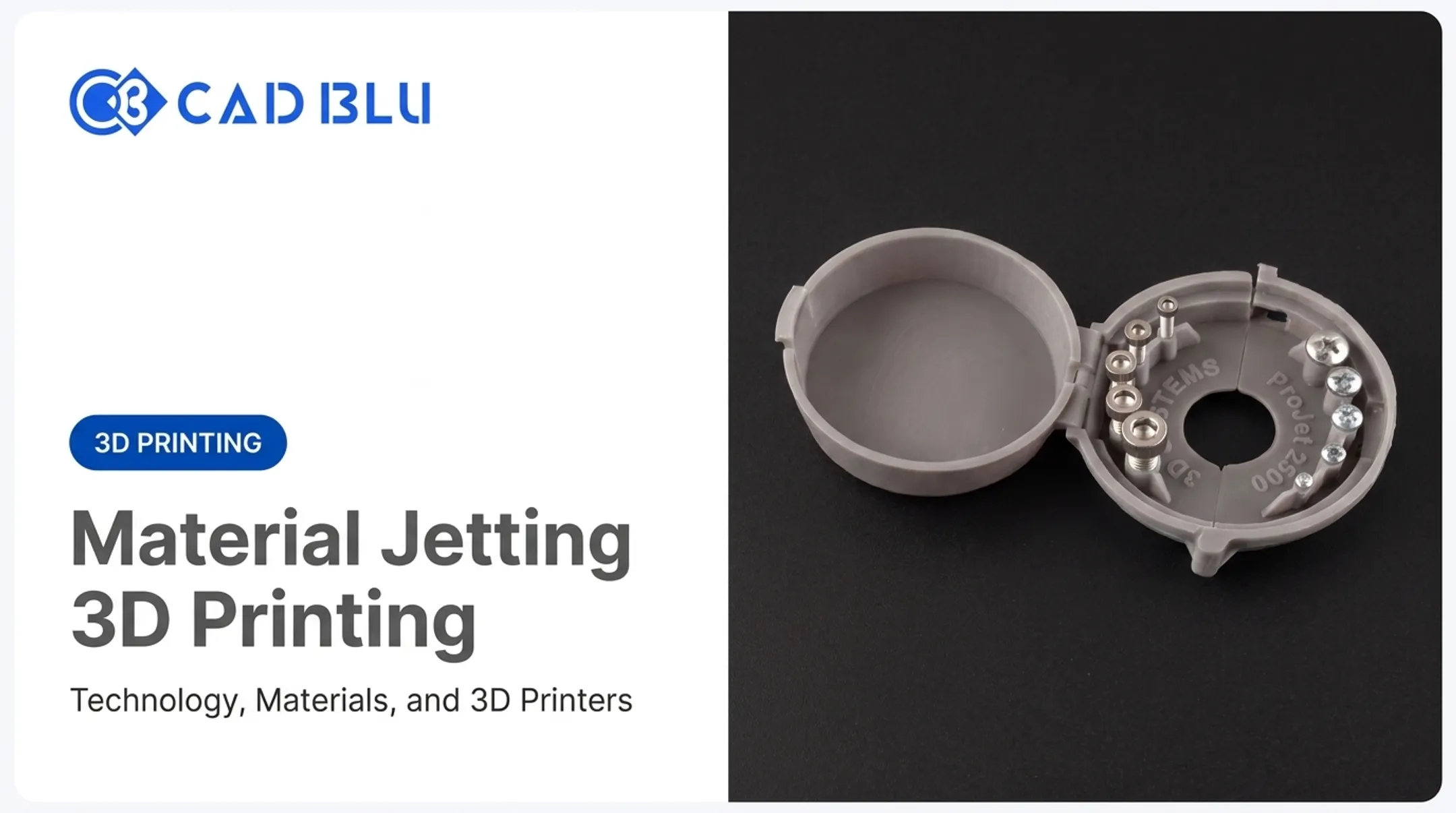
- Material jetting (PolyJet) deposits and cures droplets of liquid photopolymer, enabling fine detail and, on some systems, multiple materials in a single build.
- Binder jetting deposits a liquid binder into a powder bed — metal, ceramic, or sand — and requires sintering afterward for full density.
- Directed energy deposition (DED) feeds wire or powder into an energy source at the point of deposition. Per ASTM's DED standard, this makes it useful for large components, repairs, and adding material to existing parts.

Comparing Technologies at a Glance
| Technology | Feedstock | Typical Use | Support Needs |
|---|---|---|---|
| FDM/FFF | Thermoplastic filament | Fixtures, functional prototypes | Yes, removable |
| SLA/DLP | Liquid resin | Detailed models, castable patterns | Yes, for overhangs |
| SLS | Polymer powder | Functional end-use parts | Self-supporting |
| SLM/DMLS | Metal powder | Aerospace, medical implants | Often required; geometry-dependent |
| Material Jetting | Liquid photopolymer | Multi-material prototypes | Soluble/water-jet |
| Binder Jetting | Powder + binder | Metal parts, sand molds | Powder bed acts as support |
Always confirm current specs with manufacturer documentation. Speed, strength, and surface-finish claims vary widely by machine and material combination.
3D Printing Materials: Types, Properties, and Selection
The material you feed into a printer is called feedstock, and its form depends entirely on the technology: filament, resin, powder, wax, wire, or binder.
Thermoplastics
Common options include PLA, ABS, nylon, polycarbonate, and TPU. Each targets a different job:
- PLA — low shrinkage, good surface quality, easy to print; better for visualization than functional loads
- ABS — durable, thermally resistant, good for fit testing and prototyping
- Nylon — strong, impact-resistant, flexible; suited to tools and end-use parts
- Polycarbonate — tough, heat-resistant, chemical-resistant; used in molds and engineering parts
- TPU 95A — rubber-like flexibility with impact and chemical resistance
Moisture matters here. Many filaments absorb humidity from the air, which affects print consistency, so storage and drying are required for consistent results.
Photopolymer Resins
Resin categories split into general-purpose, engineering, flexible, castable, dental, medical, and high-temperature formulations. Choose a formulation against:
- Mechanical load and flexibility needs
- Biocompatibility or clinical requirements
- Curing behavior and achievable surface finish
Handling matters too. Uncured resin can irritate skin and eyes and requires gloves, eye protection, and ventilation per the safety data sheet. Waste cannot go down the drain; dispose of it as chemical waste under applicable regulations.
Metals and Metal Feedstocks
Where polymers stop short on strength or heat, metal AM steps in. Common alloys include stainless steels, tool steels, aluminum, titanium, and nickel alloys, depending on the process. Feedstock comes in different forms:
- Loose powder for laser and electron-beam powder-bed fusion
- Bound metal filament for extrusion-based metal printing
- Wire for directed energy deposition
None of these come out "finished." Debinding, sintering, heat treatment, machining, and inspection are typically required to hit final mechanical properties.
Composites, Waxes, and Biocompatible Materials
Carbon fiber, glass fiber, and aramid fiber reinforcements improve stiffness, strength, or temperature resistance in compatible systems. Wax and castable resins support jewelry and investment-casting workflows directly.
Medical, dental, and biocompatible applications carry extra weight: material-specific validation, intended-use restrictions, and regulatory review. The FDA's guidance on additive-manufactured medical devices makes clear that a material label alone doesn't establish suitability for a specific device or patient contact type.
Material-Selection Checklist
Before committing to a material:
- Match it to load, temperature, chemical exposure, flexibility, and appearance requirements
- Confirm compatibility with your specific printer, nozzle, or energy source
- Verify data sheets, safety docs, and supplier guidance, especially for regulated uses
Applications of 3D Printing and Additive Manufacturing
Solving Business Problems, Not Just Serving Industries
The clearest way to frame AM applications is by the business problem you need to solve, not by industry label alone.
- Rapid prototyping — testing form, fit, and function before committing to tooling or a full production run
- Tooling and fixtures — jigs, molds, and casting patterns that reduce dependence on conventional tooling shops
- Low-volume, customized production — replacement parts, personalized products, or small batches where traditional setup costs don't make sense
Industry Snapshots
- Jewelry and investment casting: Detailed wax and castable patterns support design iteration without hand-carving each variation.
- Dental and medical: Surgical guides, aligners, dentures, and prosthetic components — when printed on validated, certified workflows.
- Aerospace, automotive, and industrial: Lightweight parts, fixtures, and replacement components for complex assemblies.
- Education and small business: Digital manufacturing training without building a full production line.
A concrete example: GE Aviation moved from prototyping to serial production of fuel-nozzle tips for its LEAP engine, produced at its Auburn, Alabama plant. By the time GE Aerospace reported its 30,000th additive nozzle tip in 2018, more than 40 printers were making parts, the nozzle assembly had been reduced from roughly 20 pieces to one, and weight dropped by about 25%.

Production-ready AM looks like that outcome: a repeatable, FAA-certified process running at scale, not a one-off demo.
Benefits, Limitations, and Implementation Considerations
Real Benefits
- Internal channels, lattices, and consolidated assemblies that conventional tooling can't produce economically
- Digital design to physical part without waiting on dedicated tooling
- Small batches where injection molding's setup costs don't pencil out
- On-demand production with less dependence on external tooling sources
Real Limitations
3D printing isn't automatically cheap. The NIST report on AM supply-chain economics notes that system and material costs make up a significant portion of total product cost — labor, facility, and post-processing add more.
Plan around these constraints:
- Build volume and throughput limit how much you can produce per cycle
- Surface finish and dimensional accuracy vary by technology and often need secondary finishing
- Parts can behave differently depending on build orientation (anisotropy)
- High-volume runs may still favor injection molding or machining, depending on part economics
A Practical Adoption Path
- Define the part problem — target volume, required properties, quality standards, and budget
- Decide whether to buy equipment, use a service provider, or start with a phased solution
- Run a representative test using your actual geometry, material, and finishing process before scaling up

Adoption usually succeeds or stalls on that last step: proving the process on real parts before you scale.
CAD BLU works with U.S. businesses in jewelry, dental, medical, aerospace, automotive, and industrial applications. The company supplies commercial printers, materials, software, installation support, and OEM-certified repair across multiple technology families. Matching the right process to your workflow matters more than any single machine's spec sheet.
Frequently Asked Questions
What is the difference between 3D printing and additive manufacturing?
3D printing typically refers to the layer-by-layer creation of an object, while additive manufacturing describes the wider workflow: design, material handling, post-processing, inspection, and production control.
What is 3D printing material called?
It's called printing material or feedstock. Depending on the printer, that means filament, resin, powder, wax, metal wire, or composite material.
What are the main types of 3D printing technology?
The major families are material extrusion, vat photopolymerization, powder-bed fusion, material jetting, binder jetting, and directed energy deposition. Each uses different materials and process conditions.
Which materials can be used in additive manufacturing?
Plastics, photopolymer resins, metals, composites, elastomers, waxes, ceramics, and select biocompatible materials are all in use. Printer compatibility and application requirements determine what's appropriate.
Is 3D printing suitable for production parts?
Yes, for customized, complex, replacement, tooling, and low-to-mid-volume parts. Suitability ultimately depends on volume, required properties, quality controls, and post-processing needs.