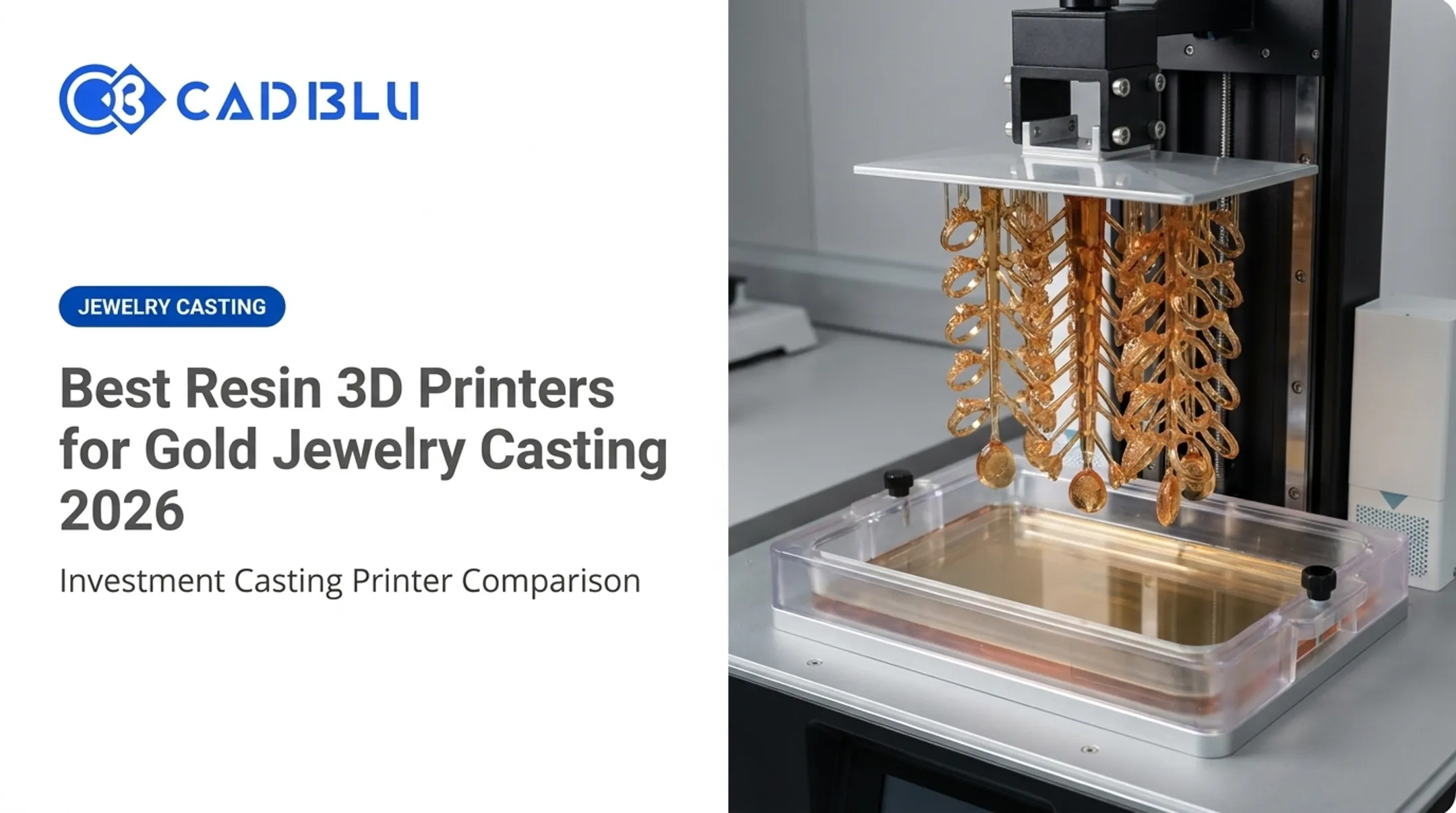
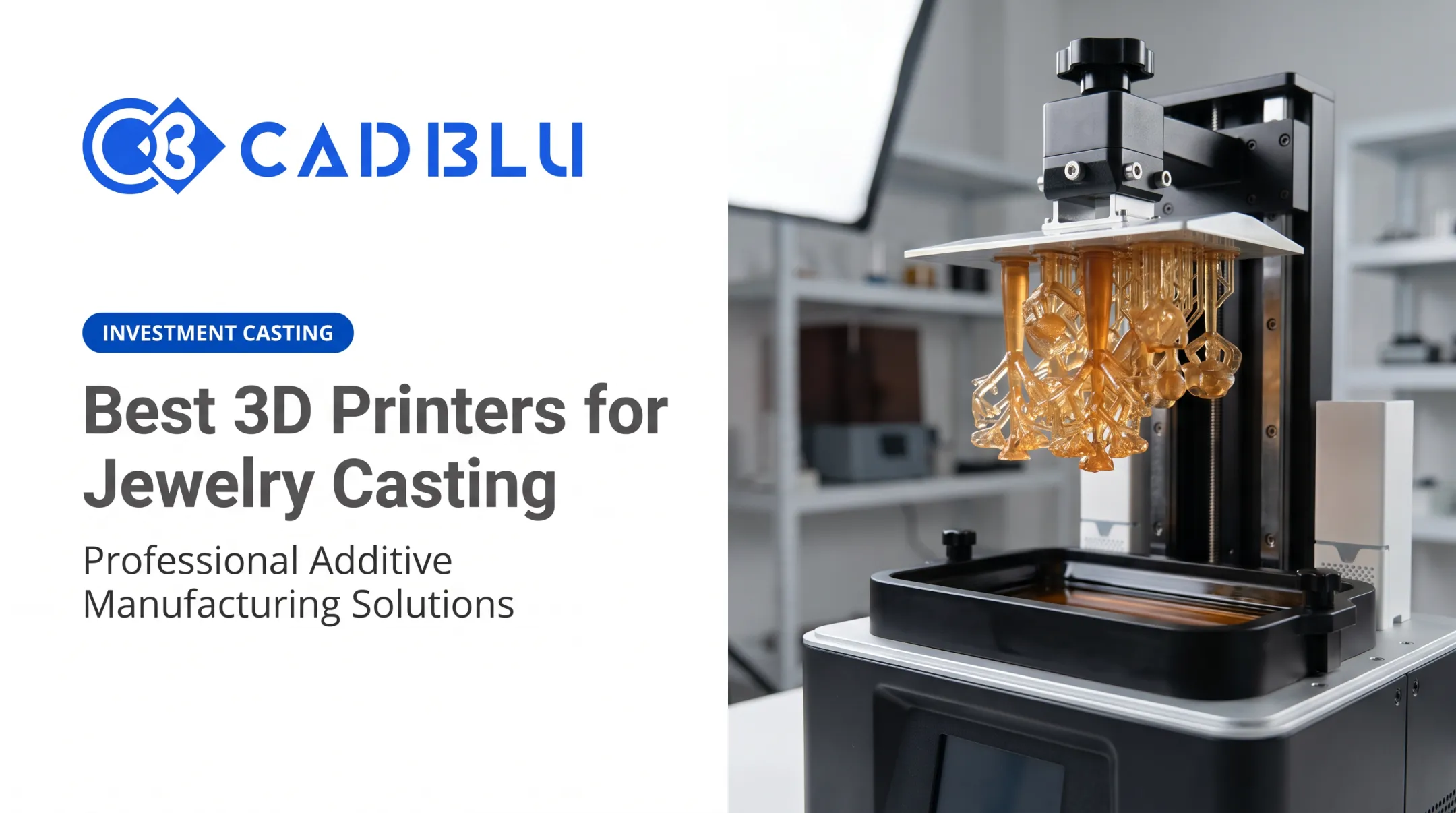
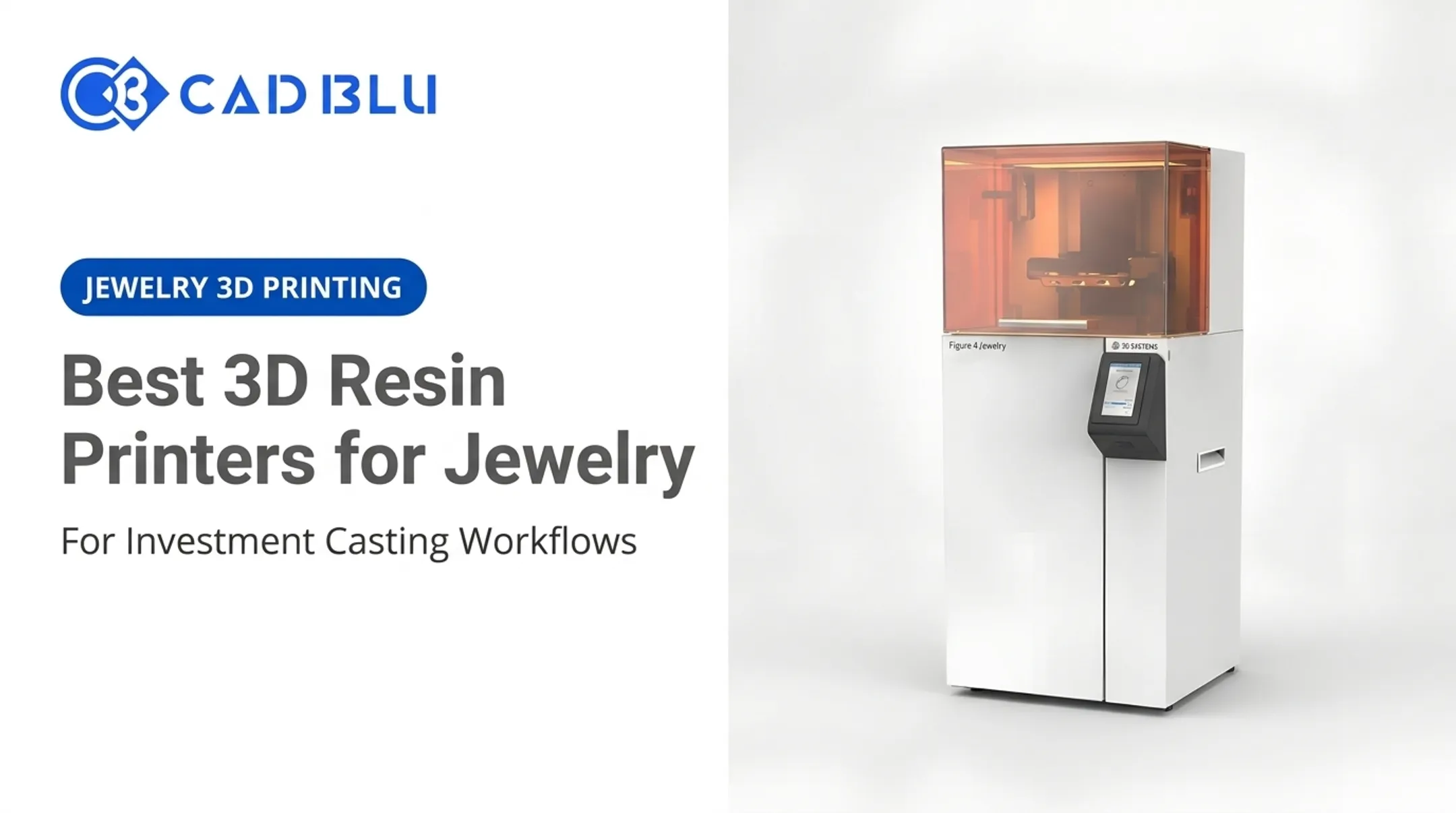
Picking the "best" printer isn't about chasing the highest advertised resolution. Your casting material, the fineness of detail your designs demand, how many pieces you need per week, how much post-processing you're willing to do, and whether you can get a technician on the phone when something breaks — these matter more than a spec sheet number.
This guide compares leading SLA, DLP, LCD, and direct-wax systems for U.S. jewelry businesses, along with what to verify before you buy.
TL;DR
- No single printer fits every shop: SLA/DLP for repeatable pro workflows, LCD for lower entry cost, direct-wax for demanding casting.
- Prioritize castable material validation, dimensional accuracy, surface finish, and total cost of ownership over marketing terms like "8K resolution."
- Treat printer, material, CAD prep, support removal, burnout, and casting as one connected system, not separate purchase decisions.
Overview of 3D Jewelry Printing for Investment Casting
A jewelry casting 3D printer doesn't print gold or silver. It prints a castable resin or wax pattern from your CAD file, and that pattern later gets invested and burned out during traditional lost-wax casting. The metal casting itself still happens in a crucible, not inside the printer.
The Digital Lost-Wax Workflow
The process follows this sequence:
- Prepare the CAD model and check wall thickness against your casting metal
- Orient and support the design for the chosen printer technology
- Print the pattern in castable resin or wax
- Wash or remove supports, then post-cure if the resin requires it
- Inspect dimensions against tolerance before committing to a tree
- Attach to a casting tree, invest, and burn out
- Cast the metal and finish the piece

Digital workflows shine for custom orders, quick design revisions, intricate filigree, and repeatable master patterns for molds. That said, a flawless print won't save a casting ruined by a poor burnout schedule or bad investment — the whole chain matters.
Comparing the Core Technologies
| Technology | How It Works | Strongest For |
|---|---|---|
| SLA | Laser traces each layer point-by-point | Fine surface quality, established material options |
| DLP | Projector cures a full layer at once | Production speed with strong accuracy |
| LCD/MSLA | LCD mask cures the full layer simultaneously | Lower entry cost, accessible pricing |
| Wax jetting | Drop-on-demand printheads deposit wax droplets | Direct wax patterns, no resin burnout step |
Resolution works differently on each platform:
- SLA: Detail depends on laser spot size and layer height
- DLP: Resolution is set by the projector's pixel size
- LCD: Screen pixel size and light uniformity control the result
Formlabs breaks this down in detail if you want the mechanical side of it.
Adoption of digital patterns keeps climbing. Grand View Research projects the global 3D-printed jewelry market to grow at a 19.9% CAGR from 2024 to 2030. That figure is a global market forecast, not a U.S.-specific adoption rate, but it still signals that digital patterns are becoming the default rather than the exception.
With the fundamentals covered, here's how the leading machines stack up against each other.
Best 3D Printers for Jewelry Casting
These picks are organized by use case, not ranked as one universal winner. We weighed casting-material compatibility, detail reproduction, surface finish, repeatability, build capacity, workflow complexity, and total operating cost. Pricing and material compatibility change often, so confirm current figures with the manufacturer or an authorized supplier before you commit budget.
Formlabs Form 4
Formlabs built the Form 4 around its Low Force Display technology, and it pairs with purpose-built jewelry resins rather than generic castable materials.
| Attribute | Details |
|---|---|
| Technology | MSLA (Low Force Display) |
| Castable materials | Castable Wax Resin, True Cast Resin, Castable Wax 40 |
| Build volume | 200 x 125 x 210 mm |
| Layer/pixel resolution | 25-200 μm layers; 50 μm pixel size |
| Starting price | From $2,625 |
Formlabs positions Castable Wax for lightweight filigree work and True Cast for medium-to-heavy pieces, with most prints finishing in under two hours. The draw is the integrated printer-software-material ecosystem: less guesswork and more consistency out of the box.
The trade-off is that you're locked into Formlabs' proprietary resins, which limits flexibility if you want to test third-party formulations later. Confirm the specific resin matches your pattern thickness before running a full production batch — thin filigree and heavier shank designs don't always want the same material.
B9 Core 5 Series XL
B9Creations built its reputation on DLP systems tuned specifically for jewelry, and the Core 5 Series XL continues that focus.
| Attribute | Details |
|---|---|
| Technology | 385 nm DLP |
| Build volume | 124.8 x 70.2 x 127 mm |
| Resolution | Under 25 μm effective; 10 μm Z resolution |
| Price | $16,955 |
B9's jewelry-castable catalog includes Emerald, Yellow, FASTWAX, and Cherry resins. Confirm the XL's validated profile with B9 rather than assuming the general catalog applies. This machine suits shops that need fine detail and steady repeatability across larger batches, not hobbyist output.
The learning curve and price tag put it out of reach for casual users. Budget time for operator training and validate your burnout schedule with whichever investment system you're running, since B9's published guidance doesn't cover every gypsum or phosphate-bonded investment on the market.
Asiga MAX X35 (Current MAX 2-Class Equivalent)
Asiga's angle is material freedom. The MAX X35 runs a 100% open material system, meaning you're not tied to one resin brand.
| Attribute | Details |
|---|---|
| Technology | DLP with Slide & Print (SPS) |
| Build volume | 67.2 x 37.8 x 75 mm |
| Pixel resolution | 35 μm (27 μm and 43 μm variants also available) |
| Price | Request a quote |
For jewelers who already work with a preferred castable resin supplier, or who want to test specialized formulations without switching hardware, this flexibility is valuable. Asiga lists jewelry directly as a supported application.
The build volume is modest compared to the Form 4 or B9 Core 5, so this fits smaller runs better than high-volume production. Open-material systems also put more burden on you: you'll need to qualify each resin and its burnout schedule yourself, since Asiga isn't validating every third-party material on your behalf.
Solidscape S3Duo
Solidscape skips resin entirely. The S3Duo jets actual wax, drop by drop, using Drop-on-Demand technology.
| Attribute | Details |
|---|---|
| Technology | Material jetting (wax) |
| Materials | Midas (build wax), Melt (washable support wax) |
| Build volume | 152.4 x 152.4 x 101.6 mm |
| Resolution | 0.00635-0.051 mm layers; up to 5,000 x 5,000 dpi |
| Price | Request a quote |
A wax pattern behaves like wax through the entire casting process: no resin burnout chemistry to manage, and no ash concerns beyond what jewelers already know from hand-carved wax. Melt support wax washes away hands-free, which cuts manual labor significantly.
Luxury houses and casting specialists who prioritize wax-like handling over speed tend to gravitate here. The trade-offs: higher acquisition cost, and Solidscape doesn't publish pricing, so plan on a sales conversation rather than a quick online checkout. Throughput needs to justify the investment.
Flashforge WaxJet WJ530
Flashforge's WaxJet line uses MultiJet Printing with a dual-wax system — model wax for the pattern, support wax for structure.
| Attribute | Details |
|---|---|
| Technology | MultiJet Printing (MJP) |
| Materials | FFWJ1200 model wax, FFWS3200 support wax |
| Build volume | 289 x 208 x 150 mm |
| Resolution | 2,900 x 2,900 x 1,700 dpi; 15 μm layers |
| Production capacity | Up to 12 kg/month (manufacturer-stated) |
| Price | Inquiry required |
The larger build volume compared to Solidscape's S3Duo makes this a candidate for batch production of intricate patterns without heavy manual support removal. Complex geometries that would be painful to support manually become far more manageable.
Capital cost and footprint are real considerations here — this is enterprise equipment, not a desktop unit. Verify regional service and wax availability before purchasing, since support arrangements can vary by location.
Lower-Cost LCD Alternative: Phrozen Sonic Mini 8K S
If budget is the primary constraint, LCD printers open the door at a fraction of the professional systems' cost.
| Attribute | Details |
|---|---|
| Technology | LCD (8K monochrome) |
| Build volume | 165 x 72 x 170 mm |
| XY resolution | 22 μm |
| Price | Around $270 |
Phrozen's jewelry guide cites a tester running BlueCast Resin X on this model with promising results. Treat that as manufacturer-published evidence, not independent proof of production-grade reliability.
This fits beginners, small studios, and prototyping workflows well. But a low machine price doesn't mean a low total workflow cost. Expect to spend time developing resin profiles, monitoring screen life, and troubleshooting dimensional consistency — costs that show up in labor rather than the purchase invoice.

How We Chose the Best 3D Printers
We prioritized repeatable casting results and real workflow economics over marketing buzzwords like "8K" or raw print speed claims. Those numbers rarely predict how a pattern will actually cast.
Technical criteria we weighed:
- Dimensional accuracy and fine-feature reproduction
- Surface finish and minimum practical wall thickness
- Build volume and orientation flexibility
- Consistency across the entire build platform, not just the center
Material and burnout evidence we required:
- Documentation of clean burnout with minimal ash or residue
- Recommended investment compatibility
- Published resin or wax handling and curing guidance
Production economics we considered:
- Machine price, consumables, and failed-print costs
- Post-processing equipment and labor time
- Maintenance, service contracts, and expected throughput
Business fit matters just as much as specs. A solo custom jeweler doing one-off commissions has different needs than a contract caster running nightly batches. At low volume, outsourcing to a service bureau can cost less than buying equipment outright.
Cost-per-part should include equipment, material, and labor together, not material price alone. A cheap resin paired with frequent failed prints costs more than it looks on paper.
Formlabs' breakdown of 3D printer ownership costs is a solid framework for running these numbers in your own shop.
Supplier support deserves real weight too. CAD BLU helps jewelry businesses with printers, materials, software, installation, workflow setup, repair, and ongoing support, including wax and resin systems for casting workflows.
That backing is separate from the models compared above, but it shows the kind of full-service support worth asking about no matter which printer you choose.
Conclusion
There's no single best jewelry casting printer. Direct wax systems, professional SLA or DLP machines, and lower-cost LCD printers each serve different production goals. Match the machine to:
- Your production volume
- Required surface detail and feature size
- How much post-processing your team can absorb
Before committing to a purchase, test a representative ring, pendant, earring, or filigree design using your actual production material and full burnout-and-casting workflow. A printer that looks great on a spec sheet can still fail on your specific investment compound or furnace schedule.
Compare total cost of ownership, not just sticker price. Real cost per finished piece also depends on:
- Technical support response and coverage
- Consumable availability and pricing
- Operator training time
- Room to scale as volume grows
If you're weighing options and want a second opinion, CAD BLU can walk through printers, materials, software, and support configurations aligned with your casting workflow, whether you're just starting out or scaling up production.
Frequently Asked Questions
What is the price of a 3D wax printer for jewelry?
Wax printer pricing tracks build capacity, automation level, and the support-material system. Brands such as Solidscape and Flashforge rarely publish fixed list prices, so request a current quote from CAD BLU or another authorized supplier.
How much does it cost to 3D print earrings?
Design size, batch quantity, metal choice, and finishing level drive most of the cost. Budget also for resin or wax, machine time, supports, wash/finish labor, failed prints, and casting prep.
What is the best 3D printer for jewelry casting?
Choose based on production volume, pattern material, and budget. Professional resin and DLP systems fit repeatable studio work, LCD models cover lower-cost entry, and direct-wax printers handle the most demanding casting jobs.
What is the best 3D printer for metal casting?
Most jewelry shops print a castable pattern for investment casting rather than printing finished metal. Pick a printer and castable material validated for your alloy and investment system.
Can you legally sell 3D printed items?
Yes—if you own or license the CAD rights, avoid trademark and copyright infringement, and meet product-safety and business-tax rules. Get legal advice for your specific products and market.
What is the most profitable thing to 3D print and sell?
Profit follows demand, design originality, material and labor cost, and clear IP rights. Custom cast jewelry and short-run casting patterns usually outperform generic prints when margins and finishing are controlled.