3D printing for orthodontics combines intraoral scanning, CAD/CAM design, additive manufacturing, and validated materials to produce patient-specific models, appliances, and guides. This shift matters because it links diagnosis, planning, production, and recordkeeping into one connected process. It doesn't remove the need for clinical oversight. This article breaks down what's actually working today, what's driving adoption, and where the technology is headed next.
Key Takeaways
- Digital scanning cuts impression time while matching traditional accuracy
- Print applications now cover models, retainers, indirect bonding trays, and select surgical guides—each needing the right material
- AI and automation support design work but clinical judgment still drives treatment decisions
- Material choice, calibration, and post-processing decide whether appliances meet patient-use standards
- ROI depends on case volume and workflow, not the printer alone
Key Trends in Orthodontic 3D Printing
3D Scanning and Digital Impressions
Intraoral scanners capture a three-dimensional map of the teeth and surrounding structures, replacing the tray-and-putty impression in most routine cases. These files feed directly into virtual models, treatment simulations, and lab transfer systems.
The 2023 comparative study mentioned earlier found no significant morphometric difference between digital and conventional impressions, with a mean deviation of just 317.86 microns (Janosi et al., 2023). Accuracy looks strong in that comparison, yet several limits still apply:
- The study tested one scanner and one impression material only
- It measured trueness, not precision or repeatability
- A 2023 systematic review found contradictory accuracy findings across studies, with no standardized testing protocol
- Edentulous arches remain difficult to scan accurately due to limited anatomical landmarks
Scanning works well for most routine cases. Full-arch and difficult anatomy still deserve extra scrutiny before you trust the file completely.
Patient-Specific Appliances and Treatment Components
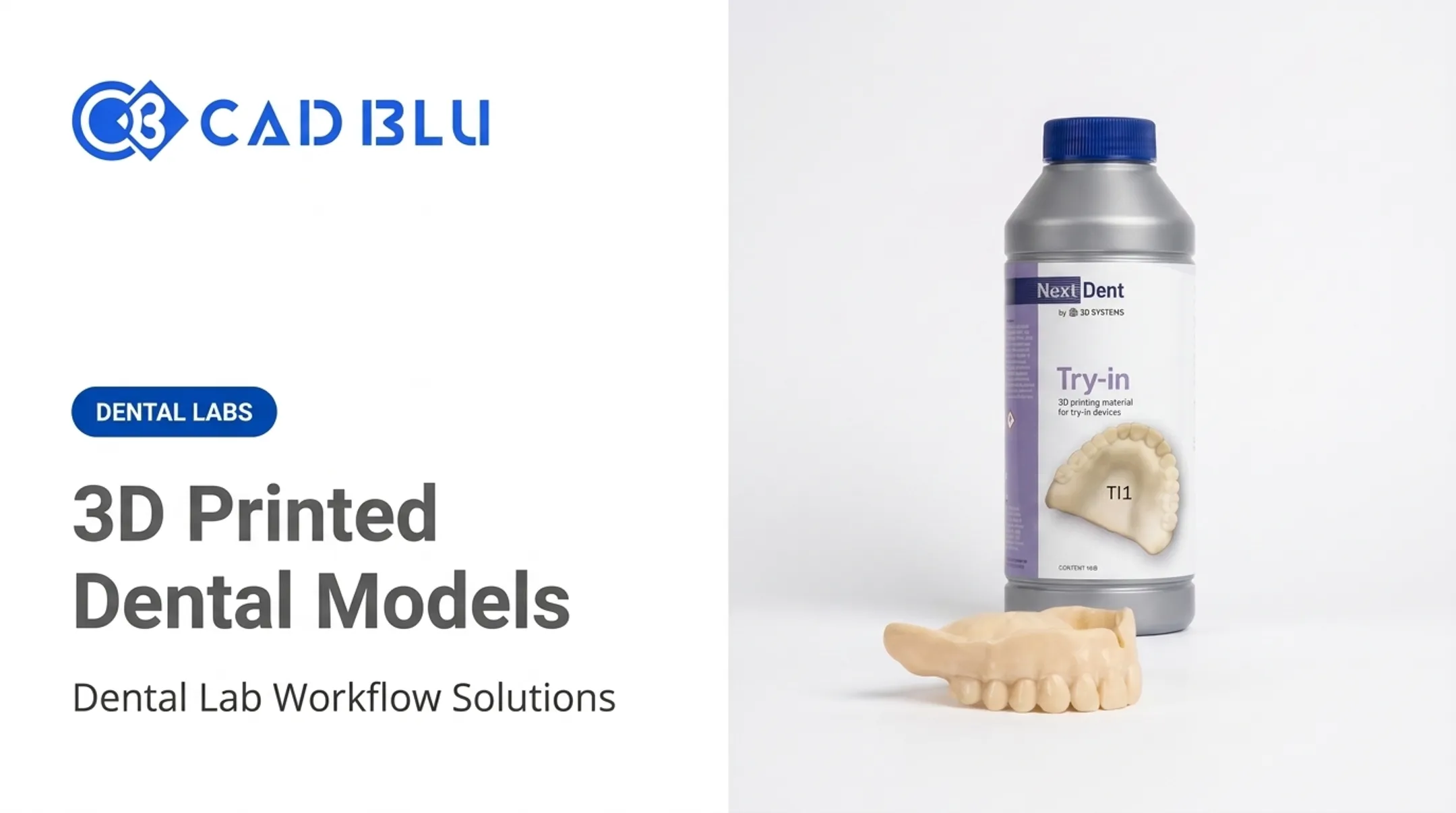
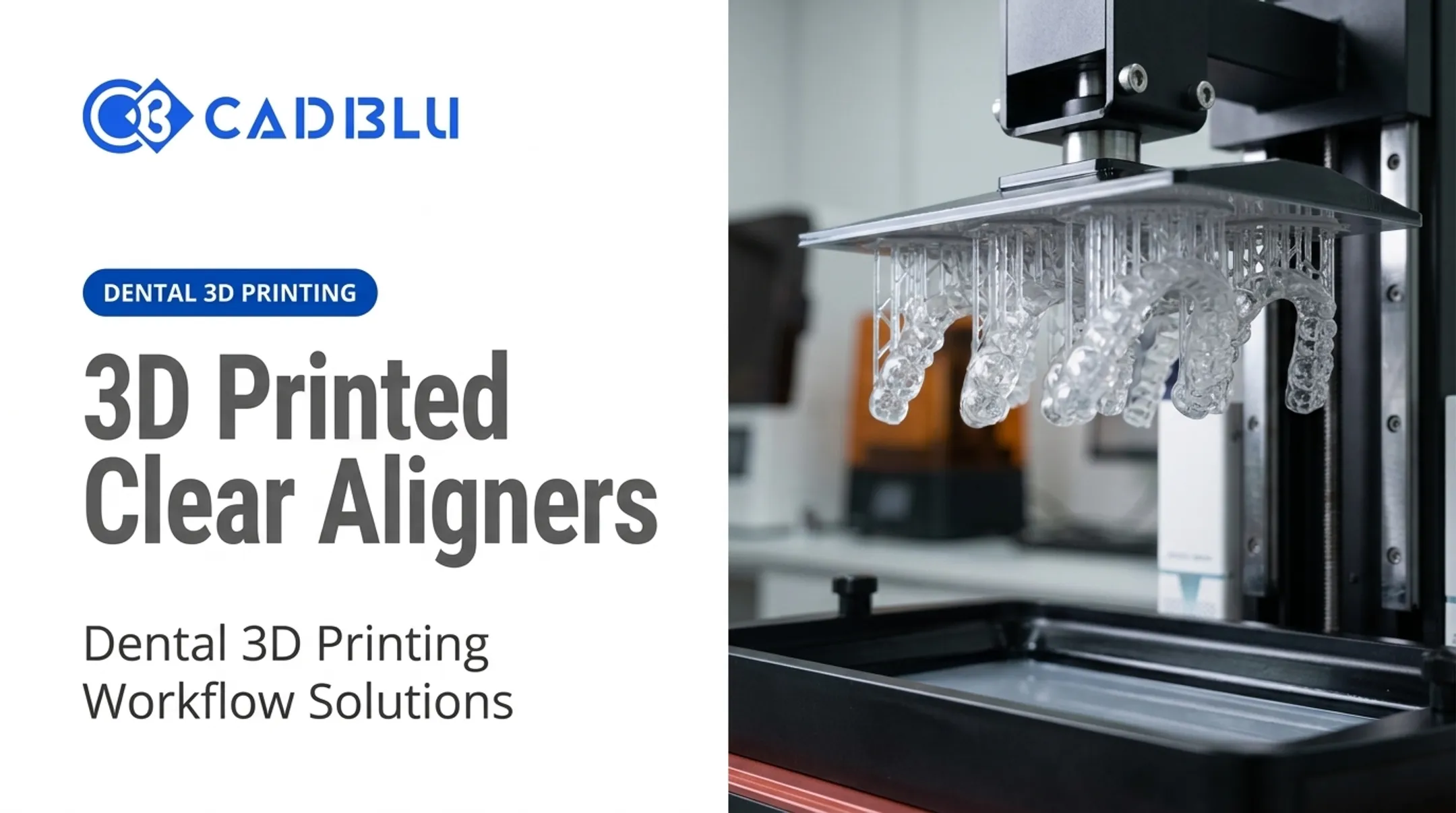
"3D printed orthodontics" isn't one product. It's a category covering models, clear aligner workflows, retainers, indirect bonding trays, custom brackets, splints, and select surgical guides. Each has different material demands and validation status.
CAD BLU's NextDent material line reflects this variety. NextDent ORTHO IBT/Clear supports indirect bonding tray design, letting orthodontists plan bracket placement digitally and place multiple brackets in one seating rather than one at a time. Precision Transdent, tested against ISO 10993 biocompatibility standards, is built for mid-term appliances like retainers.
In a 2022 clinical study of printed indirect bonding trays, bracket position differences averaged just 0.10 mm mesiodistal and buccolingual, with 96-100% of brackets placed within 0.5 mm of the planned position (2022 study, PMC9020390). That precision is hard to match with manual placement.

A 2023 materials review still found no long-term clinical studies on printed devices worn intraorally for extended periods. Biocompatibility testing doesn't always show how a material ages in the mouth over months.
Automation, AI, and Digital Treatment Planning
CAD/CAM software now automates repetitive design tasks, such as virtual setups, nesting parts for printing, and flagging cephalometric landmarks. In one comparison of 253 lateral cephalograms, an AI landmarking tool achieved a mean error of just 0.9 mm.
That speed helps analysis. It does not replace clinical review. A 2024 critical review in the Journal of Dental Research found that while indirect-bonding tray fabrication and aligner production can be automated, treatment planning and case evaluation remain the specialist's job. The same review flagged a real gap: most AI tools are trained on single-center data, which limits how well they generalize across different patient populations.
Faster Iteration and Distributed Production
Once a design exists as a digital file, revising it doesn't mean starting over with a new impression. A retainer design can be tweaked and reprinted. A file can be sent to a lab across the country instead of shipped physically.
This matters most for:
- Multi-location practices standardizing appliance production
- Labs managing replacement retainers or repeat cases
- Organizations that need version control and secure file transfer, not just faster printing
The efficiency gain is real, but it depends on having file naming conventions, quality checks, and printer capacity in place before scaling up. Skipping that groundwork tends to create more remakes, not fewer.
Materials, Precision, and Quality Assurance
Material selection has to match the appliance's intended use. A model resin isn't a retainer resin. A surgical guide material isn't a splint material. Mixing these up isn't just a quality issue, it's a compliance one.
CAD BLU's NextDent 5100 platform, built on Figure 4 print technology, illustrates how manufacturers approach this. It supports 30 distinct NextDent materials, each biocompatible and CE certified under Medical Device Directive 93/42/EEC, with FDA listing and traceability documentation for regulatory review. The NextDent SURGICAL GUIDE material, for example, permits drill-sleeve insertion right after printing and holds dimensional stability through standard autoclave sterilization.
Regulatory frameworks are catching up too. In August 2025, the FDA cleared an Additively Manufactured Aligner Resin as a Class II device under 21 CFR 872.5470, specifically for light-curing printed aligners used in tooth movement, retention, and splints (FDA 510(k) K251415, 2025). That's a meaningful signal: direct-print aligner materials are moving from experimental to formally classified.
Quality assurance isn't optional at any step:
- Calibrate the printer regularly to maintain dimensional accuracy
- Wash and post-cure resin parts according to manufacturer instructions
- Remove supports carefully to avoid distorting fine geometry
- Inspect and document each finished piece before delivery
- Sterilize per protocol, following manufacturer-specific cleaning and disinfection steps
Skip any of these and you risk an appliance that looks fine but doesn't fit or perform as designed.
What's Driving These 3D Printing Trends
Several forces are pushing orthodontic production away from manual fabrication and toward connected digital systems.
Technology Advances and Innovation
Scanner resolution keeps improving, printers run faster, and software increasingly bridges the gap between scan, design, and production. The NextDent 5100, for instance, prints at 13.3 mm per hour with layer thicknesses down to 25 microns and average accuracy around 50 microns. That combination of speed and resolution is what makes same-day appliance workflows realistic for a lab, not just a demo.
Market Demand and Patient Expectations
Patients notice the difference between a scanner and a mouthful of alginate. A 2018 Ohio State University study of 180 orthodontic patients found that those who received digital scans preferred them, while patients who received alginate impressions were neutral at best (Burzynski et al., 2018). Preference varies by scanner, but digital impressions clearly land better with patients overall.
Cost Pressures and Efficiency Needs
Digital workflows aren't automatically cheaper. A 2019 study comparing digital and conventional model acquisition in children found the digital process initially cost 10.7 times more per case. Under that study's volume assumptions, cost parity took about 3.6 years.
In-house printing changes that math for higher-volume practices. A 2022 paper in the Journal of the World Federation of Orthodontists described in-house 3D printing as feasible and cost-effective, citing printer costs roughly in the $3,800–$7,600 range depending on platform. As a concrete US market example, CAD BLU's NextDent 5100 lists at $10,995, with purchase and lease financing available for labs weighing in-house production against outsourcing.

Before investing, weigh:
- Current case volume and remake frequency
- Outsourcing and shipping costs versus in-house labor
- Staff training time and equipment maintenance
- Material costs per appliance type
Regulatory, Clinical, and Compliance Influences
Patient-use appliances require documented materials, traceable manufacturing processes, and infection control procedures. The ADA's 2023 guide on 3D printing notes that resin composition varies by product. Post-processing steps—washing, curing, polishing—depend on the end application and manufacturer instructions. Printed models may carry lighter documentation requirements than appliances that sit in a patient's mouth for months.
Competitive and Operational Dynamics
Labs and practices that can turn around custom appliances faster have an edge, but equipment alone doesn't create that advantage. A printer sitting next to an unchanged manual workflow doesn't solve anything. Adoption depends on the full workflow. CAD BLU pairs NextDent printers and materials with installation, workflow support, and OEM-certified repair—support that often decides whether a printer stays in production or sits idle.
How These Trends Are Impacting the Orthodontic Industry
Operational Impact
The case lifecycle now runs through scanning, CAD design, print preparation, post-processing, inspection, and delivery. Remake workflows build around digital files rather than new physical impressions. That shift brings new responsibilities:

- Resin handling and storage
- Printer calibration and maintenance schedules
- Cleaning, curing, and sterilization documentation
- Data security and backup procedures for patient files
Business Impact
Investment decisions now span printers, scanners, software licenses, materials, and staff training, not just equipment purchase price. Most practices land in one of three models:
| Model | Best Fit | Trade-off |
|---|---|---|
| Fully in-house | High case volume, multiple locations | Higher upfront cost, staff training needed |
| Fully outsourced | Lower volume, testing the waters | Less control over turnaround |
| Hybrid | Most mid-size practices | Requires clear criteria for what stays in-house |
Total cost of ownership, not sticker price, should drive this decision.
Workforce and Patient-Care Impact
Roles are shifting from manual model trimming and appliance fabrication toward scanning, digital design review, and print quality management. For patients, that means fewer messy impressions and appliances built to their specific anatomy rather than a standard mold.
That said, no printed appliance replaces clinical judgment. Orthodontists remain responsible for diagnosis, treatment planning, fit verification, and ongoing monitoring, regardless of how the appliance was manufactured.
Future Signals for 3D Printing in Orthodontics
Adoption will evolve as materials, software, and regulations mature. Rather than forecasting outcomes, here's what to watch:
- Validated direct-print materials expand after the 2025 FDA clearance of a Class II aligner resin, pointing to more formal classifications—not marketing claims alone.
- AI moves from analysis into workflow tools such as cloud collaboration and automated quality inspection; fully autonomous planning still needs specialist review per the 2024 JDR critical review.
- Interoperability improves across scanners, practice-management software, CAD tools, and printers, with less manual file handling.
- Hybrid production grows as practices print routine appliances (retainers, IBTs) in-house and outsource complex or lower-volume cases over the next one to three years.
Conclusion
3D printing is becoming a genuine foundation for digital orthodontics, connecting scanning, personalized design, and additive production into one workflow. The technology itself, though, is only as good as the material choices, calibration discipline, and staff training behind it.
Before investing, lock in three basics:
- Map your intended applications
- Confirm materials are validated for that specific use
- Run workflow economics against your actual case volume
Start with a well-controlled use case, such as indirect bonding trays or study models, and scale once the process is proven. Platforms like CAD BLU's NextDent 5100 offer a defined entry point, but the workflow around the printer matters just as much as the printer itself.
Frequently Asked Questions
What is a 3D scan at the dentist?
An intraoral scanner captures digital three-dimensional images of your teeth and oral structures in minutes. This scan supports orthodontic planning and appliance design and replaces the physical impression tray and putty most patients remember.
Can 3D printing be used for orthodontics?
Yes. Common applications include study models, retainers, indirect bonding trays, custom appliances, and select surgical guides. Each requires application-specific validated materials and clinician oversight before patient use.
Are 3D printed braces good?
3D printing more often supports custom trays, models, and appliances than traditional braces themselves. Indirect bonding trays and similar components can improve placement precision and save chair time, though results still depend on the case, materials, and your orthodontist's plan.
What are the differences between 2D and 3D imaging in orthodontics?
2D images, such as panoramic radiographs, show a flattened view of teeth and jaws, while 3D CBCT or intraoral scans provide volumetric detail. The AAOMR recommends CBCT only when lower-dose 2D imaging cannot answer the clinical question, since each exposure adds radiation risk.