For US manufacturers, that difference isn't academic. It changes your tooling investment, how much material ends up as scrap, what geometry you can actually produce, achievable tolerances, and your cost per unit.
There's no single "better" process. The right call depends on production volume, how complex the geometry is, your material, tolerance requirements, and whether the design is actually finished or still evolving. This guide breaks down the trade-offs so you can make that call with confidence.
Key Takeaways
- Investment casting fits complex near-net-shape parts in volume; CNC wins for prototypes, design changes, and tight tolerances.
- CNC skips mold tooling; casting cuts per-part time and waste once volume covers tooling cost.
- Casting forms internal passages, undercuts, and thin walls that are costly to machine from solid.
- CNC holds tighter control on accessible features and often finishes critical cast surfaces.
- Compare total project cost—not just tooling: setup, waste, machine time, secondary ops, and volume.
Investment Casting vs CNC Machining: Quick Comparison
Use this side-by-side view to shortlist a process, then dig into the details below.
| Factor | Investment Casting | CNC Machining |
|---|---|---|
| Upfront cost | Tooling often $2,000–$30,000+ | No mold tooling; pay for programming and machine time |
| Best volume | Medium to high, stable designs | One-offs, prototypes, low volume |
| Design changes | Expensive after tooling is cut | Fast—update the CAD/toolpath |
| Geometry | Internal passages, undercuts, thin walls | Limited by tool access and setups |
| Precision | ~0.005 in/in as-cast; critical features often finish-machined | Tighter control on bores, threads, and hard callouts |
| Material use | Near-net shape, less scrap | More chips from stock removal |
| Lead time | Pattern/shell prep can slow first articles | Fast first part from approved CAD |
Cost
Investment casting carries real upfront cost. Wax-pattern tooling alone typically runs $2,000 to $30,000 or more, depending on part geometry and complexity, according to the DFMA investment-casting cost estimating guide. That guide also shows how tooling amortization shifts with volume:
- At roughly 100 parts per year, tooling adds about $20 to $300 per part
- At roughly 10,000 parts per year, that drops to about $0.20 to $3 per part
CNC machining usually skips dedicated mold tooling. Per-part cost comes from programming, fixturing, machine hours, tool wear, and how much stock you remove. Simple parts stay cheap at low volume; heavy stock removal or multiple setups get expensive fast, at any quantity.
Production Volume and Design Stability
Casting rewards a finished, stable design. Once tooling is cut, changes get expensive—but once volume spreads that tooling cost, per-part economics improve sharply.
CNC handles instability better. A revised CAD file means a revised toolpath, not a rebuilt die. That makes it the default for:

- One-off parts and low-volume orders
- Prototypes awaiting design validation
- Projects where specs might still shift
Geometry and Complexity
Investment casting shapes metal inside a cavity, so it can form features a cutter can't reach: internal passages, undercuts, thin walls, and consolidated assemblies that would otherwise need multiple machined and welded pieces.
CNC is limited by tool access. A cutter and holder need a clear path to the surface, so deep cavities, enclosed channels, and hidden internals often need extra setups, special tooling—or get skipped.
Precision and Surface Finish
As-cast tolerances vary with alloy, part size, pattern quality, and foundry process control. Guidance from the Investment Casting Institute's 2024 conversion-process consensus puts typical linear and profile tolerance around 0.005 inches per inch. Tighter requirements usually need agreed machine stock for finishing.
CNC generally gives tighter, more predictable control on:
- Bores and mating surfaces
- Threads and fits
- Any dimension inspected against a hard callout
That's why many cast parts still hit a CNC machine for their most critical features. Those hybrid workflows also shape the material and lead-time trade-offs below.
Material Efficiency and Lead Time
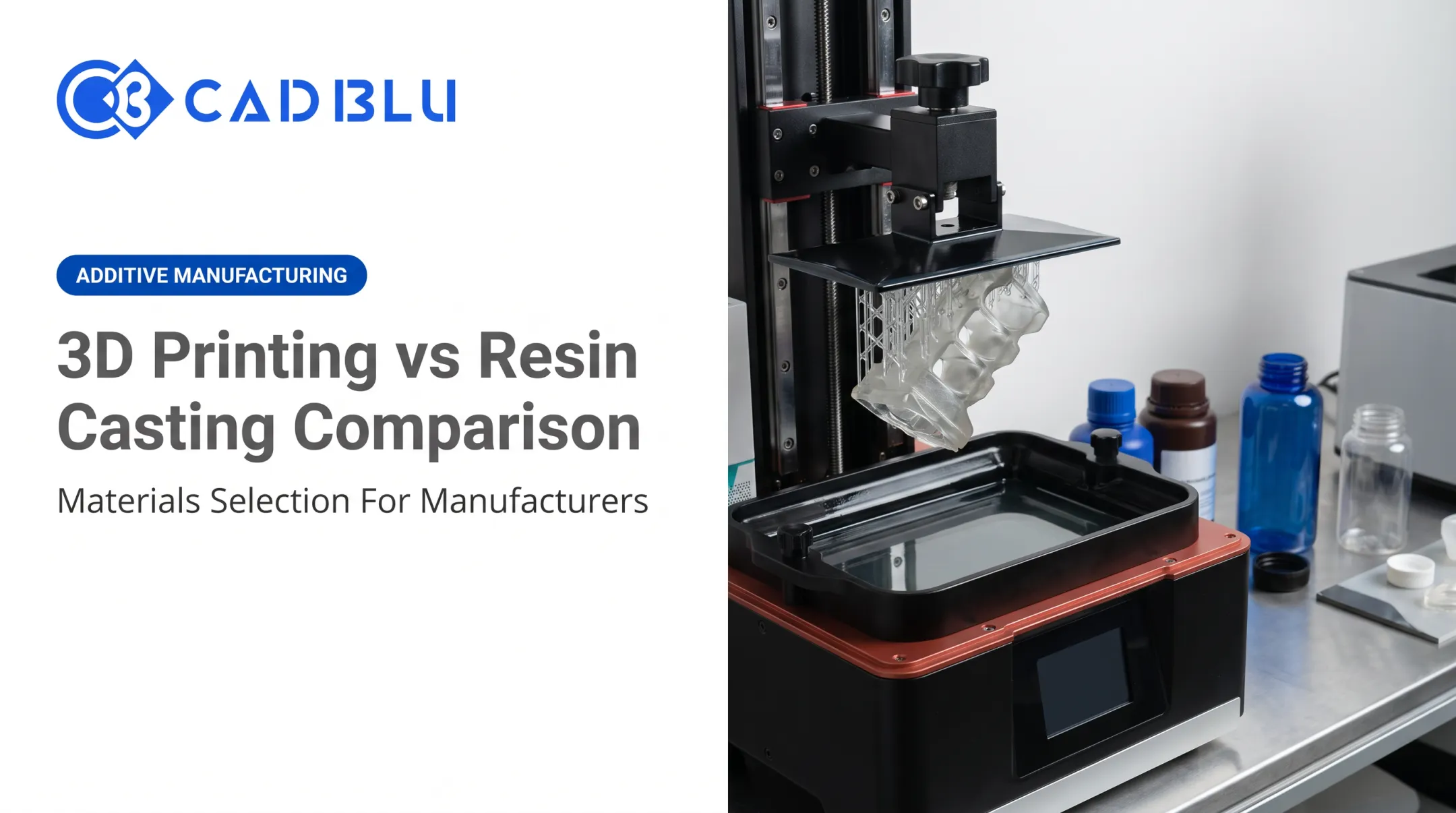
Near-net-shape casting leaves less billet as chips. On the pattern side, options like CAD BLU's PolyCast™ filament 3D-print castable patterns without hard tooling, which can cut both cost and lead time—with reported savings up to 50% in material waste and solvent usage versus older pattern workflows.
The trade-off is pattern and shell prep, which can stretch first-article lead time versus machining.
CNC's edge is speed from an approved CAD model to a first part. The offset is chips, scrap, machine capacity limits, and slower cycles on tough alloys or complex geometry.
What Are Investment Casting and CNC Machining?
Investment Casting
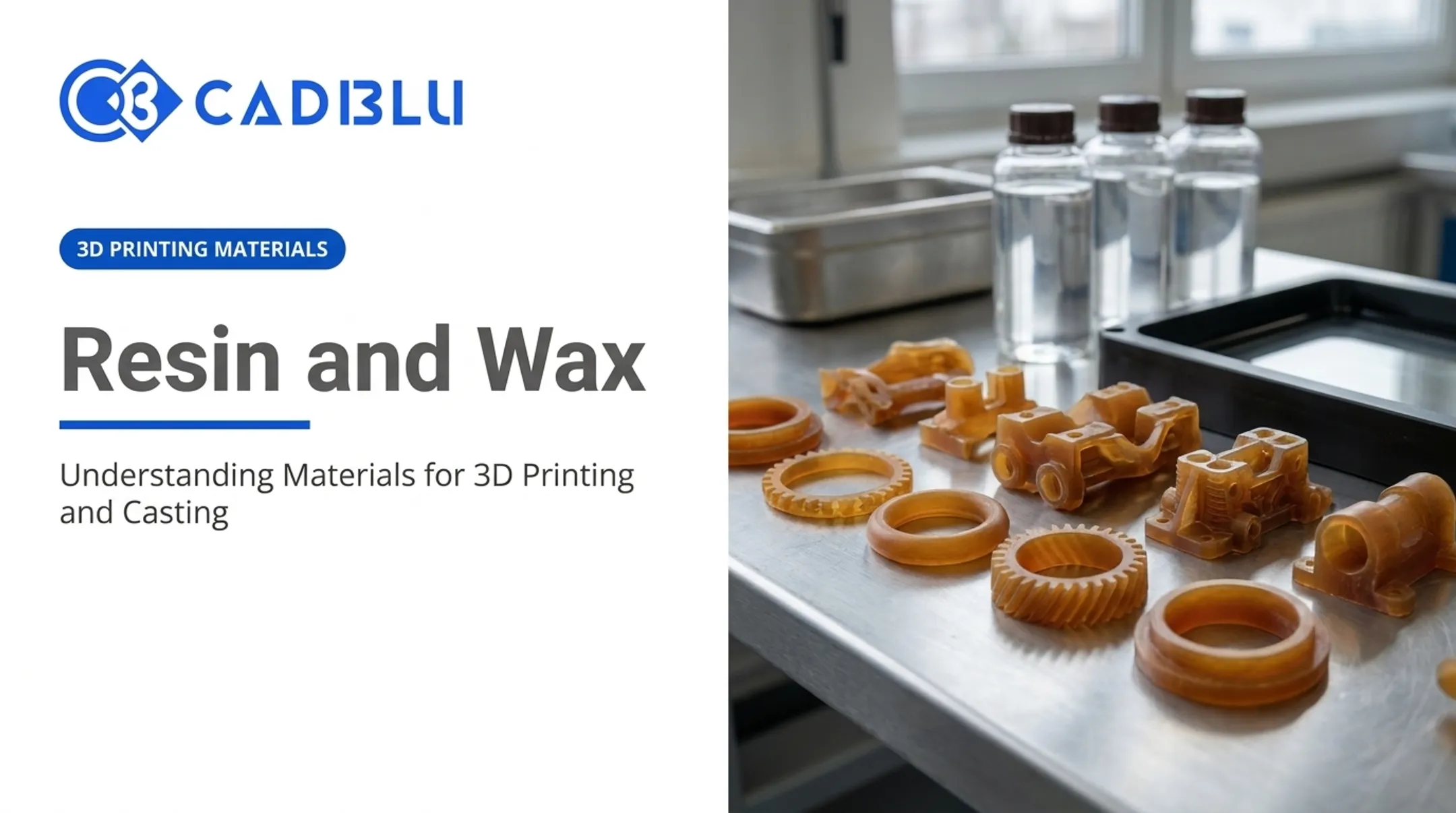
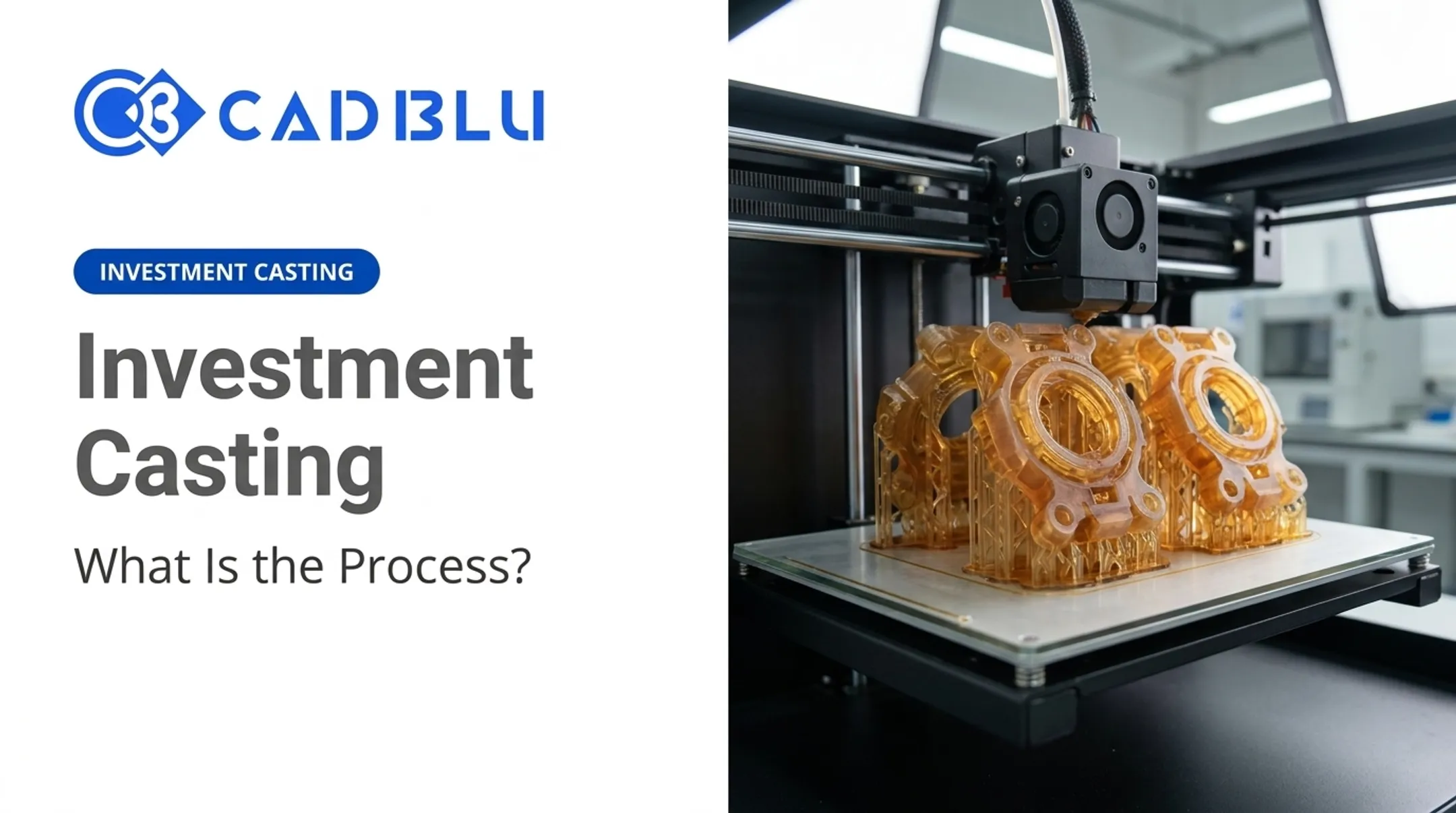
Investment casting, also called lost-wax casting, builds a metal part around a sacrificial pattern. A wax or polymer pattern is coated repeatedly with ceramic slurry to build a shell. The pattern is then melted or burned out, leaving a cavity that molten metal fills.
The typical production sequence:
- Pattern creation - traditionally injection-molded wax, though patterns can also be 3D printed directly. CAD BLU's ProJet MJP 2500IC, for example, prints RealWax patterns without any tooling at all, which is useful for bridging production or validating geometry before committing to a die.
- Tree assembly - multiple patterns are attached to a central sprue for batch processing.
- Ceramic-shell building - repeated slurry and stucco coats form the mold.
- Dewaxing and burnout - the pattern material is removed, leaving the ceramic cavity.
- Pouring - molten alloy fills the shell.
- Shell removal, cutoff, finishing - parts are separated from the tree and cleaned.
- Heat treatment and inspection - final properties and dimensional checks.

Near-net-shape parts need far less material removal than machining from solid billet. Multiple components can consolidate into one casting, and alloys that are expensive or slow to machine become far more practical to produce.
Limitations:
- Pattern and shell tooling adds upfront cost and lead time
- Casting defects like shrinkage or porosity are process risks
- Dimensional variation is inherent to the process
- Draft angles and other design-for-casting rules constrain shape
- Critical features often still need secondary machining
Aerospace, industrial equipment, automotive, medical, and jewelry manufacturers all rely on investment casting where geometry or alloy makes machining from solid stock impractical.
CNC Machining
CNC machining is subtractive: computer-controlled mills, lathes, drills, or multi-axis systems cut material away from a solid workpiece following a digital toolpath.
A typical workflow looks like this:
- CAD model and drawing review - confirming tolerances and critical features
- Process planning and programming - defining toolpaths and operation sequence
- Workholding setup - fixturing the part securely
- Roughing and finishing passes - removing bulk material, then refining to spec
- Deburring, inspection, and surface treatment - final quality checks
CNC's operational strengths are rapid design iteration, high precision on any surface the tool can reach, strong repeatability, and compatibility with a huge range of materials. It's the natural fit for prototypes and low-to-medium production runs.
Limitations include material lost as chips, tool-access constraints, workholding limits, machine envelope size, and rising cost as setup count and material removal volume climb.
A simple mounting bracket machines cleanly in one or two setups. A manifold with internal cooling channels and enclosed passages may favor casting instead.
Investment Casting vs CNC Machining: What Is Better?
Neither process wins by default. The right choice depends on the part's actual requirements and the economics of the full production route, not just which method sounds more advanced.
Choose investment casting when the part has:
- Complex geometry, internal passages, or undercuts
- Thin walls or opportunities to consolidate multiple parts into one
- Alloys that are expensive or slow to machine from solid stock
- Repeat production volume that can justify pattern tooling
Choose CNC machining when:
- The job calls for a one-off part or small quantity
- The design is still changing
- The prototype is urgent
- The geometry is simple and accessible
- Specific features demand especially tight tolerances
Volume economics deserve real modeling, not a rule of thumb. Weigh tooling, programming, setup, material, machine time, finishing, inspection, and scrap against your expected order quantity. There's no universal break-even number. It shifts with part size, alloy, complexity, and your specific supplier's tooling design.
Before choosing either route, your drawings should nail down critical dimensions, datums, threads, mating surfaces, surface-finish callouts, structural performance requirements, and inspection criteria. Guessing at these after tooling is cut gets expensive.
The Hybrid Route: Cast and Machine
Many production parts don't pick one process exclusively. They cast a near-net shape, then send only the critical bores, threads, or sealing faces to a CNC machine for final precision. This combines casting's material efficiency and geometric freedom with machining's tight control on the features that actually get inspected.

Real-World Examples and Hybrid Workflows
Casting conversion, automotive: According to Eagle Group's 2023 case study, engineers redesigned a Ford engine-assembly component, originally produced by full machining, as an 8620 low-alloy-steel investment casting.
The redesign added windows to the part and achieved roughly a 25% weight reduction. The part still required machining for threads after heat treatment, a clear example of the hybrid cast-and-machine approach.
Prototype and low-volume machining: Frequently revised parts, like an early-stage bracket or housing that's still getting design feedback, are a classic CNC scenario. Each revision just needs an updated program, not a new die, so a part can go through several design iterations in the time it would take to build a single casting tool.
Where CAD BLU fits in: CAD BLU doesn't run casting furnaces or CNC machines. What the company does provide is the digital front end that both routes depend on. CAD, 3D scanning, and 3D printing tools help teams:
- Validate geometry before committing to any tooling
- Print castable wax or resin patterns (Accura CastPro™, VisiJet M2 ICast) for foundry evaluation without cutting a die
- Prototype design variants quickly to compare against machining feasibility
If your team is weighing a casting-pattern workflow, evaluating a prototype strategy, or validating a CAD model before committing to production tooling, CAD BLU's team can help. The conversation stays process-neutral, focused on helping you make an informed call rather than pushing one method.
Conclusion
Investment casting is usually the stronger fit for complex, repeat-production metal parts built around near-net-shape goals. CNC machining wins for prototypes, evolving designs, accessible geometry, and features that demand tight tolerances.
Evaluate total cost and manufacturability together. Factor in:
- Tooling and setup costs
- Material waste
- Machine time
- Secondary operations
- Quality requirements
- Delivery schedule
A single line-item comparison rarely tells the whole story.
Before committing to production, run a design and process review. In many cases, a hybrid route—casting the near-net shape and machining only the critical features—outperforms either process alone.
Frequently Asked Questions
What is the difference between machining and casting?
Machining removes material from a solid workpiece with cutting tools; casting pours molten metal into a mold. Investment casting builds a ceramic shell around a wax pattern, then pours metal after that pattern is removed.
Is investment casting cheaper than CNC machining?
It depends on quantity, tooling cost, geometry, alloy, material waste, and secondary operations. Model your part's numbers rather than assuming one process is cheaper by default.
Which process is better for prototypes: investment casting or CNC machining?
CNC machining is usually faster for early prototypes because it skips tooling and cuts directly from a CAD file. Pattern-based casting still makes sense when the prototype must match final casting geometry.
Do investment-cast parts require CNC machining?
Some parts ship with minimal finishing straight off the tree. But critical bores, threads, mating faces, and tight-tolerance features often still need CNC machining to hit spec.
Which process provides tighter tolerances?
CNC machining generally offers tighter control on accessible features. Investment casting achieves strong repeatability on its own and can be finished by machining wherever tighter tolerances are required.
How does production volume affect the choice between investment casting and CNC machining?
Casting tooling becomes easier to justify as repeat volume climbs, since the cost spreads across more parts. CNC machining avoids dedicated tooling altogether, making it attractive for one-offs, prototypes, and low-volume runs.