Engineers, manufacturers, product designers, and casting buyers evaluating complex components need more than a surface-level definition. Getting the process right affects quality, cost, lead time, and whether a part passes inspection the first time.
Most people know investment casting by its older name: lost-wax casting. Fewer understand what actually happens at each stage, from pattern creation to shell removal. This article breaks down the steps, the process controls that matter, where the method fits best, and when it doesn't.
TL;DR
- Investment casting forms a ceramic shell around a wax or polymer pattern, removes the pattern, pours metal, then breaks the shell.
- It suits complex geometries, fine detail, and a wide alloy range with little secondary machining.
- Pattern tooling and expendable shells make it less economical for simple parts or very high volumes.
- Shell quality, alloy choice, gating, pouring, and inspection drive final accuracy and integrity.
What Is Investment Casting and Why Is It Used?
The term "investment" refers to surrounding a pattern with refractory ceramic slurry—investing it in mold material. Once that shell hardens, the pattern is melted or burned out, leaving a hollow cavity shaped exactly like the original part. Molten metal fills that cavity and takes on the pattern's geometry, down to fine surface texture.
The goal is straightforward: reproduce a detailed three-dimensional shape in metal with enough accuracy that little or no secondary machining is required.
Confusion often starts with what is reusable and what is not:
- Master tooling—injection molds, machined patterns, or 3D-printed templates—can be reused across production runs
- Wax patterns and ceramic shells are single-use; each casting needs a new pattern and shell, both destroyed during shell removal
This is why investment casting shines for intricate shapes, undercuts, internal passages, thin features, and part consolidation, combining what used to be several machined pieces into one casting. It also handles alloys that resist easy shaping through rolling or forging.
How It Compares to Other Processes
| Process | Best for | Tooling | Surface finish |
|---|---|---|---|
| Investment casting | Complex geometry, tight tolerances | Moderate, pattern-based | Smooth, minimal machining |
| Sand casting | Large parts, simple shapes | Low | Rougher, more finishing |
| Die casting | High-volume nonferrous parts | High (steel dies) | Good, but limited alloys |
| CNC machining | Prototypes, low volume | None (subtractive) | Excellent, but material waste |
That mix of geometry freedom and finish quality is why the process is so widely adopted. According to the Investment Casting Institute, it supports more than 40,000 jobs and contributes over $7 billion annually to the North American manufacturing economy—deeply embedded in aerospace, automotive, medical, and industrial supply chains.

How the Investment Casting Process Works
Investment casting moves from pattern creation through tree assembly, shell building, dewaxing, pouring, cooling, shell removal, and inspection. Each stage introduces variables that affect the final part.
Step 1: Create the Pattern
The pattern is produced from a master die (wax injection), a machined template, or an additive-manufactured mold. It copies the intended geometry, including allowances for metal shrinkage during solidification and wax shrinkage during cooling.
Dimensional stability, draft, and core placement all get locked in at this stage—so pattern quality sets the ceiling for the finished part. Foundries typically rely on supplier or standards-based shrinkage values rather than estimating.
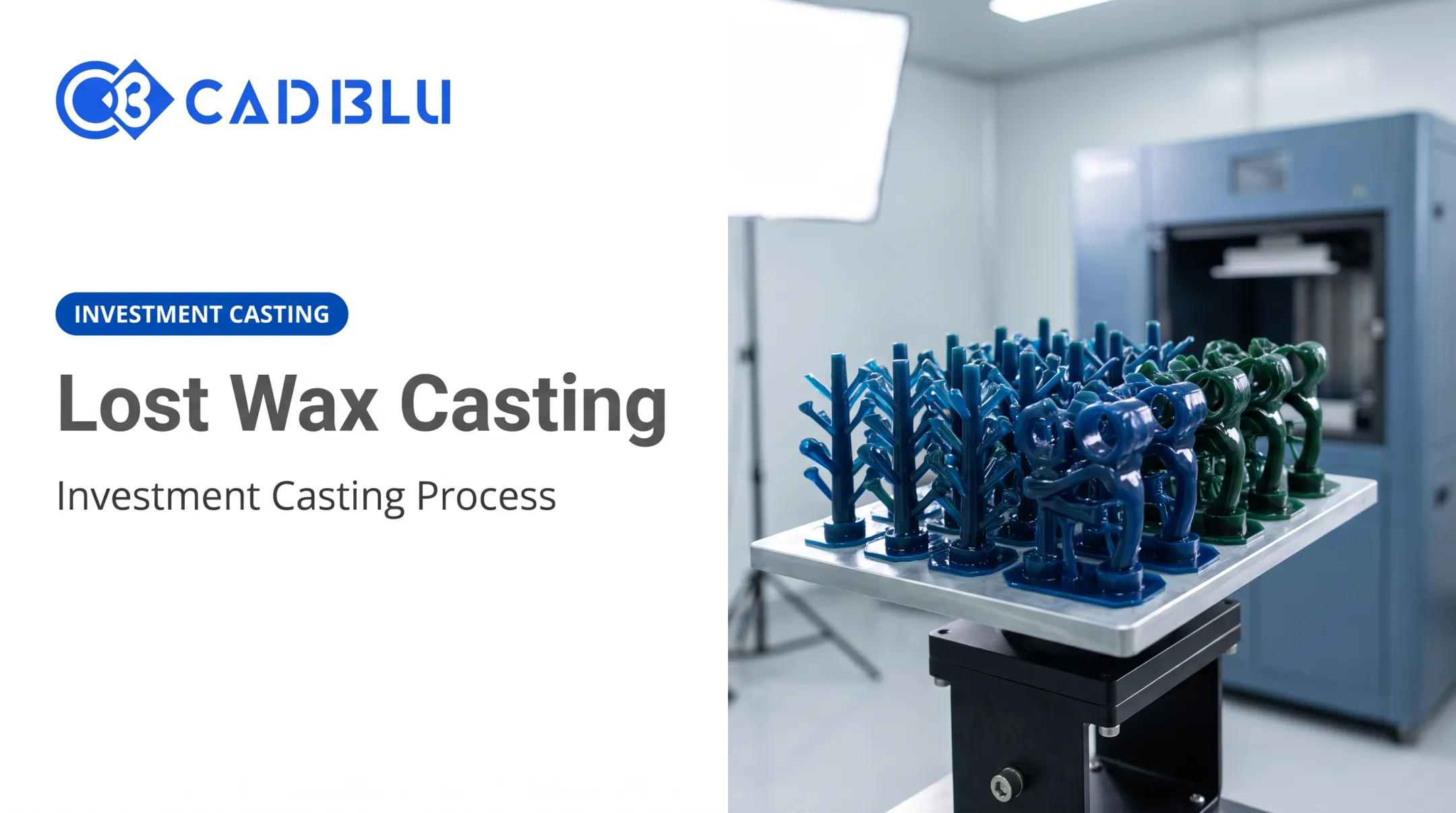
3D-printed wax and castable resin patterns have changed this step for many manufacturers. Materials like 100% wax formulations, printed via MultiJet Printing, let teams skip injection tooling entirely, producing patterns directly from CAD data. That's useful for validating a design before committing to production tooling, or for runs where building a traditional injection mold doesn't make financial sense.
Step 2: Assemble Patterns Into a Tree
Multiple patterns attach to a central sprue and runner system, called a tree, so a foundry can cast several parts in a single pour. One tree might hold anywhere from a handful of patterns to over a hundred, depending on part size.
Gating and riser design control:
- Metal flow into each cavity
- Feeding during solidification to offset shrinkage
- Air entrapment that causes porosity if unmanaged
- Yield—how much poured metal becomes usable part versus runner scrap
Poor gating shows up later as misruns, shrinkage defects, or trapped inclusions.
Step 3: Build the Ceramic Shell
The tree gets dipped in ceramic slurry, coated with fine sand (stucco), then dried. This cycle repeats several times, often six to eight, building up layers of refractory material.
Shell composition typically includes fused silica, zircon, or alumina, bound with colloidal silica. Shell quality depends on:
- Consistent slurry viscosity between dips
- Controlled drying time and humidity
- Uniform layer thickness across the whole tree
- Careful handling to avoid cracks before firing
A shell that's too thin risks cracking under molten metal pressure. Too thick, and it can slow cooling in ways that affect grain structure.
Step 4: Dewax and Fire the Shell
Steam autoclaving or flash firing removes the wax, leaving the hollow ceramic shell. Flash-fire systems commonly operate in the 1,400-1,600°F range, though exact figures vary by equipment and shell design.
After dewaxing, the shell gets fired to burn off residue and increase strength. Preheating the shell before pouring reduces thermal shock and prevents the metal from solidifying too quickly as it enters the cavity, which can cause incomplete filling.
Step 5: Pour, Cool, and Solidify the Metal
The alloy gets melted and poured into the still-hot shell using gravity, vacuum, pressure, or centrifugal methods, depending on the alloy and part geometry. Vacuum melting, for example, is common for nickel-base superalloys where oxidation control matters.
Variables that affect the outcome:
- Pouring rate and turbulence — slower, controlled filling reduces oxidation and porosity
- Mold temperature at pour time
- Alloy temperature relative to its melting point
- Atmosphere control, especially for reactive alloys
Get any of these wrong, and you risk porosity, inclusions, or cracking that shows up during inspection.
Step 6: Remove the Shell, Finish, and Inspect
Once cooled, the ceramic shell gets knocked off through mechanical vibration or blasting. Individual parts are cut from the metal tree, gates ground down, and surfaces cleaned. Heat treatment and machining follow when the specification calls for it.
Inspection depends on part risk and criticality:
| Method | Detects | Common standard |
|---|---|---|
| Visual | Surface cracks, porosity | ASTM A802 |
| Dye penetrant | Surface discontinuities | ASTM E165 |
| Radiography | Internal porosity, inclusions | ASTM E94 |
| Ultrasonic | Subsurface flaws | ASTM A609 |
According to the Steel Founders' Society of America, visual inspection alone cannot detect subsurface defects, which is why critical parts typically pair it with radiography or ultrasonic testing.
Upstream CAD, 3D scanning, and additive tools still sit outside the pour itself—but they shorten the path from design to first casting by validating patterns before anyone commits to production tooling.

Where Investment Casting Is Applied and What Affects Results
Investment casting shows up wherever complex geometry meets demanding material requirements.
Common applications include:
- Turbine components and structural aerospace brackets
- Valve bodies, impellers, and pump housings
- Surgical instruments and orthopedic implants
- Automotive brackets and housings
- Jewelry, dental, and other fine-detail castings
- Industrial equipment parts requiring alloy versatility
Alloy Selection Drives the Outcome
The right alloy depends on strength, corrosion resistance, wear performance, temperature exposure, weight, and, for medical applications, biocompatibility. Stainless steels, carbon and alloy steels, aluminum, nickel-based superalloys, cobalt alloys, and titanium are all used in investment casting—subject to what a given foundry is qualified to pour.
Nickel-based superalloys, for instance, are commonly vacuum cast for hot-section gas-path parts operating above roughly 1,500°F. Titanium is chosen for its strength-to-weight ratio and corrosion resistance, particularly in aerospace and medical contexts.
Design-for-Casting Factors
A handful of design choices determine whether a part casts cleanly:
- Uniform wall thickness wherever the geometry allows
- Generous transitions and radii instead of sharp corners
- Shrinkage allowances built into the pattern, not corrected afterward
- Machining datums placed where inspection can actually access them
- Complexity limited to features that serve the part's function
Regulatory Considerations
For US aerospace, medical, and automotive applications, quality frameworks matter:
- AS9100D for aviation, space, and defense quality management
- ISO 13485 for medical device manufacturing
- IATF 16949 for automotive supply chains
- ISO 10993-1 referenced by the FDA for biological evaluation of medical devices
These frameworks govern quality systems, not automatic approval of a specific casting or alloy. Verify a foundry's actual qualifications rather than assuming certification covers your part.
Common Issues and When Investment Casting May Not Be Appropriate
A finished-looking casting isn't necessarily a finished part. Gates need removal, heat treatment may be required, and machining or surface finishing often follows before the component meets spec.
High precision doesn't eliminate the need for design-for-manufacturing review either. Shrinkage planning, process simulation, and defect prevention still matter, even with tight process controls. Those same controls determine which failure modes show up on the floor.
Common Failure Modes
| Issue | Typical cause | Control point |
|---|---|---|
| Wax distortion | Poor handling, temperature swings | Pattern storage, tooling compensation |
| Shell cracking | Thin shell, dewax stress | Shell thickness, dewax method |
| Misrun | Poor fluidity, slow filling | Gating design, pour temperature |
| Porosity | Air entrapment, turbulent gating | Bottom-fill gating, degassing |
| Inclusions | Contaminated alloy, shell erosion | Metal cleanliness, shell integrity |
When to Consider a Different Process
Investment casting isn't always the right call. Consider alternatives when:
- The design is simple enough for sand casting or machining
- Production volume is high enough to justify a reusable die-casting mold
- The part is exceptionally large and impractical for a ceramic shell
- Only a few easily machined prototypes are needed
According to Dynacast, die casting suits high-volume runs using durable steel dies capable of 150,000 or more shots, while investment casting fits lower-volume work with broader alloy flexibility, including ferrous metals die casting typically can't handle.
Supplier Evaluation Checklist
Before committing to a foundry, confirm:
- Tooling ownership — who owns the pattern die
- Pattern method — injection, machined, or 3D-printed/castable wax
- Alloy capability — verified, not assumed
- Inspection plan — matched to part criticality
- Lead time and MOQ — stated expectations before PO
- Design-change process — how revisions get handled mid-production

Conclusion
Investment casting follows a controlled sequence:
- Form a ceramic shell around an expendable pattern
- Dewax and fire the shell
- Fill the cavity with molten metal
- Finish and inspect the part to spec
Its real value comes from matching complex geometry and material requirements with the right process controls, not from defaulting to it for every metal part. Simple geometries, oversized parts, or very high-volume runs often fit better with sand casting, die casting, or machining.
Before committing to production, validate the design, alloy, expected volume, and inspection requirements with a qualified manufacturing partner. If pattern prototyping or design validation is part of that early-stage work, CAD BLU's 3D printing and digital manufacturing tools, including wax and castable resin systems, can support that step ahead of production tooling decisions.
Frequently Asked Questions
What are the steps in the investment casting process?
It runs through pattern creation, tree assembly, ceramic shell building, dewaxing, pouring, cooling, shell removal, finishing, and inspection. Dimensional accuracy depends on how tightly each of those stages is controlled.
How much does a casting mold cost?
Cost varies widely based on part geometry, pattern tooling, alloy, shell method, size, and inspection requirements. Request a project-specific quote rather than relying on general pricing estimates.
Why is investment casting so expensive?
Pattern tooling, single-use ceramic shells, controlled processing, labor, and alloy choice drive most of the cost. Reduced machining and part consolidation often claw back a meaningful share of that spend.
Is investment casting the same as lost wax casting?
Yes, both terms describe the same core process. Modern investment casting may use advanced waxes, 3D-printed patterns, and automated shell-building systems, but the fundamental sequence hasn't changed.
Is investment casting cheaper than die casting?
It depends on volume, alloy, and geometry. Investment casting needs lower tooling investment and offers more alloy flexibility, while die casting becomes more economical at very high volumes with compatible nonferrous alloys.
What metals are best for investment casting?
Choose the alloy for the strength, corrosion resistance, and temperature performance you need. Stainless, carbon, and alloy steels, plus aluminum, nickel-based, and cobalt alloys, are common—if your foundry is qualified to pour them.