Introduction
Jewelry businesses used to depend on hand-carved wax models or outsourced prototypes to bring a design to life. Today, a 3D printer can turn a CAD file into an accurate castable pattern in hours, cutting wait time and guesswork from production.
But picking "the best" printer isn't just about advertised resolution. Burnout performance, dimensional accuracy, surface finish, and repeatability all matter. So does workflow fit—and whether the final cast piece matches the digital design.
Many jewelry designers struggle with a specific problem: a printer that looks great in marketing photos but produces patterns that warp, ash unevenly, or shrink unpredictably during casting.
This guide compares five printer options suited to different U.S. jewelry workflows, from production studios to independent designers. You'll see how to match the right machine to your business.
Key Takeaways
- Resin SLA, DLP, and LCD/MSLA printers cover most castable jewelry patterns
- Wax and direct-metal systems fill specialized casting and production needs
- Match printer choice to volume, pattern size, detail level, material, and casting process
- Score options on specs, materials, software, and ideal user fit
- Most printers create casting patterns—not finished gold—unless you use direct-metal equipment
Overview of 3D Printers in the Jewelry Casting Industry
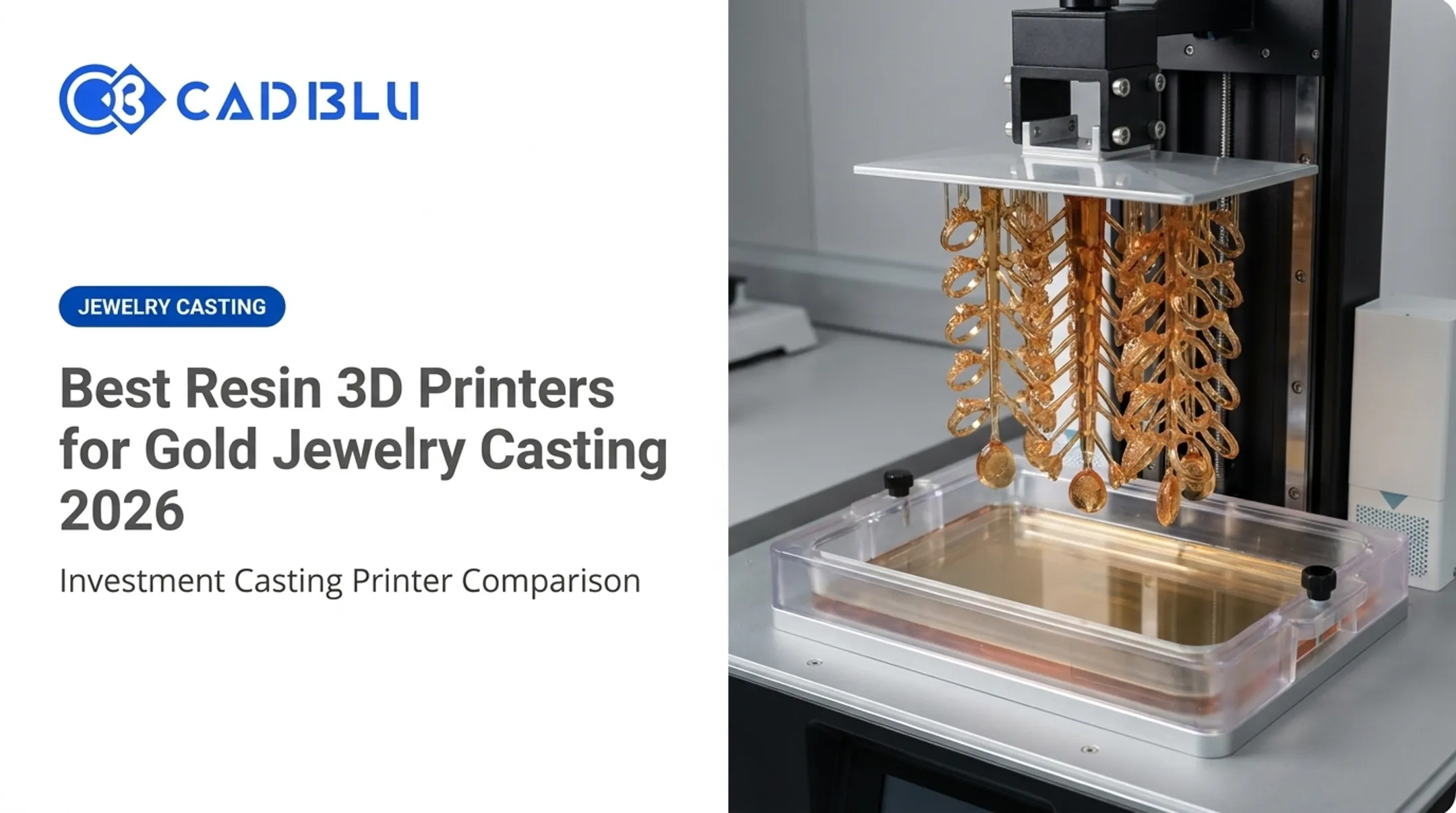
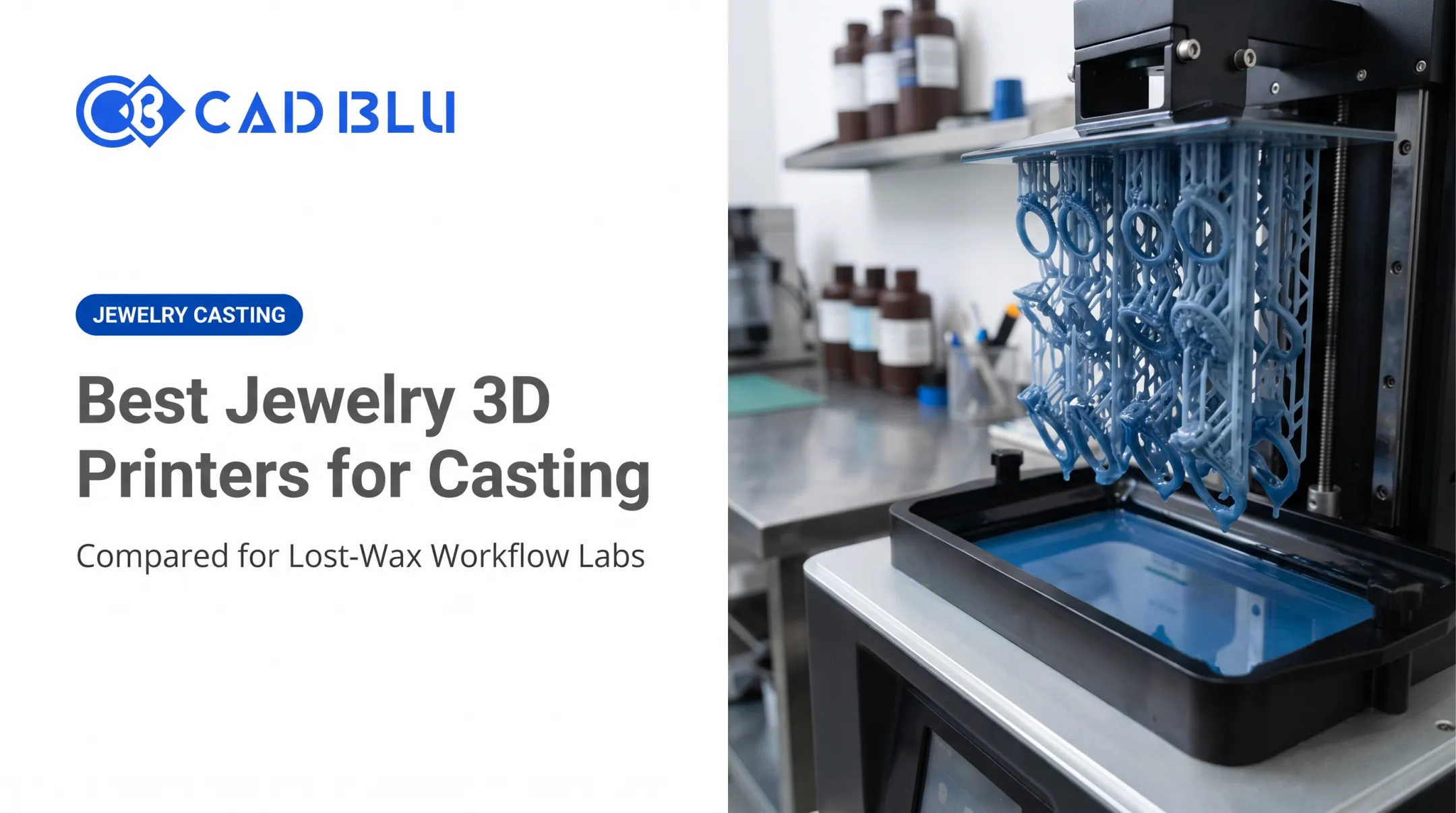
Jewelry casting, works like this: a CAD model gets printed as a castable pattern, invested in a mold, burned out or dissolved away, and replaced with molten precious metal.
That's different from printing a display prototype or attempting to print finished metal jewelry directly. Choosing the wrong equipment for the wrong stage is one of the most common mistakes new adopters make.
The Pattern-to-Metal Workflow
A typical jewelry casting workflow moves through these stages:
- CAD preparation - orient the model and add supports for printing
- Printing - the pattern builds layer by layer in resin or wax
- Washing and curing - removes uncured material and stabilizes the pattern
- Inspection and sprueing - checks for defects and attaches the pattern to a casting tree
- Investment and burnout - surrounds the pattern in plaster or investment slurry, then removes it with heat
- Casting and finishing - molten metal fills the cavity, then the piece is cleaned and polished

Comparing the Main Technologies
| Technology | How It Works | Best Suited For |
|---|---|---|
| SLA | Laser cures resin point by point | Professional detail work, smooth surfaces |
| DLP | Projector cures a full layer at once | Fast, consistent production runs |
| LCD/MSLA | Masked light source through an LCD screen | Lower-cost entry point, fine detail |
| Wax printing | Prints 100% wax directly | Dedicated casting-house workflows |
| Metal AM | Prints metal directly, no casting step | Separate investment category entirely |
Formlabs notes that DLP generally cures a layer's full cross-section at once, which can improve productivity, though resolution often decreases as build volume grows. LCD/MSLA systems use a similar masking principle but rely on an LCD screen, making them more affordable but more dependent on calibrated exposure settings.
Castable material data matters just as much as the printer itself. Not every resin labeled "castable" performs identically during burnout.
Stuller's guidance on investing and burnout notes that low-temperature wax removal typically runs 250-300°F for 1.5 to 3 hours. Full burnout commonly reaches 1,350°F and holds for 3-5 hours depending on flask size. Skip a manufacturer's documented burnout schedule, and you risk cracked investments or porous castings.
Top 5 3D Printers for Jewelry Casting
We evaluated each printer on castable-material compatibility, fine-detail performance, surface finish, dimensional consistency, production capacity, and total cost of ownership. Confirm current pricing and specs directly with the manufacturer before buying, since models and pricing change.
| Printer | Technology | Build Volume | Starting Price* | Best For |
|---|---|---|---|---|
| Formlabs Form 4 | MSLA (LFD) | 20 x 12.5 x 21 cm | $5,749 | Studios wanting an integrated ecosystem |
| Asiga MAX 2 | DLP | Up to 119 x 67 x 76 mm | Quote required | Repeatable small-batch production |
| DWS DW 029MKIII/HR | SLA laser | 170 x 170 x 200 mm | Quote required | High-value commercial work |
| Phrozen Sonic Mighty 8K | LCD/MSLA | 21.8 x 12.3 x 23.5 cm | $410 | Small studios, testing designs |
| Solidscape S3Duo | Wax DOD | 152.4 x 152.4 x 101.6 mm | Quote required | Established wax-pattern workflows |
*Prices reflect manufacturer listings at time of research and are subject to change.
Formlabs Form 4
The Form 4 uses Formlabs' Low Force Display technology, a form of MSLA designed to reduce peel forces during printing. Lower peel force helps produce smoother pattern surfaces and sharper fine jewelry detail.

Key specifications:
- 50 micron XY resolution, 25-200 micron layer thickness
- Build volume: 20.0 x 12.5 x 21.0 cm
- ±0.15% XY dimensional tolerance
- Complete Package price: $5,749 USD
Formlabs offers two relevant materials. Castable Wax Resin is 20% wax-filled, produces zero ash during burnout, and requires no post-curing, starting around $299 per liter. True Cast Resin targets intricate jewelry with recommended wall thicknesses between 500 microns and 5mm, reporting minimal shrinkage and just 0.03% ash.
This setup fits studios that want a supported ecosystem, repeatable workflows, and documented material profiles. The tradeoff is proprietary resin costs—and confirming your casting house's burnout schedule matches Formlabs' documentation.
Asiga MAX 2
The MAX 2 uses DLP with Asiga's SPS layer-formation technology and an auto-calibrating UV LED, listing "Jewellery" as a stated application category.
Key specifications:
- Pixel options: 50 or 62 microns
- Build volume: 96 x 54 x 76mm (50-micron) or 119 x 67 x 76mm (62-micron)
- Open Material Architecture supporting 650+ materials
- 385nm wavelength standard, 405nm available on request
Asiga's open architecture is the main advantage. Instead of locking into proprietary resin, studios can choose castable resins their casting partner already validates. That flexibility helps custom ring makers and small-batch producers keep dimensional control across varied designs.
No public U.S. price is listed, so plan on a direct quote. Before you buy, confirm burnout profiles for your resin, training availability, and replacement-part lead times with the reseller.
DWS DW 029MKIII/HR
The DW 029MKIII/HR is a laser SLA system built specifically for precision casting patterns rather than general-purpose prototyping. It uses DWS's Solid State BlueEdge laser with galvanometer scanning.
Key specifications:
- Build volume: 170 x 170 x 200mm
- HR resolution: 20 microns
- Tolerance down to 0.05mm
- Minimum feature thickness: 0.10mm on castable materials
DWS reports a 10% productivity gain over prior models. The machine is aimed at commercial production and high-value custom work, where repeatability can justify a higher acquisition cost.
No public U.S. price is listed, so expect a quote-based purchase. Weigh whether your volume truly needs this specialized system versus a general-purpose resin printer—for many low-volume designers, it is more machine than necessary.
Phrozen Sonic Mighty 8K (with Liqcreate Wax Castable)
The Sonic Mighty 8K is an LCD/MSLA printer, not a dedicated jewelry system. Paired with a validated castable resin, it becomes a practical lower-cost option for smaller studios.
Key specifications:
- 10.1-inch 8K monochrome LCD, 28 micron XY resolution
- Build volume: 21.8 x 12.3 x 23.5cm
- Printer price: $410; replacement LCD screen: $126
Liqcreate's Wax Castable resin works on open LCD/MSLA, DLP, and laser systems in the 385-420nm range. It reports clean, ash-free burnout at a recommended layer thickness of 0.05mm or lower on a calibrated printer.
Liqcreate documents average casting shrinkage of 2.62%, which matters for ring sizing. Skip compensation, and a ring can come out a full size smaller than designed.
This combo suits hobbyists and small studios testing designs before they scale. It is a weaker fit for production shops that need validated repeatability without careful calibration upfront.
Solidscape S3Duo
The S3Duo takes a different approach entirely. Instead of printing photopolymer resin, it prints 100% wax patterns directly using Drop-on-Demand technology with washable supports.
Key specifications:
- Build volume: 152.4 x 152.4 x 101.6mm
- Resolution: 5,000 x 5,000 dots per inch (X and Y)
- Accuracy: ±0.005 inch for the first inch, ±0.001 inch per additional inch
- Layer thickness: 0.00635-0.051mm (Advanced) or 0.0254-0.0508mm (Solidjet mode)
Direct wax printing removes a step some resin workflows require, since there's no photopolymer burnout chemistry to validate. This suits established jewelry manufacturers or casting operations that already run a dedicated wax pattern process and want to keep it.
Solidscape does not publish pricing publicly, so expect a reseller quote.
CAD BLU also carries 3D Systems' MJP 2500W, another direct-wax option that uses VisiJet M2 CAST and reportedly prints up to 25 rings in under three hours. Compare it with Solidscape's Muse and S3Duo lines based on your throughput needs.
How We Chose the Best 3D Printers
We built this comparison from manufacturer specifications, published material datasheets, and documented casting guidance. Brand reputation and headline resolution numbers did not drive the rankings.
Print Quality and Dimensional Accuracy
Advertised resolution isn't the same as usable casting detail. Vendors also measure accuracy differently, which makes side-by-side comparisons tricky:
- Formlabs Form 4: ±0.15% XY dimensional tolerance
- DWS DW 029MKIII/HR: tolerance down to 0.05mm
- Solidscape S3Duo: ±0.005 inch first inch, ±0.001 inch per additional inch
These numbers use different test conditions, so treat them as directional rather than directly comparable.
Casting Compatibility
We prioritized printers whose manufacturers publish a validated castable material and burnout schedule—often more important than the hardware itself. Factors that affect final casting quality include:
- Ash content after burnout
- Cracking risk during the kiln cycle
- Expansion behavior in the investment
A resin that's 20% wax-filled with zero ash, like Formlabs' Castable Wax, behaves very differently in a kiln than an unvalidated general-purpose resin.
Productivity and Total Ownership Cost
Purchase price is only part of the equation. A full cost picture includes:
- Resin or wax consumables
- Wash and cure equipment (IPA, UV curing stations)
- Replacement screens or resin tanks
- Support material removal labor
- Operator training and calibration time
For context, professional-tier systems like the 3D Systems MJP 300W Plus list around $64,700, while entry LCD printers like the Phrozen Sonic Mighty 8K start near $410. That gap reflects throughput, material ecosystem, and support—not hardware alone.

Business Fit and Support
Match the printer to your actual production needs, not aspirational ones. A hobbyist testing one-off designs doesn't need the same machine as a casting house running daily production batches. CAD BLU works with jewelry businesses across the U.S. to evaluate printers, materials, and software fit before purchase so shops size capacity to real production demand.
Common buying mistakes to avoid:
- Choosing FDM printers for intricate patterns without validating the workflow first
- Ignoring burnout requirements until after purchase
- Comparing only sticker prices, not total ownership cost
- Overlooking ventilation and post-processing space needs
- Skipping a test casting run with your actual casting house before committing to volume
Conclusion
The best 3D printer for jewelry casting depends on the full pattern-to-metal workflow. CAD design, material choice, supports, post-processing, investment, burnout, and finishing all have to work together.
If you need repeatable, detailed production, a professional resin or DLP system makes sense. For carefully validated lower-volume work, an LCD/MSLA setup can work well once you've tested the resin pairing. Established casting operations often stick with a dedicated wax printer for consistency.
Before you buy, lock in these checks:
- Request sample prints in your target castable material
- Calculate full cost of ownership, not just machine price
- Confirm resin or wax supply and service coverage with your reseller
CAD BLU works with U.S. jewelry businesses to evaluate 3D printing equipment, materials, workflow setup, training, and ongoing technical support based on actual production requirements. Contact the team to match a system to your studio's volume, castable materials, and budget.
Frequently Asked Questions
Which 3D printer is best for jewelry making?
It depends on whether you need design prototypes or castable patterns. High-detail resin printers (DLP, SLA, or LCD/MSLA) and dedicated wax systems all work when matched to your volume, material, and finishing workflow.
What 3D printer is best for jewelry casting?
The best option supports a validated castable resin or wax and matches your detail requirements, production volume, burnout process, budget, and casting-house specifications.
Can a 3D printer print jewelry?
Most jewelry 3D printers create plastic, resin, or wax patterns that get cast in metal afterward. Direct precious-metal printing requires specialized metal additive manufacturing equipment—a separate, higher-cost category.
How much does a gold 3D printer cost?
A printer that creates castable patterns typically runs $400–$70,000+. Specialized direct-metal equipment costs significantly more. Compare equipment, materials, post-processing, and service costs together.
What kind of jewelry can I make with a 3D printer?
Rings, pendants, earrings, bracelets, custom settings, and filigree work are all common. Wall thickness, supports, material choice, and casting process determine what actually survives the pattern-to-metal journey.