Introduction
Choosing a flexible denture material for 3D printing isn't just about picking the softest resin on the shelf. The material also has to survive the print, the post-cure, and years of chewing forces in a patient's mouth.
Digital workflows are changing how US dental labs approach removable prosthetics.
A 2022 NADL survey found that in-house 3D-printer adoption among dental labs rose from 11% in 2014 to 62% by 2022, according to a report published by Carbon on the NADL Dental Technology Survey. That growth comes from repeatable results, digital case records, and fewer manual fabrication steps.
This article breaks down the main flexible material categories and explains the difference between directly printable resins and thermoplastics that still require injection or milling. It also outlines how to vet a validated material-printer workflow before you commit.
Key Takeaways
- Flexible denture material spans several distinct categories, not one product type
- Manufacturer-validated indications matter more than general flexibility claims
- Compare mechanical data, printability, repairability, and regulatory docs before buying
- CAD BLU helps labs match printers, materials, software, and support to denture workflows
What Flexible Denture Material Means for Digital 3D Printing
A flexible denture material is a polymer or thermoplastic that bends under load where rigid acrylic or metal would not. Labs use it when a removable appliance needs controlled give, resilience, or patient comfort.
"Flexible" is not one property. These terms get mixed together in practice:
- Flexibility – how much the material deforms under load
- Elasticity – whether it returns to its original shape after that load is removed
- Hardness – resistance to surface indentation
- Toughness – resistance to fracture, meaning how much energy it absorbs before breaking
- Rigidity – resistance to bending in the first place, tied to elastic modulus
Nylon-based denture materials, for example, often show relatively low modulus and rigidity, yet still deliver high toughness and fracture resistance. A material can flex easily and still be a poor choice for a full denture base if it lacks dimensional stability.

One manufacturing distinction matters early. Some flexible resins are formulated to be directly 3D printed layer by layer. Others, including many familiar nylon-based systems, are conventional thermoplastics that still require injection molding, milling, or another non-printing process. Confusing the two leads to failed prints and wasted material.
In digital dentistry, flexible materials commonly show up in:
- Selected partial-denture components
- Flexible clasps
- Soft or resilient liner components
- Provisional appliances
- Hybrid designs combining flexible and rigid elements
Always confirm the manufacturer's intended use for each specific application. A resin cleared for a flexible partial base isn't automatically approved for a soft liner or a definitive full denture.
Why Material Choice Matters in Digital Denture Production
Material choice drives clinical outcomes: fit, retention, occlusal stability, comfort, aesthetics, fracture resistance, and how consistently a lab can reproduce an approved design.
Picking a material based on flexibility alone tends to backfire. Common issues include:
- Distortion during printing or post-curing
- Inadequate support under load
- Poor surface finish or difficult insertion
- Bacterial retention on rough or porous surfaces
- Premature wear or an appliance that's hard to repair or reline
A 2024 literature review on flexible dentures notes that thermoplastic polyamide materials tend to show greater distortion than PMMA and are notably difficult to repair or reline, according to Binaljadm et al.'s 2024 review in the National Library of Medicine. Match each resin to its cleared indication and verify claims against manufacturer documentation and peer-reviewed data—not marketing copy.
Flexible Denture Material Options
There's no single "best" flexible material. The right choice depends on the appliance, the patient, the printer, the processing method, and the expected service life. The main categories compare as follows.
Flexible Photopolymer Resins
These resins cure layer by layer in a resin-based 3D printer, typically under a specific light wavelength. Before adopting one, research:
- Shore hardness and elongation at break
- Tear strength and flexural behavior
- Water sorption and dimensional stability
- Post-cure requirements
Photocentric Dental Flexible, for instance, is documented at 4.9 MPa tensile strength and 40% elongation at break, and it has passed initial biocompatibility testing.
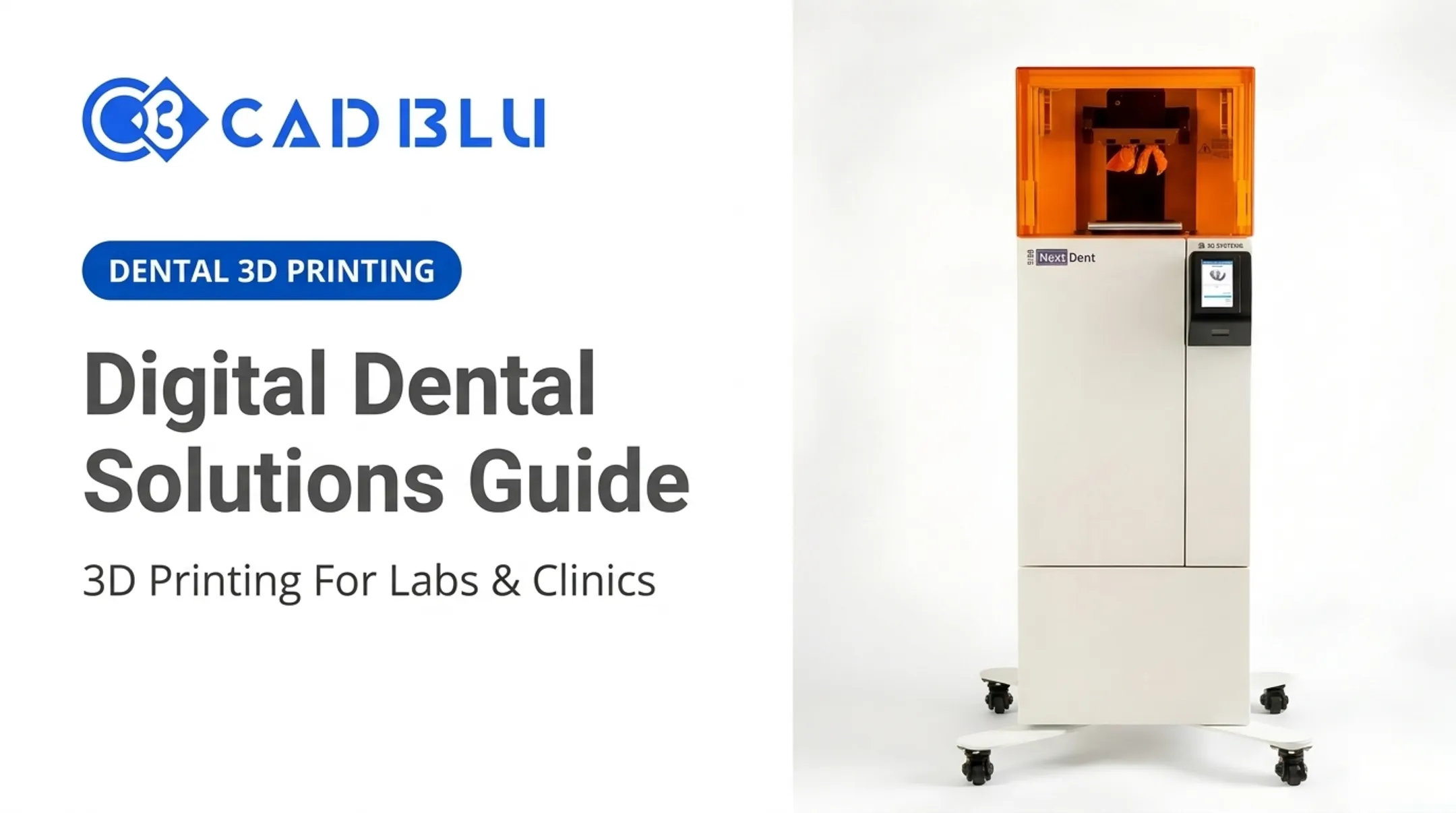
NextDent DENTURE 3D+ (3D Systems) is a Class IIa biocompatible resin for removable denture bases. It comes in five shades and shows lower shrinkage than standard PMMA, so compatible software can compensate for a better fit.
Other systems worth checking against manufacturer data:
- Figure 4 FLEX-BLK 10 — polypropylene-like flexible photopolymer; 104% elongation at break, 76D hardness
- Figure 4 ELAST-BLK 10 — elastomer photopolymer; 65A Shore hardness, 83% elongation
Verify biocompatibility documentation, the supported printer model, layer thickness, wash-and-cure procedure, and whether the finished part is cleared for prolonged intraoral contact. Flexible resins support fast digital production and complex geometry, but they're also more sensitive to orientation, support placement, and washing than rigid denture-base materials.

Printable Thermoplastic or Filament-Based Systems
Thermoplastic filament systems are heated and deposited layer by layer, which means processing temperature, moisture control, nozzle settings, and cooling behavior all shape the final part.
Not every thermoplastic filament is dental-grade. Equipment such as the ARGO 500 (extrudes up to 500°F; supports functional nylon and flex-TPU) shows what filament printers can handle. Still, confirm any nylon or polyolefin filament is validated for dental use before treating it as interchangeable with injection-molded flexible denture nylon.
Strengths worth confirming with data:
- Toughness and reduced brittleness
- Lightweight, metal-free aesthetics
- Potential for reduced material waste
Limitations to plan around:
- Surface roughness that varies with print speed and layer thickness
- Anisotropic strength depending on print orientation
- Difficulty forming fine clasp geometry
- Added challenges with adjustment, repair, or reline
Semi-Flexible Polymers and Acetal-Type Materials
Acetal (POM) sits between highly flexible nylon-like materials and rigid acrylic or metal frameworks. Dental acetal discs are typically CAD/CAM milled, not printed, with reported specs around 60 MPa tensile strength and 2,800-3,200 MPa elastic modulus.
That stiffness has trade-offs. A finite element analysis comparing clasp materials found acetal's modeled retentive force at roughly 0.02 N versus 2 N for cobalt-chromium. Acetal clasps typically need thicker, shorter designs and deeper undercuts to compensate.
Semi-flexible options make sense when a case needs more support or controlled clasping than a fully flexible base can provide. Always request manufacturer or lab data before comparing wear resistance across categories.
Hybrid Material and Multi-Component Designs
Hybrid dentures pair a flexible component with a rigid or aesthetic one to balance comfort against support. In flexible bases, denture teeth typically aren't chemically bonded to the resin; retention comes from mechanical features like T-shaped diatoric holes that let the flexible material flow around the tooth.
Before recommending a hybrid design, check:
- Bonding or mechanical integration between components
- Differences in wear and water absorption between materials
- Whether each component carries a compatible clinical and regulatory indication
Justify any hybrid recommendation with lab protocols or clinical literature—combining materials does not automatically improve performance.
Conventional Flexible Thermoplastics Used Alongside Digital Workflows
Named systems such as Valplast, DuraFlex, and various TCS nylon and acetal products remain common in removable prosthodontics. Most require injection or another non-printing process rather than direct 3D printing.
Valplast's system, for example, uses an injection press and digital furnace. Its published workflow lets dentists submit digital case files through an online portal, but the final part is still injection molded. That's a hybrid digital-to-injection workflow, not direct printing.
Comparing the two approaches:
| Factor | Direct 3D Printing | Digital Design + Injection/Milling |
|---|---|---|
| Equipment | Resin printer, cure unit | Injection press, flask, furnace |
| Repeatability | High, file-based | Moderate, technique-sensitive |
| Turnaround | Faster for batches | Slower, manual steps involved |
| Record keeping | Digital file archive | Digital design + physical process log |
Always check current technical documentation before naming or recommending any branded material category, since formulations and indications change.
How to Choose the Right Material
The right material comes down to clinical indication and validated workflow fit, not flexibility, popularity, or the lowest price per kilogram.
Intended Appliance and Clinical Requirements
Start by identifying the exact use case: flexible partial, definitive base, provisional, soft component, clasp, repair, or hybrid. Then assess:
- Span length and abutment support
- Occlusion and any parafunction (grinding, clenching)
- Ridge anatomy, insertion path, and tissue condition
- Aesthetic expectations
Long-span cases, distal extensions, high-load situations, unstable abutments, severe bruxism, and hard-to-clean designs are poor fits for a fully flexible base. Those cases usually need a more rigid, metal, milled, or hybrid alternative.
Mechanical and Intraoral Performance
Compare flexural strength, modulus, elongation, impact resistance, fatigue behavior, wear, and water absorption. FDA-recognized ISO 20795-1 testing sets minimum flexural strength at 65 MPa and flexural modulus at 2,000 MPa for most denture-base resin types, per FDA's Denture Base Resins performance criteria. These numbers affect daily insertion, chewing loads, clasp retention, and long-term maintenance.
Separate lab test values from real clinical outcomes. When citing any mechanical figure, note the test method, sample condition, and source, whether that's the manufacturer or an independent study.
Printer, Software, and Processing Compatibility
Build a checklist before committing to any material:
- Printer resolution and build volume – confirm the part fits and prints at required detail
- Wavelength or extrusion system – match to the resin or filament's requirements
- Layer thickness and orientation – verify against manufacturer recommendations
- Support strategy and nesting – check slicing software compatibility
- Wash, cure, and post-processing – confirm equipment and timing

Approval for one printer or cure protocol doesn't automatically transfer to another. Systems like the NextDent 5100, which pairs a documented material portfolio with 3D Sprint software and traceable batch data, show what a validated end-to-end workflow looks like.
Document print parameters, lot information, and remake rates so successful cases can be reproduced.
Regulatory, Safety, and Documentation Requirements
Confirm the material's intended intraoral use, biocompatibility documentation, safety data sheet, instructions for use, and applicable FDA clearance.
Terms like "BPA-free," "biocompatible," or "dental-grade" aren't substitutes for product-specific evidence. For example, Detax's Freeprint denture flex resin received FDA 510(k) clearance in 2025 specifically for additively manufactured flexible partial dentures, per FDA's clearance letter, a level of specificity generic marketing language can't provide.
Track traceability, lot control, expiration dates, storage conditions, and patient-specific records as part of routine documentation.
Total Cost and Long-Term Serviceability
Price per milliliter or kilogram is only part of the equation. Factor in:
- Printer utilization and support structures
- Failed prints, washing, and curing time
- Labor and finishing
- Equipment maintenance and remakes
- Shipping and staff training
Also weigh whether the finished appliance can be adjusted, repaired, relined, or have teeth added. Limited serviceability drives up total cost of ownership over the appliance's life.
Installation support, training, and OEM-trained technical service reduce the friction of bringing a new material or printer online. CAD BLU provides that support for labs building out validated dental workflows.
What to Check Before Finalising a Material
What to Check Before Finalizing a Material
Don't select a material just because it's marketed as flexible, strong, or "unbreakable." Verify the specific appliance indication, clinical evidence, and complete processing instructions first.
Post-processing steps deserve equal attention, since they can shift flexibility, surface quality, color, and dimensional accuracy:
- Washing and drying
- Curing
- Support removal and polishing
- Conditioning and inspection
Before offering a new material routinely, confirm your lab can manage fit verification, quality control, cleaning instructions, repairs, relines, remakes, and follow-up.
Quick pre-purchase checklist:
- Regulatory documentation and FDA clearance status
- Printer and software compatibility
- Validated print parameters
- Mechanical performance data
- Biocompatibility evidence
- Surface finish quality
- Serviceability (repair, reline, rebase)
- Supplier support and training
- Total workflow cost, not just material price
Conclusion
Flexible denture materials for digital 3D printing fall into several distinct categories:
- Flexible photopolymer resins
- Printable thermoplastics
- Semi-flexible acetal-type polymers
- Hybrid designs
- Conventional thermoplastics that still rely on injection or milling
Directly printable materials and conventionally processed flexible thermoplastics aren't interchangeable. Treating them as such leads to workflow failures.
The best selection balances:
- Clinical indication and patient needs
- Mechanical performance and serviceability
- Print-and-post-process reliability
- Regulatory evidence
- Total cost
Consult qualified dental-material and equipment specialists—such as CAD BLU’s materials and workflow team—before rolling a new material into production.
Frequently Asked Questions
What is the best type of flexible denture?
The best type depends on the patient's clinical situation, the appliance's purpose, the material's validated indication, and the retention, support, and aesthetics required.
How do flexible dentures stay in your mouth?
Retention comes from anatomy, clasp or retentive design, tissue adaptation, remaining teeth, and insertion path, not from flexibility alone. Professional design and fit matter more than the base material's softness.
How long do flexible partial dentures typically last?
Service life varies with material, design, occlusion, hygiene, and repairability. Published evidence on nylon-based partials remains limited to case reports and small studies, so ask your lab or manufacturer for specific guidance.
Can flexible dentures be 3D printed?
Some flexible resins and thermoplastic systems are directly printable, while conventional flexible materials often still require injection molding or another process. Always verify the manufacturer's approved workflow.
What materials are used for 3D printed dentures?
Categories include denture-base resins, tooth resins, flexible or resilient photopolymers, printable thermoplastics, and hybrid systems. Material choice should always follow the appliance's intended use and regulatory clearance.
Are flexible 3D printed denture materials safe for long-term use?
Long-term safety depends on product-specific biocompatibility evidence, FDA clearance, correct printing and post-curing, and proper cleaning within manufacturer instructions. Rely on a professional dental evaluation rather than generalizing across materials.