Introduction
Jewelry businesses used to wait days for a wax model or a hand-carved master pattern. Now, a CAD file can become a physical prototype, a castable pattern, or a customer-approval sample in hours. That shift is why resin 3D printing has become standard equipment in casting houses and design studios alike.
But "best printer" isn't a fixed answer. A studio validating prototypes for customer sign-off has different needs than a casting house running trees of rings every night. Resolution matters, but so does resin compatibility, dimensional consistency, and total workflow cost.
This guide compares five resin printer platforms worth investigating for jewelry work. We'll look at resolution, build volume, resin compatibility, workflow requirements, and support, so you can match a platform to your actual production needs rather than a spec sheet.
Key Takeaways
- Fine detail reproduction (prongs, pavé, engravings) is achievable on most modern resin printers, but casting compatibility isn't automatic.
- Validated exposure profiles and Z-axis stability matter more than raw resolution numbers.
- Desktop printers suit prototyping; production studios need repeatability, automation, and service support.
- Total cost includes resin, wash-and-cure gear, ventilation, and failed prints, not just the printer price.
- A specialist supplier like CAD BLU can help evaluate printers, materials, and installation before you buy.
Overview of Resin 3D Printing in the Jewelry Industry
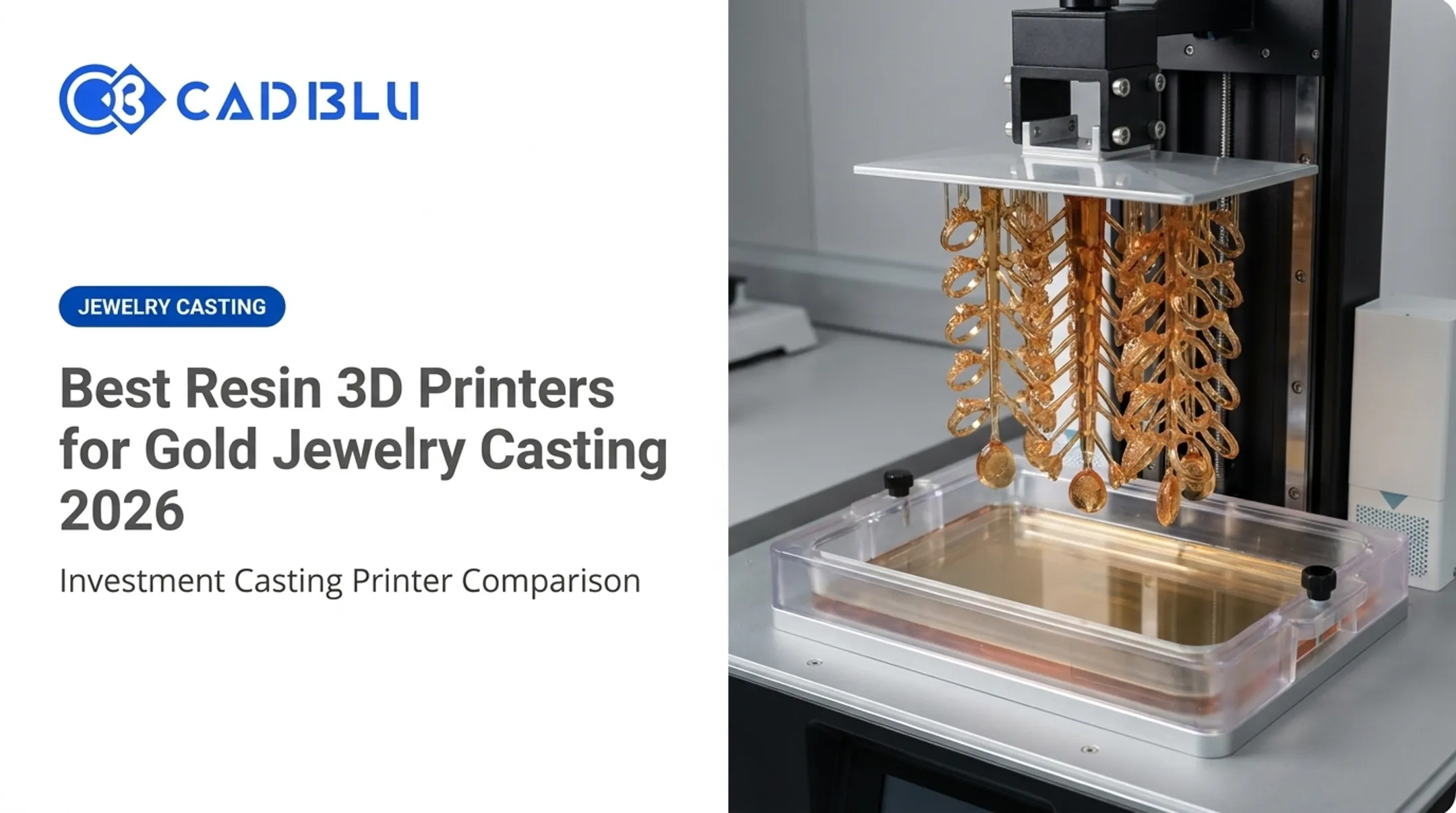
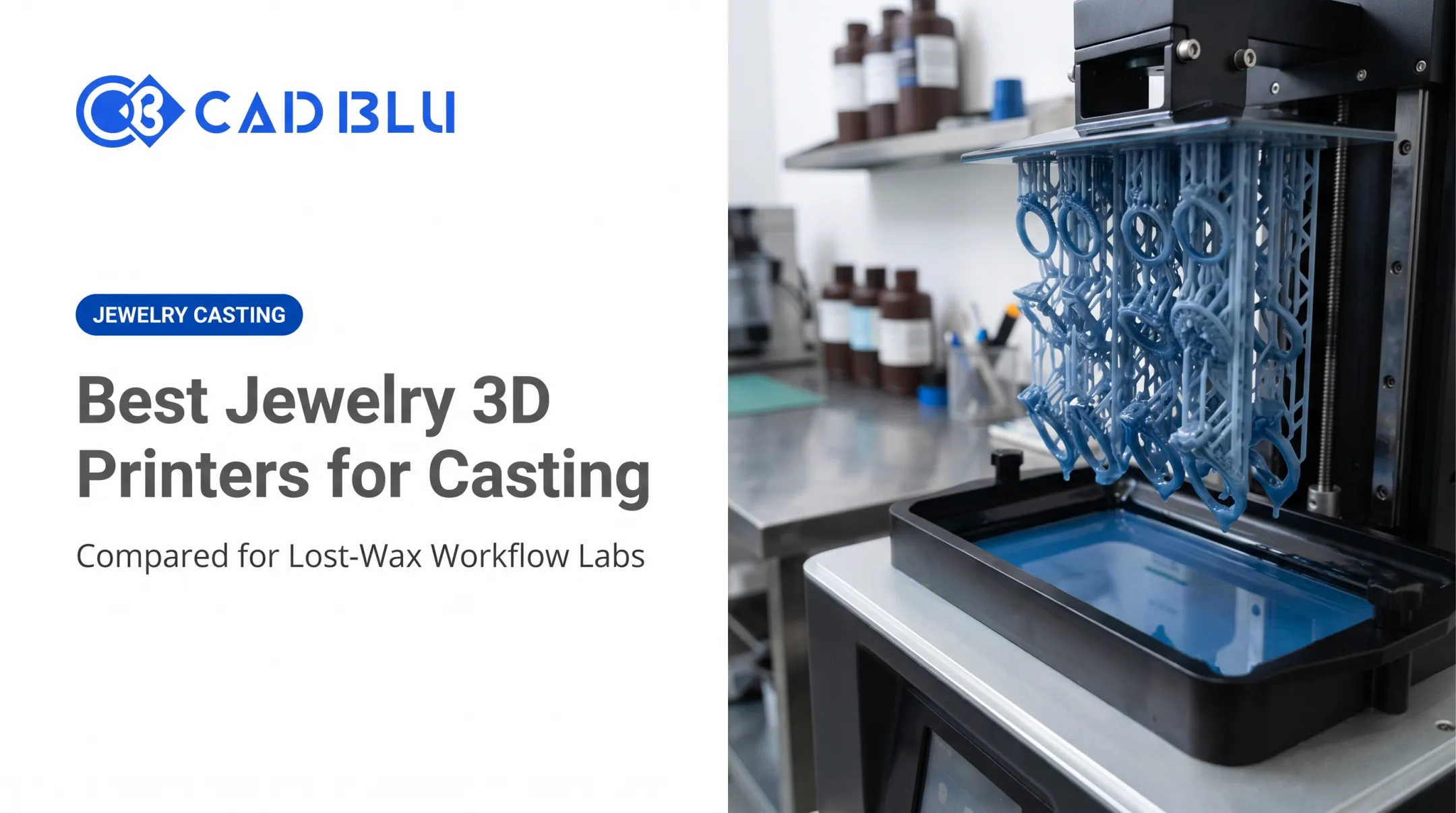
Resin 3D printing, technically called vat photopolymerization, uses UV light to selectively cure liquid resin layer by layer. The result: intricate jewelry geometries built directly from CAD files, without tooling.
Common jewelry applications include:
- Design validation and customer-approval samples
- Custom-fit pieces built from scanned measurements
- Master patterns for mold-making
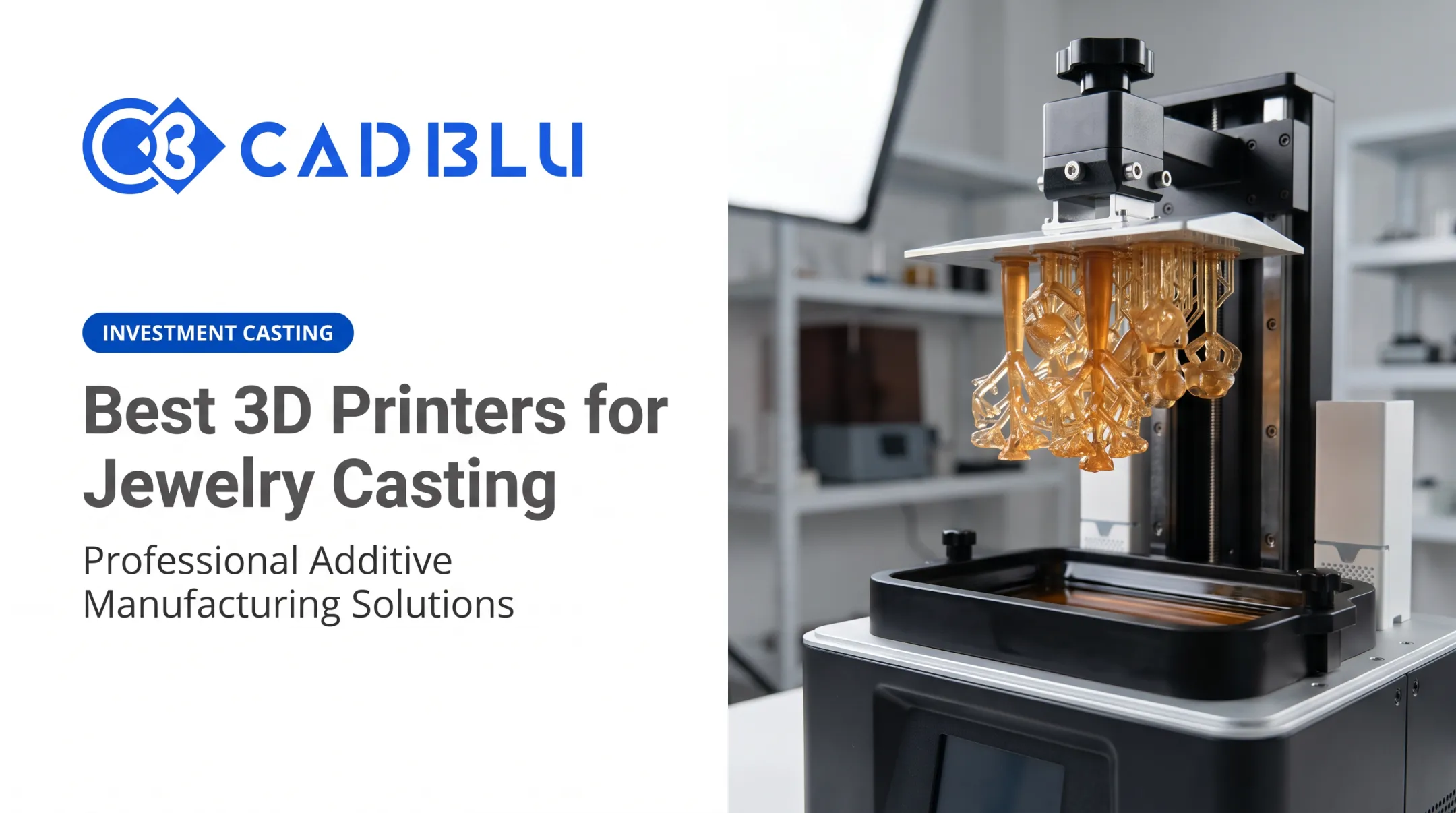
- Investment-casting patterns printed directly in castable resin
- Small-batch production runs
- Prototyping complex settings, filigree, or mesh hand-carving can't easily match
The category is growing fast. Grand View Research estimates the global 3D-printed jewelry market at $1.2 billion in 2025, forecasting $5.1 billion by 2033, a 19.9% compound annual growth rate. That figure tracks finished jewelry, not printer sales—but it still points to real demand for the workflow.
Not All Resins Are Created Equal
Choosing a printer means choosing a resin ecosystem too. The categories differ significantly:
| Resin type | What it's for | Key detail |
|---|---|---|
| Standard/model | Prototypes, display pieces | Not formulated for burnout |
| Castable/wax-filled | Direct investment casting | ~20% wax; zero ash after burnout (Formlabs Castable Wax) |
| Wax-filled for fine detail | Intricate settings up to 5mm | Clean burnout, minimal residue |
| Tough/engineering | Fit and function testing | Not a casting material |
Resin chemistry alone doesn't guarantee clean casting. You still need to validate the full stack—printer, exposure profile, investment material, and burnout schedule. A resin that casts cleanly on one machine can fail on another with different light uniformity or layer settings.

Next: how five printer platforms compare for jewelry work.
Best Resin 3D Printers for Jewelry
This is a comparison of platforms built around different priorities, not a single ranked winner. Specifications, pricing, and resin compatibility change often, so verify current details directly with the manufacturer before purchasing.
Formlabs Form 4
Formlabs positions the Form 4 as a jewelry-capable printer, pairing it with a dedicated materials lineup: Castable Wax, True Cast, and Castable Wax 40. The printer uses Formlabs' Low Force Display process rather than a standard LCD engine, for more consistent light exposure across the build plate.
What to evaluate:
- Print quality and repeatability across full builds
- PreForm software's support generation and editable printability settings
- Wash-and-cure integration (Form Wash, Form Cure)
- True Cast's suitability for intricate detail up to 5mm
Compact specs:
- Intended use: Prototypes, master models, castable patterns
- Build volume: 200 x 125 x 210 mm; layer range 25-200 µm; XY resolution 50 µm; dimensional tolerance of ±0.15% XY
- Price and service: Form 4 Basic Package listed at $2,625; service plans available up to five years, starting at $599
Formlabs reports 98.7% print success in independent testing, though that figure isn't jewelry-specific. Castable Wax's minimum layer height (25 µm) is worth checking against your finest detail requirements.
Asiga MAX 2
Asiga takes a different approach: open material strategy over a closed ecosystem. The MAX 2 uses DLP projection with 50 µm or 62 µm pixel configurations, and Asiga states compatibility with more than 650 third-party materials.
That openness matters for casting houses that want to test multiple castable resins without being locked to one brand's chemistry.
What to evaluate:
- Pixel size versus your build volume needs (smaller pixels, smaller build area)
- Auto-calibrating UV LED and integrated radiometer for consistent output
- SPS layer-thickness control for repeatability across production runs
- Whether your chosen resin has a validated print profile on this specific platform
Compact specs:
- Intended use: Detailed prototypes, castable patterns, repeatable production
- Build volume: 96 x 54 x 76 mm (50 µm) or 119 x 67 x 76 mm (62 µm)
- Support and files: 12-month warranty, unlimited lifetime technical support, STL/SLC/PLY/STM file compatibility, Wi-Fi and Ethernet connectivity
Current US pricing and a manufacturer-named jewelry castable resin weren't confirmed in official current documentation, so budget conversations should happen directly with an Asiga-authorized reseller.
Nova3D GEM3 Max
The GEM3 Max targets studios wanting a larger build area without sacrificing fine detail. Nova3D names three castable materials directly on its product page: Precision Cast, Hi-Wax Cast, and Filigree Cast.
What to evaluate:
- Whether the full build plate delivers consistent light uniformity, not just the center
- Z-axis rigidity during longer, taller prints
- Heating consistency (the manual identifies 30°C / 86°F as ideal operating temperature)
- Slicer compatibility with your existing workflow
Compact specs:
- Intended use: Castable-resin workflows, larger batch prototyping
- Build volume: 211 x 118 x 120 mm; resolution 15120 x 6230; pixel size 14 x 19 µm; layer thickness 20-200 µm
- Software and price: Compatible with NovaMaker, CHITUBOX, Tango, and Lychee; officially listed between $1,599 (sale) and $1,899 (regular)
A GEM3 Max-specific calibration system wasn't documented in reviewed manufacturer sources, so ask directly about factory calibration procedures before buying.
HeyGears Ultracraft Reflex (or Reflex RS)
HeyGears leans into automation. Automatic resin refill, auto zeroing, assisted leveling, and release-film monitoring reduce the manual babysitting that resin printing often requires.
The company names PAC10 Wax Casting Resin specifically for lost-wax casting, paired with PAM10 Design Resin for prototyping.
What to evaluate:
- Whether automation features actually reduce failed prints in your workflow, not just labor
- Light uniformity (the original Reflex reports at least 94%)
- Proprietary-material costs versus open-material flexibility
- The newer Reflex RS's tighter tolerances if repeatability is critical
Compact specs:
- Intended use: Fine prototypes, customized jewelry, small-batch production
- Original Reflex: 192 x 121 mm screen, 5760 x 3600 resolution, 30 µm layer thickness, COB light source
- Reflex RS: 222 x 122 x 228 mm build volume, 29.7 µm native XY, ±15 µm accuracy, 30-100 µm layers
- Price and warranty: Listed at $1,399 (sometimes discounted), 14-day refund window, one-year warranty
Build volume and print speed for the original Reflex weren't confirmed in current official specs, so the RS variant is the clearer option to compare on published specs.
Phrozen Sonic Mini 8K S / Mighty 8K
Phrozen's 8K lineup targets desktop users who want high pixel density without professional-tier pricing. The Mighty 8K, in particular, offers a larger build volume than the Mini 8K S while keeping a similar resolution class.
What to evaluate:
- Whether desktop-level calibration and support design are workable for your team
- Ventilation and post-processing setup, since these platforms require more hands-on operation
- Jewelry-specific casting validation, since neither model has a confirmed manufacturer-named castable resin qualification
- Print-plate consistency across larger builds
Compact specs:
- Mini 8K S: 165 x 72 x 170 mm build volume; 22 µm precision; layer height 0.01-0.30 mm
- Mighty 8K: 218 x 123 x 235 mm build volume; 28 µm 10.1-inch 8K mono LCD; max speed 70 mm/h
- Warranty: Three months on the mono-LCD, twelve months on LED module, build plate, Z-axis, resin vat, and body (excludes FEP/PFA/ACF films)
These platforms may work well for design validation and small studios, but expect more manual calibration and experimentation before castable results are reliable.
Which Platform Fits Which Buyer?
- Beginner or small-studio prototyping: Phrozen's 8K lineup offers detail at a lower entry point, with more hands-on setup
- Small jewelry studio: Formlabs Form 4 or Nova3D GEM3 Max, for balance between ecosystem support and price
- Casting-focused workflow: Formlabs (named castable materials) or Asiga (open-material validation)
- Professional production: Asiga MAX 2 or HeyGears Reflex RS, for repeatability and automation
None of these is a universal winner. The right pick depends on your build volume needs, resin strategy, and how much operator time you want to spend on calibration versus production.

How We Chose the Best Resin 3D Printers
Resolution and print speed are the numbers manufacturers lead with, but they're not the whole story. A printer with a tiny pixel size still fails jewelry buyers if it can't hold calibration across a full build plate, or if no castable resin has a validated profile for it.
Evaluating Print Performance
We looked past marketing claims and focused on jewelry-relevant results:
- Fine features: Prongs, pavé settings, thin walls, and engravings are the real test—brand claims (such as Formlabs' True Cast detail rating) help, but they aren't cross-brand tests.
- Dimensional accuracy: Specs like Form 4's ±0.15% XY tolerance or the Reflex RS's ±15 µm accuracy use different test methods, so they aren't a direct ranking.
- Resin validation: A 405nm resin isn't automatically compatible with every printer—casting success depends on exposure profile, wax content, and burnout schedule together.
Evaluating Production Fit and Cost
Print quality alone doesn't determine whether a platform works for your business. Consider:
- Batch capacity and how often failed prints interrupt production
- Wash-and-cure time per build (Form Wash V2 at $699; Form Cure V2 at $999)
- Ventilation, PPE, and hazardous-waste handling for resin and solvents
- Software licensing and slicer compatibility with your existing files
The largest recurring costs aren't the printer itself. They're resin usage, failed patterns, consumables like release films and filters, and casting-validation time.
Manufacturer documentation, warranty terms, and access to trained repair technicians matter as much as the spec sheet. That is where an experienced implementation partner earns its value.
CAD BLU, for example, works with OEM-trained technicians and jewelry-focused materials—including castable and wax-filled resins and platforms like the Figure 4 Jewelry system—so shops can compare printers, validate casting workflows, and secure installation and repair support before committing capital.
Conclusion
There's no single "best" resin printer for jewelry. The right choice depends on your required detail level, casting process, production volume, material strategy, and operator experience, not just whichever printer has the highest advertised resolution.
Before you buy, test your own files against real production geometry:
- Print delicate prongs, thin sections, and engraved surfaces in your intended resin
- Run a full burnout and casting cycle if the workflow requires it
- Treat page specs as a baseline; they often fail on actual jewelry geometry
If you're comparing commercial 3D printers, materials, or workflow options for jewelry production, CAD BLU works with businesses across the United States and internationally on printer selection, installation, training, repair, and ongoing workflow support.
Frequently Asked Questions
Can I 3D print jewelry with a resin printer?
Yes. Resin printers can produce jewelry prototypes, master patterns, and some castable patterns. But the resin, exposure profile, supports, and post-processing all need to match your intended casting or production outcome.
What type of resin is best for jewelry making?
It depends on the piece's purpose. Standard resin suits display prototypes, while castable, wax-filled, or burnout resins are formulated specifically for investment casting. Tough or engineering resins are meant for fit-testing, not casting.
What resolution should a resin 3D printer have for jewelry?
Pixel size and layer height are useful starting indicators, but they don't guarantee quality alone. Optical uniformity, Z-axis stability, calibration, and a validated resin profile matter just as much as the numbers on a spec sheet.
Is a castable resin printer different from a regular resin 3D printer?
The hardware is often similar, but castable workflows require a validated resin profile, reliable exposure control, and a compatible burnout and investment process. A printer without those validations can still print, but casting results may be unreliable.
What else do I need besides a resin 3D printer for jewelry?
You'll need CAD and slicing software, jewelry-compatible resin, wash-and-cure equipment, ventilation, and PPE. For casting workflows, add investment material, a burnout oven, and casting equipment, or a qualified casting partner.
How do I choose between a desktop and professional resin printer?
Desktop printers cost less upfront but need more hands-on calibration and support design. Professional platforms cost more but offer repeatability, batch capacity, automation, and service support suited to consistent production output.