This guide is written for jewelry businesses, dental labs, foundries, engineers, and manufacturers across the US evaluating investment casting for parts with fine detail or complex geometry. It's a process most people have heard of, but far fewer understand at the level needed to actually run a production floor or vet a supplier.
The global investment casting market is projected to grow from $18.45 billion in 2026 to $23.82 billion by 2031, a 5.24% CAGR, according to Grand View Research's 2026 industry analysis. That growth reflects real demand across aerospace, automotive, medical, dental, and jewelry manufacturing.
We'll cover the process stages, material choices, common applications, accuracy realities, and situations where lost wax casting isn't the right call.
Key Takeaways
- Lost wax casting and investment casting name the same process: build a pattern, invest it, burn it out, then pour metal.
- Results hinge on pattern quality, gating design, shell integrity, and burnout, not just the pour itself.
- CAD and 3D-printed patterns can replace hand-carved wax without changing the investment workflow.
- The right process depends on geometry, volume, alloy, and finish requirements, not habit.
What Is Lost Wax Casting and Why Is It Used?
What Is Lost Wax Casting?
Lost wax casting and investment casting refer to the same core method, just from two different angles. "Lost wax" describes what happens to the pattern: it gets melted or burned away. "Investment casting" describes what surrounds it, a refractory material that "invests" the pattern before it disappears.
The goal is simple: take a detailed positive pattern and turn it into a metal part by forming a negative cavity around it, then filling that cavity with molten metal.
There are two ways to get that pattern:
- Direct pattern: A single wax or castable pattern, hand-carved, 3D-printed, or machined, gets invested and burned out once.
- Indirect pattern: A master pattern is used to create a die or reusable mold that produces multiple wax patterns for the same design.
Jewelry manufacturers and foundries running repeat production tend to lean on indirect workflows. One-off prototypes or short runs usually go direct.
Why Is the Process Used?
Investment casting exists because some geometries are hard, or impossible, to machine or forge economically. Thin walls, internal channels, undercuts, and fine surface texture come out of the mold nearly finished.
Common reasons manufacturers choose it:
- Complex geometry without multi-axis machining or assembling separate pieces
- Dimensional consistency across repeat runs once the pattern process is locked in
- Reduced material waste compared to machining from solid stock
- Alloy flexibility, including specialty alloys that are difficult to machine or forge
According to the Investment Casting Institute, aerospace and defense, power generation, automotive, oil and gas, and medical devices are among the industries built on this process. The organization cites surface finish, alloy range, and near-net geometry as the core benefits.
Skip a proper investment-casting workflow and the alternative isn't pretty. Expect more machining hours, extra assembly steps to fake geometry that should have been cast as one piece, inconsistent patterns run to run, and higher tooling and labor costs overall.
How the Investment Casting Process Works and Where It Is Applied
The End-to-End Process
The Investment Casting Institute breaks the shop-floor process into eight stages. Here's what happens at each one, and what actually affects the outcome.
- Design the part. Whether it starts as a hand-carved master, a CAD model, scanned geometry, or a wax die, the design has to account for metal shrinkage, support structures, and gating allowances.
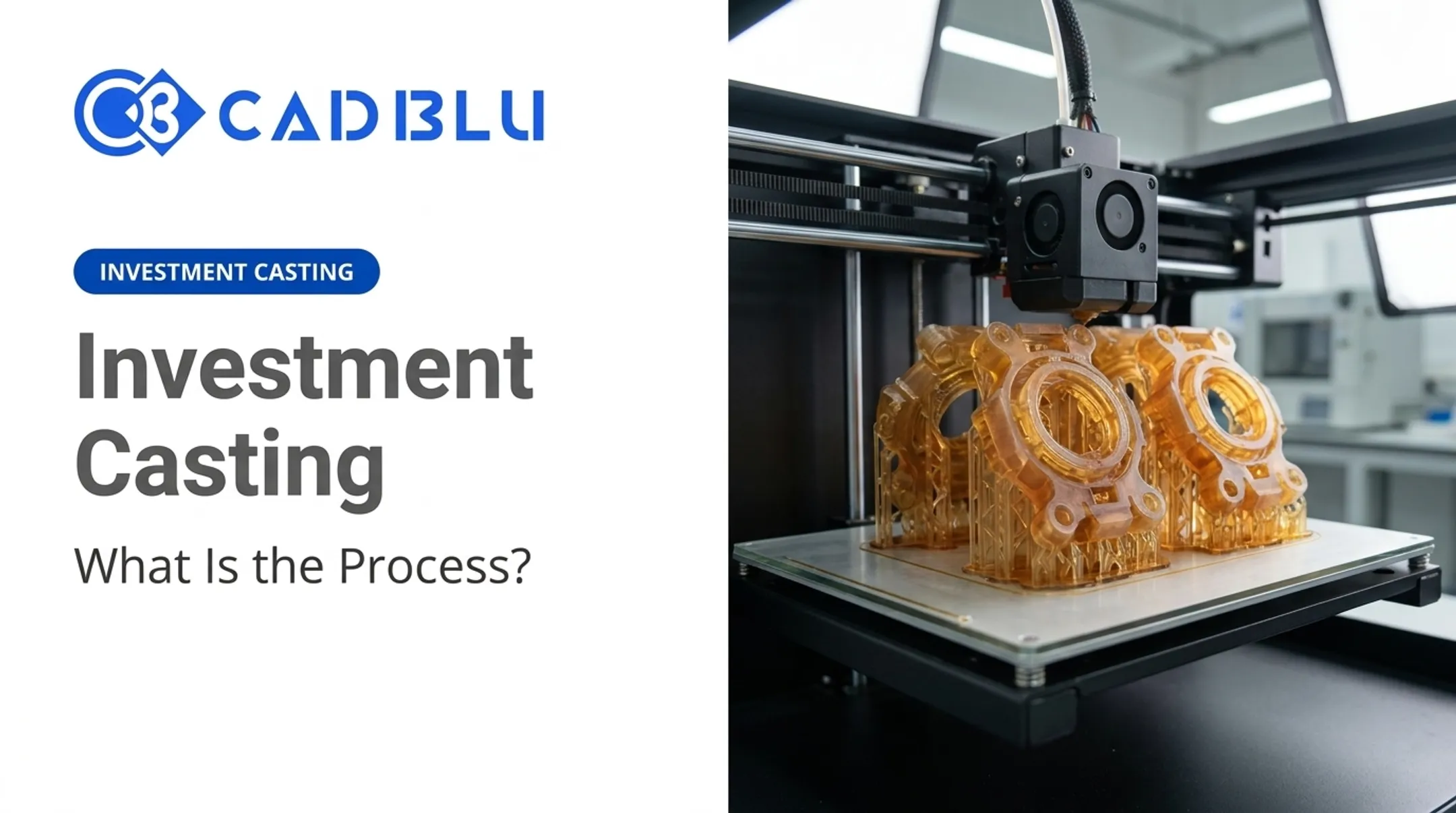
- Produce the pattern. Wax injection, hand carving, molding, or 3D printing with castable wax or resin all work, but the pattern needs clean surfaces, dimensional stability, and a chemistry that burns out completely without residue.
- Assemble the casting tree. Patterns attach to sprues, runners, and gates, giving the wax an escape route during burnout and the metal a path during the pour.
- Apply the investment. The tree gets dipped into ceramic slurry, coated with fine sand or stucco, and dried, building up layered shell coats. Air bubbles need to be eliminated so delicate features stay supported.
- Dewax and burn out. A steam autoclave removes most of the wax quickly, then a flash-fire oven burns off residual wax and cures the shell.
- Melt and pour. Metal is typically induction-melted, then poured into the preheated shell using gravity, vacuum, pressure, or centrifugal assistance depending on the alloy and equipment on hand.
- Cool, knock off, and cut apart. Once cooled, the shell is broken away, castings are cut from the tree, and sprue metal is usually recycled back into the melt.
- Finish and inspect. Vibratory finishing, grinding, and blasting come next, followed by machining precision surfaces, heat treatment where needed, and dimensional inspection.

Digital Pattern-Making With CAD and 3D Printing
Swapping in a CAD model and a 3D printer changes how the pattern gets made, not what happens to it afterward. Investment, burnout, pouring, and finishing still need the same process control regardless of where the pattern came from.
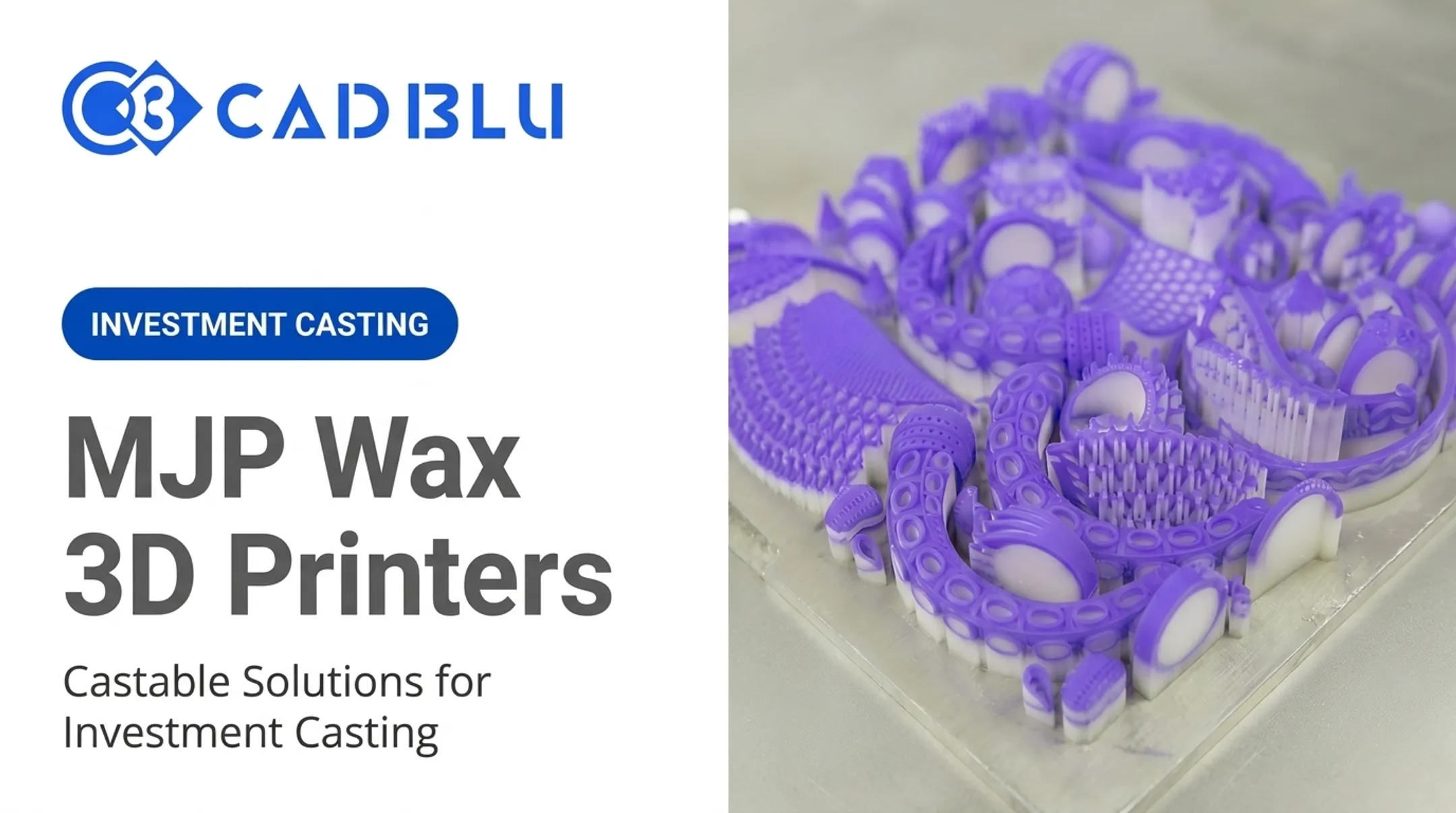
CAD BLU's ProJet MJP 2500 IC, for example, prints patterns straight from CAD files using 100% wax material like VisiJet M2 ICast. The result is sharp edges and tight tolerances that drop into an existing foundry's investment process without changing the shell or burnout steps downstream.
Comparing pattern methods:
- Hand-carved wax: maximum design freedom for artistic or one-off work, but slow and dependent on the carver's skill. No tooling, no repeatability either.
- Molded wax (injection): fast and cheap per pattern once a die exists, ideal for high-volume repeat runs. Tooling cost and lead time are the tradeoff.
- 3D-printed castable patterns: no tooling needed, patterns are identical every time, and design changes cost nothing extra.
According to 3D Systems' investment casting pattern guide, injection tooling still wins on a per-part basis once you cross roughly 10 to 50 castings of the same design. Below that, printed patterns tend to make more economic sense.
Before locking in a castable wax or resin, confirm:
- Burnout behavior and ash residue
- Recommended investment material and schedule
- Maximum section thickness the material supports
- Compatible alloy families and printer
Businesses weighing a digital pattern-making setup, whether that's a wax-jet printer or a castable SLA resin workflow, can work through material and equipment fit with CAD BLU's team before committing. That decision ultimately shapes which industries can rely on the process for their specific tolerances and production volumes.
Where Is Lost Wax Casting Applied?
Jewelry is the classic use case: rings, bezels, filigree, and stone settings. Thin wire-mesh and filigree designs push pattern materials hardest, since fragile geometry has to survive handling before it ever reaches the investment.
Dental and medical applications include crowns, bridges, partial frameworks, and surgical guides, where repeatability and accuracy matter. This space carries regulatory weight. ISO 22674 governs metallic materials for dental restorations, and any clinical or regulatory claim about a specific material should be verified against its current certification.
Aerospace, automotive, and industrial manufacturing rely on the process for complex housings, gearbox components, impellers, and brackets. Internal geometry, like the cooling channels formed by ceramic cores inside turbine blades, often matters more than raw production speed.
Whether a job runs as a one-off or a production run shapes the pattern strategy. One-off prototypes typically work as direct digital patterns. Repeated production usually justifies master tooling or a full multi-cavity casting tree.
Key Factors and Common Issues
Materials and Inputs
Pattern material choice depends on the job: filled and non-filled waxes, runner or gating wax, sticky wax for tree assembly, water-soluble wax for cores, and castable resins for digital workflows.
CAD BLU's VisiJet M2 ICast, priced around $478 per 1.3 kg bottle, is formulated to emulate standard casting-wax burnout behavior so it drops into an existing wax-casting line without retooling.
Investment materials fall into plaster-based and ceramic-shell systems. The right pick depends on the pattern material, burnout cycle, alloy pour temperature, and target surface finish.
A ceramic shell needs enough green strength to survive wax removal, enough fired strength to hold up under molten metal, and enough permeability to vent gas, while staying weak enough to knock off afterward.
Alloy selection drives melting temperature, fluidity, shrinkage, oxidation risk, and final mechanical performance. There's no universal alloy recommendation. The right metal depends entirely on what the part needs to do.
Operating Conditions and Equipment
A long list of variables shapes the final casting: pattern temperature, shell drying time, burnout ramp rate, mold temperature at pour, metal temperature, fill speed, vacuum or pressure assistance, and cooling rate.
CAD BLU's burnout guidance for Figure 4 JCAST-GRN 10 patterns shows how specific this gets:
- Hold at 150°C for 1 to 3 hours to drive off moisture.
- Ramp to 370°C and hold 1 to 2 hours for the investment's thermal transition.
- Ramp to 730°C and hold 2 to 3 hours to fully burn out the pattern.
- Stabilize at pour temperature for at least an hour before casting.
Rush any of those ramps and shell cracking or incomplete burnout tends to follow.
Equipment dependencies span the whole line: wax injection systems or 3D printers, CAD and scanning software, burnout ovens, melting furnaces, and casting rigs. Higher throughput justifies pattern duplication and larger casting trees; low-volume or prototype work often doesn't need either.
Common Defects and Misconceptions
Most defects trace back to a handful of upstream causes:
- Porosity: insufficient deoxidation, contaminated melt stock, or improper burnout
- Shrinkage: poor gate design, inadequate feeding, or excess gas content
- Ceramic inclusions: refractory breakdown in the shell or furnace lining
- Shell cracking or fins: dewax cracks or mismatched expansion between coats
- Incomplete fill: low metal or shell temperature, poor fluidity, or slow pouring
A misconception worth correcting: investment casting doesn't eliminate machining or finishing. Gates and sprues need cutting off. Flash needs grinding. Critical tolerances often still call for secondary machining.
"High accuracy" isn't one fixed number, either. ISO 8062-3 sets dimensional tolerance grades for cast parts, but the actual number you'll hit depends on alloy, geometry, pattern method, and the specific foundry's capability.
A 3D-printed pattern can tighten repeatability, but it doesn't guarantee a defect-free casting on its own. Burnout, shell prep, and metal handling still matter just as much as they did with a hand-carved wax.
When Lost Wax Casting May Not Be Appropriate
Investment casting isn't always the right tool. A few signals point toward other processes:
- Very large, simple parts: sand casting is usually cheaper when there's no fine detail to preserve.
- High-volume, simple geometry: die casting amortizes better once volumes climb into the thousands.
- Tight-tolerance mating features: CNC machining, as a final process or a finishing step, often beats chasing unattainable as-cast tolerances.
- Fragile or oversized patterns: if a pattern can't survive handling, or a part exceeds a foundry's shell and furnace capacity, costs climb fast.
| Process | Best For | Watch Out For |
|---|---|---|
| Investment casting | Complex geometry, fine detail | Pattern fragility, burnout limits |
| Sand casting | Large, simple parts | Coarser surface finish |
| Die casting | High-volume simple parts | High upfront tooling cost |
| CNC machining | Tight tolerances, low volume | Material waste |
| Metal 3D printing | Complex internal geometry | Slower per part |
If your shop is seeing repeated shell failures, excessive finishing labor, or tooling costs that never quite pay off, something's off. That usually points to a mismatch between process and part, not a broken process.

Conclusion
Lost wax casting comes down to five moves: build a detailed temporary pattern, invest it in a refractory shell, remove the pattern, pour molten metal into the cavity, then finish the part. Simple to describe, but every step, from wax choice to gating to burnout to pour, affects whether the casting actually works.
Businesses that get consistent results validate geometry, alloy, volume, and finishing requirements before committing to a workflow, not after a shell cracks or a batch comes back porous.
If you're weighing digital pattern production, whether that's a wax-jet printer, a castable resin, or scanning existing masters into CAD, CAD BLU's team can help. They'll walk through printers, materials, and workflow fit for your specific casting process before you invest in equipment that doesn't match the job.
Frequently Asked Questions
How does lost wax investment casting work?
A detailed wax or castable pattern is encased in refractory investment, then burned out by heat to leave a cavity. Molten metal fills that cavity, cools, and the casting is broken out of the shell for finishing.
What is investment casting used for?
It's widely used in jewelry, dental and medical devices, aerospace, automotive, and industrial manufacturing. Shops choose it when parts need fine detail, complex geometry, or a specialty alloy that's hard to machine.
Is lost wax casting still used?
Yes, it remains a standard production method across multiple industries. It's increasingly paired with CAD, 3D scanning, and 3D-printed castable patterns rather than replaced by them.
How accurate is investment casting?
Accuracy depends on part geometry, pattern method, alloy shrinkage, and shell and pour control. ISO 8062-3 sets tolerance grades for cast parts, but results vary by foundry, so confirm capability directly with your supplier.
What materials are used in lost wax investment casting?
Pattern waxes or castable resins, refractory investments or ceramic shells, and metal alloys ranging from precious metals to steel and superalloys. Material compatibility still needs validation for your specific workflow.
What wax is used in investment casting?
Filled and non-filled pattern wax, runner and gating wax, sticky wax for assembly, water-soluble wax for cores, and castable wax or resin for 3D-printed patterns. The right choice depends on pattern size, strength, and burnout needs.