Many buyers struggle with the same question: what's the best material? Unfortunately, there isn't one. The right choice depends on your printer's technology, the part's intended use, its operating environment, and how much post-processing you're willing to do.
This guide breaks down filaments, resins, powders, metals, and composites, then walks through a practical framework for narrowing your options. CAD BLU's own materials catalog spans more than 77 products organized by printer, technology, and property, which gives a sense of just how wide this landscape really is.
Key Takeaways
- Most applications fall into five material groups: thermoplastic filaments, photopolymer resins, polymer powders, metals, and composites
- Evaluate printer compatibility and material properties together—never separately
- Use PLA for simple models and early prototypes; choose PETG, ABS, nylon, TPU, resins, or metals for functional parts
- Check technical data sheets and certifications before medical, dental, food-contact, or safety-critical use
What Materials Are Used for 3D Printing?
The printing process you're using largely dictates which materials you can use.
- FDM/FFF melts and extrudes thermoplastic filament layer by layer
- SLA, DLP, and MSLA cure liquid photopolymer resin using light
- SLS fuses polymer powder with a laser
- Metal additive manufacturing uses metal powder, wire, or polymer-bound metal feedstock depending on the system
Thermoplastics vs. Photopolymers
Thermoplastics soften when heated and solidify when cooled, and they can go through this cycle repeatedly.
Photopolymer resins work differently. They cure through a light-triggered chemical reaction, and once cured, they don't remelt the same way. That difference affects recyclability, storage, and whether you can rework a failed print.
The Five Major Categories
- Thermoplastic filaments — PLA, ABS, PETG, nylon, polycarbonate, TPU, and dissolvable support materials
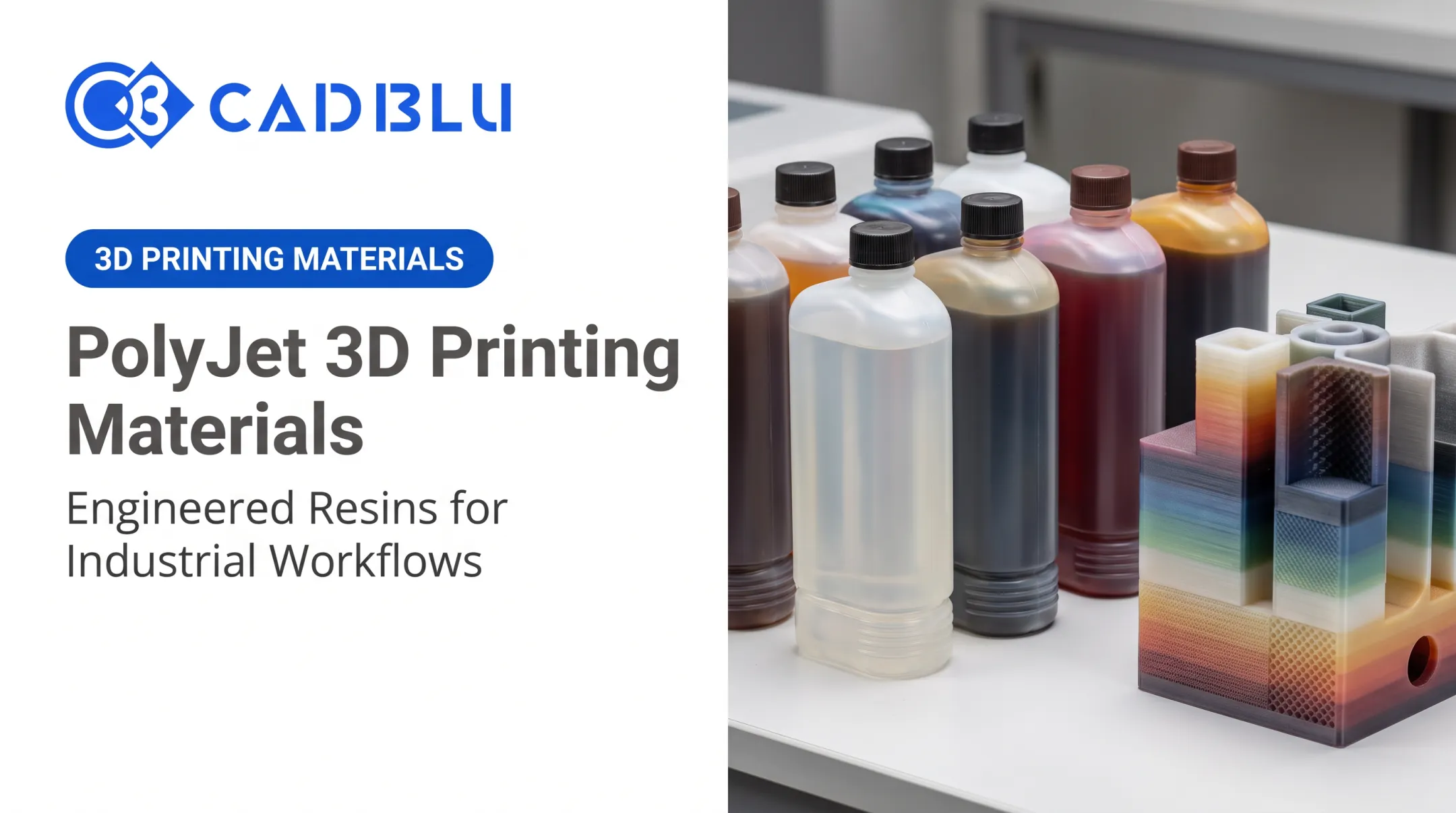
- Photopolymer resins — general-purpose, tough, flexible, high-temperature, castable, dental, and medical formulations
- Polymer powders — nylon, TPU, and polypropylene used in powder-bed processes like SLS
- Metals — stainless steel, aluminum, titanium, tool steel, nickel alloys, and precious metals
- Composites and filled materials — polymer bases loaded with carbon fiber, glass fiber, wood, ceramic, or metal particles

CAD BLU organizes its materials and resins along similar lines, with categories such as bio-compatible, elastomeric, general purpose, high temperature, transparent, and wax and castable resins.
Before buying anything, check your printer's approved materials list, build temperature range, chamber requirements, and nozzle or vat compatibility. Matching the material to those specs up front prevents buying a spool or bottle your system cannot run.
Common 3D Printing Filaments and Resins
Most professional FDM workflows start with one of three filaments, then expand as strength, heat, or flexibility requirements change.
PLA, ABS, and PETG
PLA is the default for concept models, fit checks, and visual prototypes. It's easy to print and reasonably rigid, but it struggles with heat, sudden impact, and prolonged outdoor exposure.
ABS trades some of that ease for toughness and better heat resistance, making it a common choice for functional prototypes. Expect warping issues without an enclosure, plus the need for decent ventilation given the fumes it produces during printing.
PETG sits in between. It offers useful toughness, chemical resistance, and moisture resistance, and it's fairly accessible to print. Watch for stringing and confirm any food-contact claims directly with the manufacturer rather than assuming.
Nylon and TPU
Nylon brings strength, wear resistance, and a bit of flexibility, which makes it popular for gears, fixtures, and hinges. Its biggest quirk is moisture absorption. Store it in a dry box and dry it before printing, or your parts will suffer.
TPU covers flexible needs, meaning seals, grips, gaskets, and vibration-damping components. Ultimaker's TPU 95A, for example, holds up to 580% elongation at break with an Izod impact strength of 34.4 kJ/m². Printing it requires slower speeds and a redesigned feed path compared to rigid filaments.
Resin Families by Performance
Resins get grouped by what they do, not by brand:
- General-purpose and model resins for detailed visual parts
- Tough and engineering resins for functional testing and housings
- Flexible and elastic resins for compliant, rubber-like parts
- High-temperature, flame-retardant, ESD-safe, castable, dental, and biocompatible resins for specialized workflows
Resin printing delivers fine detail and smooth surfaces. It also demands disciplined handling:
- Washing and post-cure steps
- Proper waste disposal
- Verification that the finished part meets the properties you need
Specialty, Composite, and Metal 3D Printing Materials
Once standard filaments and resins hit their limits, specialty and composite materials fill the gap.
Composite and High-Performance Polymers
Carbon-fiber and glass-fiber-filled polymers boost stiffness and dimensional stability, but the fibers are abrasive. You'll need a hardened nozzle and settings tuned for the extra wear.
Polycarbonate, PEEK-family grades, and other high-temperature polymers handle demanding heat, chemical, or mechanical environments. They typically need a controlled chamber and specialized hardware—systems such as Roboze's ARGO 350 extrude at temperatures up to 500°C.
Plan for:
- Hardened nozzles and abrasion-ready feed paths for fiber-filled filaments
- Heated chambers and high-temp hotends for PC, PEEK, and similar polymers
- Tuned print profiles that account for warping, moisture, and slower throughput
Specialty Filaments
Filled filaments—wood, ceramic, stone, metal, conductive, magnetic, and glow—are mostly aesthetic or lightly functional. Added particles can increase brittleness, wear nozzles faster, and raise clog risk, so treat them as niche tools rather than everyday materials.
Metal Additive Manufacturing
Metal 3D printing runs through a few distinct workflows:
- Powder-bed fusion, which laser-fuses metal powder layer by layer
- Bound-metal systems, which print a "green" part from metal powder and polymer binder
- Metal-filled filament, a lower-cost entry point with limited final-part density
A green part isn't finished metal. Solvent debinding produces a "brown" part; furnace sintering then consolidates the powder and shrinks it to final dimensions.

These materials show up in aerospace components, automotive tooling, investment casting, and dental or medical workflows. Always verify the industry standards or certifications required—not every grade is validated for regulated use.
CAD BLU stocks plastics, elastomers, composites, wax, metal, and biocompatible options, and helps teams match materials to compatible printers and workflow requirements.
How Material Properties Affect 3D Printed Parts
Choosing a material means understanding what its numbers actually mean for your part.
- Tensile and flexural strength matter for parts under pulling, bending, or structural load
- Impact strength and elongation matter if a part gets dropped, flexed, or hit with sudden force
- Heat deflection temperature (HDT) and creep resistance matter for parts exposed to heat or sustained load
- Hardness, tear strength, and compression set matter for elastomers, seals, and grips
- Chemical, moisture, UV, and wear resistance matter for outdoor, automotive, or fluid-contact use
Orientation Changes Everything
The same spool of filament can behave like two different materials depending on how you print it. FFF and composite parts are strongest in planes parallel to the build plate. Vertical forces can split layer lines, while horizontal forces distribute along the filament strands.
Infill, wall thickness, and post-processing shift performance further. The NIST report on materials testing standards outlines the ASTM methods used to generate these property comparisons.
Material Comparison at a Glance
| Material | Ease of Printing | Strength | Flexibility | Heat Resistance | Moisture Sensitivity | Typical Use |
|---|---|---|---|---|---|---|
| PLA | Easy | Moderate | Low | Low | Low | Visual models, prototypes |
| PETG | Easy-moderate | Good | Low-moderate | Moderate | Low | Functional prototypes, housings |
| ABS | Moderate | Good | Moderate | Moderate-high | Low | Durable functional parts |
| Nylon | Difficult | High | Moderate | High | High | Gears, fixtures, hinges |
| TPU | Moderate | Moderate | High | Low-moderate | Low | Grips, seals, gaskets |
| Tough Resin | Easy | High | Low | Moderate | Moderate | Housings, functional testing |
| Metal (PBF) | Complex | Very high | Low | Very high | Low | Tooling, end-use production |
Always compare materials using manufacturer technical data sheets tested under consistent methods (ASTM D638 for tensile, ASTM D648 for HDT) rather than relying on rough estimates.
How to Choose the Right 3D Printing Material
Work through this in order, and you'll avoid the most expensive mistakes.
- Define the part's purpose. Visual model, form-and-fit prototype, functional prototype, tooling, casting pattern, or end-use production part?
- Identify the operating environment. Will it face heat, impact, flexing, chemicals, moisture, sunlight, wear, or sustained mechanical load?
- Translate requirements into properties, then prioritize. Separate must-haves from nice-to-haves like color or easy post-processing.
- Check printer and workflow compatibility. Confirm filament diameter, resin chemistry, powder type, nozzle or vat requirements, and support/curing/sintering needs.
- Compare total workflow cost, not just material price. Factor in failed prints, storage, consumables, labor, and expected service life.
- Print a test coupon before committing. Evaluate accuracy, surface finish, strength, and fit against the real use case, not a spec sheet alone.

Once those requirements are clear, side-by-side material comparisons get much easier. CAD BLU's materials portfolio is organized by application, printer, and technology, so you can narrow resin, filament, or metal options without starting from scratch.
If you still need help matching a workflow to production needs, CAD BLU's specialists can support installation, workflow optimization, and ongoing service.
Frequently Asked Questions
What materials are used for 3D printing?
Thermoplastic filaments, photopolymer resins, polymer powders, metals, and composite materials cover the major categories. Your printer's process, whether FDM, SLA, SLS, or metal AM, determines which of these are actually compatible.
What is the best filament material for 3D printing?
It depends on required strength, flexibility, heat resistance, environment, and budget. PLA suits models, PETG and ABS suit functional parts, nylon suits wear-resistant components, and TPU suits flexible applications.
Should I use PLA or PETG?
PLA is easier for models and indoor prototypes. PETG adds toughness and moisture resistance for more demanding functional use. Confirm your printer settings and the specific manufacturer's data sheet either way.
Are PLA fumes harmful to human health?
Emissions vary by printer, temperature, ventilation, and additives. NIOSH research on 3D printing emissions and controls found particle emissions that varied by material, and recommends ventilation such as local exhaust or HEPA filtration.
Can you drink out of 3D-printed PLA?
Not automatically. Filament additives, layer lines, and cleaning process all affect food safety. Formlabs' guide to food-safe 3D printing notes that layer crevices can harbor bacteria, so verify certifications before any food contact.
Is PETG OK to drink out of?
The PETG polymer itself may carry food-contact approval in some formulations, but a finished 3D-printed part isn't automatically safe for drinking vessels. Verify the exact material, surface finish, and applicable U.S. food-contact requirements first.