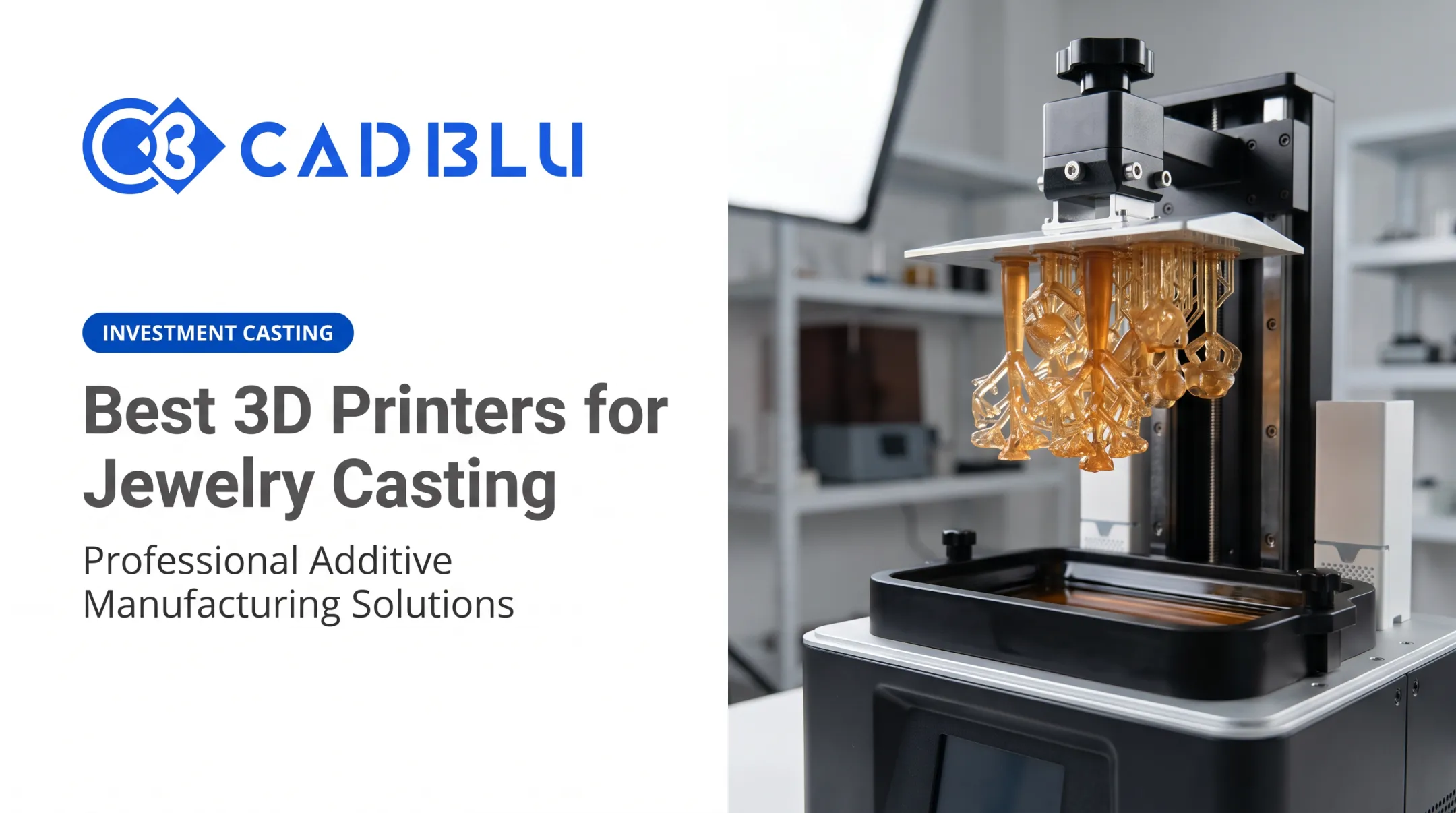
But here's the distinction that trips up a lot of buyers: no resin printer prints gold. It prints a castable pattern that gets invested, burned out, and replaced by molten metal through lost-wax casting. The printer you choose determines how well that pattern holds detail, burns clean, and casts consistently, batch after batch.
This guide compares five resin printer options against the full casting workflow, not just headline resolution numbers.
Key Takeaways
- Match the printer to design complexity, volume, build size, and budget—not resolution alone.
- Prioritize validated resin profiles and documented burnout schedules over nominal pixel size.
- SLA and DLP both succeed when printer, resin, and burnout are properly matched.
- Test your designs and confirm 2026 pricing, warranty, and U.S. support before buying.
Overview of Resin 3D Printing for Gold Jewelry Casting
The castable-resin workflow is consistent from file to finished gold. Every step affects whether the final piece matches the digital design:
- Slice the CAD model and print it in castable resin
- Clean uncured resin, then post-cure under UV light
- Invest the pattern in plaster or gypsum
- Burn out the resin in a kiln
- Cast molten gold into the cavity

Resin printing supports fast design iteration, small-batch runs, and shapes that are slow or costly to carve by hand. A pattern can be reprinted identically, resized without re-carving, or recovered after a failed cast—something a hand-carved original can't do.
Filigree, thin wire mesh, and detailed stone-setting work are also easier once you start from a digital file instead of a wax block.
Why Resolution Isn't the Whole Story
Jewelry-focused printers differ from general-purpose resin machines in a few key ways:
- Validated castable resins tested for burnout and casting, not only general printing
- Dimensional stability through cleaning, curing, and investment
- Cleaner surfaces and easier support removal, so less bench finishing
- Published burnout schedules and ash content instead of guesswork
A printer's advertised XY or pixel resolution doesn't independently prove casting performance. Real detail depends on optics, exposure control, resin formulation, orientation, and post-processing working together. A 22-micron printer with poor exposure calibration can underperform a 50-micron machine with a well-documented resin profile.
JCK, a long-running jewelry trade publication, reported in February 2025 that its Jewelry Symposium program dedicated sessions to additive manufacturing and 3D printing, alongside AI and sustainability. That programming is a clear signal the trade is treating digital patterns as mainstream practice, even without a single adoption percentage to cite.
Treat the five printers below as use-case recommendations. Specs, resin compatibility, and pricing change, so verify everything against current manufacturer documentation before you buy.
Top Resin 3D Printers for Gold Jewelry Casting in 2026
Each entry below was evaluated against the same criteria:
- Verified castable-resin compatibility and documented burnout guidance
- Fine-detail capability on rings, filigree, and pavé settings
- Dimensional repeatability across print runs
- Build volume relative to production needs
- Workflow usability, from slicing software to support removal
- Serviceability and U.S. distributor or manufacturer support
Confirm current 2026 pricing and resin availability with each manufacturer before purchasing.
Formlabs Form 4
Formlabs publishes the most complete public jewelry-casting workflow on this list. That documentation makes Form 4 a strong default for studios that want clear guidance at every step.
It uses MSLA technology with 50-micron XY resolution and a 20.0 x 12.5 x 21.0 cm build volume—large enough for multi-ring platforms. Jewelry studios get reliable casting results without an industrial footprint. High-volume production teams may still want more build area.
| Spec | Details |
|---|---|
| Price | $5,749 (Complete Package) |
| Technology | MSLA, 50-micron XY resolution |
| Build volume | 20.0 x 12.5 x 21.0 cm |
| Castable resins | Castable Wax ($299), True Cast ($199), Clear Cast |
| Software | PreForm, Dashboard |
| Burnout guidance | Certus Prestige Optima investment; 732°C+ for direct-casting resins |
Formlabs' white paper on casting for 3D printed jewelry patterns recommends vertical orientation for True Cast rings, drain holes for parts over 3mm, and specific investment temperatures by resin type. That level of documentation is rare.
Worth investigating before you buy: required post-curing time, whether burnout protocols fit your existing kiln schedule, and whether your workflow depends on proprietary Formlabs consumables.
Asiga MAX X and Max X Plus
Asiga's DLP line stands out for one reason: buyers can select resolution rather than accept whatever the hardware defaults to. MAX X and Max X Plus offer 27, 35, or 43-micron resolution depending on the configuration.
Build volumes run smaller, from 51.8 x 29.2 x 75mm up to 82.3 x 46.4 x 75mm, which suits fine jewelry patterns rather than large statement pieces.
| Spec | Details |
|---|---|
| Price | Not publicly listed; sold through U.S. resellers |
| Technology | DLP, selectable 27/35/43-micron resolution |
| Build volume | 51.8x29.2x75mm to 82.3x46.4x75mm |
| Castable resins | SuperCAST X/S/HD/v3 (gypsum-bonded), SuperWAX (phosphate & gypsum) |
| Notable | SuperCAST HD prints sub-10-micron layers |
Asiga's materials page describes SuperCAST as ash-free with explicit gypsum-bonded investment compatibility, and SuperWAX as suited to both phosphate and gypsum investments. Named investment pairing cuts setup guesswork.
Who should consider this: studios producing high-detail patterns, like intricate pavé or filigree work, where resolution flexibility matters more than build size. Confirm training, calibration support, and software licensing terms with your local reseller before purchasing.
Phrozen Sonic Mini 8K S
Phrozen's entry is the affordability outlier. At $270, the Sonic Mini 8K S undercuts every other printer on this list. It still packs a 22-micron XY resolution 8K monochrome LCD.
| Spec | Details |
|---|---|
| Price | $270 (printer); AnyCast resin $126 |
| Technology | 8K mono LCD/MSLA, 22-micron XY |
| Build volume | 165 x 72 x 170 mm |
| Layer range | 0.01-0.30mm |
| Castable resins | AnyCast Green, W40 Orange, W20 Green, Jewelry Violet |
Phrozen's jewelry materials page claims clean burnout and minimal shrinkage across its castable resin family. Published documentation is thinner on post-cure schedules, investment pairing, and controlled casting-yield data than Formlabs or Asiga.
Limitations to weigh: smaller build capacity limits batch size, calibration is largely manual, and support-structure generation takes some skill to get right. Treat manufacturer anecdotes as a starting point, not proof, and run your own controlled test batch before committing to production use.
HeyGears Reflex RS
Reflex RS pairs automation with a jewelry-specific wax resin, PAC10, aimed at reducing trial-and-error for teams that don't want to fine-tune exposure settings by hand.
| Spec | Details |
|---|---|
| Price | $499-999 (printer); PAC10 resin $250 |
| Technology | 10.3" 8K mono LCD/MSLA |
| Build volume | 222 x 122 x 228 mm |
| Layer range | 30-100 microns |
| Castable resin | PAC10 (70-80% wax, 0.02% ash, 0.12mm min wall) |
Automatic resin refill, resin heating, and full-field screen calibration reduce day-to-day operator error. PAC10's low ash content and 0.12mm minimum wall thickness are built for fine jewelry work, not borrowed from a general-purpose resin.
The gap: HeyGears' official pages don't publish a printer-specific jewelry burnout schedule or a controlled casting-yield result. If repeatability and simplified setup appeal to you, request a validated casting protocol directly from HeyGears before scaling production, and confirm PAC10's compatibility with your specific burnout equipment.
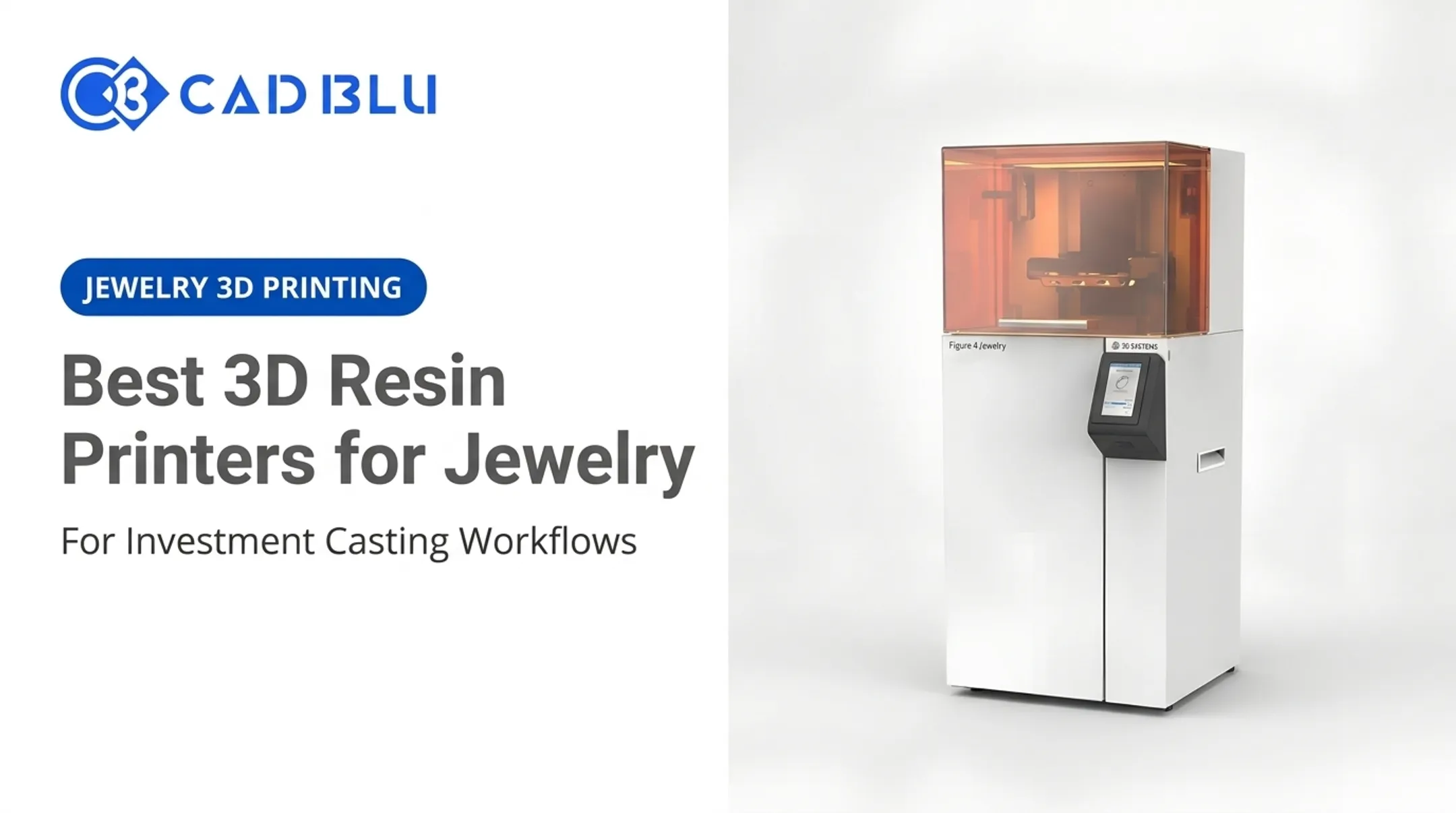
3D Systems Figure 4 Jewelry
For businesses that need a printer built for production casting rather than adapted for it, Figure 4 Jewelry is worth a closer look. CAD BLU carries this system with its matched resin, a pairing aimed at jewelry casting houses.
| Spec | Details |
|---|---|
| Price | $12,000 |
| Technology | DLP-based, 30-micron layers in Jewelry Mode |
| Print speed | 16 mm/hr (Jewelry Mode); up to 4x faster on full ring platforms |
| Castable resin | JCAST-GRN 10 ($300 per 1 kg) |
| Support system | MicroPoint ultra-fine-tip supports |
| Burnout | Gypsum investment, flask casting; requires LC-3DPrint Box UV cure unit |
JCAST-GRN 10 was built for Figure 4 hardware and fine-detail jewelry master patterns. Standard Mode runs 0.02mm layers at 8 mm/hr; Jewelry Mode runs 0.03mm at 16 mm/hr, so studios can trade speed for detail by job. MicroPoint supports leave a cleaner surface and cut bench finishing time.
The manufacturer's burnout guide is direct about limitations: investment type, furnace behavior, and pattern geometry all affect results, and larger flasks need longer heating cycles. That candor is useful when you plan production schedules.
Who this fits: production-oriented jewelry studios and casting houses that want a printer built around one validated workflow rather than a general-purpose machine adapted for the job. Confirm current warranty terms and training availability with your supplier.

How We Chose the Best Resin 3D Printers
Every printer above was screened the same way, prioritizing documented casting performance over marketing claims.
Selection criteria, in order of weight:
- Casting compatibility — Published burnout guidance, a named investment material, and evidence the printer suits gold jewelry patterns—not general prototyping
- Detail and dimensional performance — Feature-size guidance, layer consistency, and support-mark visibility on parts jewelers actually make
- Workflow productivity — Build area, print time, cleaning and post-cure steps, and how many patterns a shop can run in a real production day
- Total cost of ownership — Wash stations, curing units, investment, burnout furnace, and labor—not sticker price alone
Parts we checked for detail included thin filigree and wire mesh, pavé settings and engraved surfaces, hollow pieces with drain holes, and thicker signet-style tops.
A $270 printer and a $12,000 printer both need the same supporting workflow. None of the sources reviewed here publish a reliable cross-brand cost-per-ring or labor-hour figure, so we did not invent one. Budget for the full process, not just the hardware line item.

Common mistakes worth avoiding:
- Choosing by resolution alone while ignoring exposure calibration and resin quality
- Running an unvalidated resin on a printer it was never tested with
- Skipping burnout compatibility checks before you buy
- Underestimating ventilation and safety needs for resin handling
- Skipping a test run with your own designs before committing to production
Conclusion
The best resin 3D printer for gold jewelry casting delivers repeatable, clean-burning patterns matched to your design complexity, production volume, and budget. The smallest micron number on a spec sheet does not guarantee that outcome.
Run a side-by-side trial with your own representative models:
- A ring
- A thin filigree piece
- Something hollow
- Something thick
Take that batch through the full print-to-cast cycle and score:
- Detail retention
- Burnout behavior
- Rework time
That test tells you more than any spec sheet.
If you're comparing printers, materials, or software for a U.S. jewelry operation and want help sorting the options, CAD BLU works with jewelry businesses on printer selection, installation, and workflow support.
Frequently Asked Questions
What is the best 3D printer for metal jewelry?
It depends on whether you value fine detail, production volume, low entry cost, or integrated materials and support. Resin printers create castable patterns for the lost-wax process; they don't print metal jewelry directly.
Can a 3D printer make gold jewelry?
No. Most resin 3D printers produce castable patterns that get invested, burned out, and replaced by molten gold during lost-wax casting. The printer never touches actual gold.
Which resin is best for jewelry casting?
Look for clean burnout, low ash content, dimensional stability, and a named compatible investment material. Manufacturer-supported exposure and post-curing instructions matter as much as the resin formulation itself.
Is SLA or DLP better for jewelry casting?
Either can work well. SLA uses a laser to cure each layer; DLP uses a projector to cure the full layer at once. Performance depends on validated exposure settings and burnout workflow, not the technology label alone.
What should I test before buying a jewelry resin 3D printer?
Print a representative ring, a thin filigree or pavé detail, a hollow piece with drain holes, and a thicker section. Run all of them through cleaning, curing, investment, burnout, and casting before deciding.
Do small jewelry businesses need an industrial 3D printer?
Not necessarily. A professional desktop system can handle small-shop production if its resin, build volume, and repeatability meet your needs. Higher-volume casting houses may eventually outgrow desktop hardware.