Before going further, one distinction matters more than any other: printing a true sintered ceramic is not the same as printing a ceramic-filled resin or printing a pattern that gets processed conventionally afterward. Each path has different strength, aesthetics, and regulatory implications.
This article covers the materials and technologies behind ceramic additive manufacturing, where it's actually being applied in dentistry today, how the workflow runs from scan to sintered part, and what a lab or practice should weigh before investing. We'll separate what's commercially available from what's still confined to research settings.
Key Takeaways
- Ceramic 3D printing delivers complex geometries with less waste when material, orientation, and post-processing are controlled
- Zirconia, alumina, and ceramic-reinforced composites differ in strength, density, and clinical suitability
- Many applications remain provisional, lab-based, or dependent on product-specific regulatory clearance
- Results depend on the full digital chain from scanning through sintering and inspection, not the printer alone
What Materials and Technologies Are Used to 3D Print Dental Ceramics?
Ceramic additive manufacturing starts with a ceramic-loaded slurry or feedstock, not a solid block. A printer shapes this material layer by layer into a "green body," which then goes through binder removal and high-temperature sintering to become an actual ceramic part. Skip either step, and the part is not a finished ceramic restoration.
Printing Technologies Compared
Several methods dominate dental ceramic printing, each with different tradeoffs:
| Method | Strengths | Limitations |
|---|---|---|
| Lithography-based ceramic manufacturing (LCM) | Up to 100 layers/hour; 25–100 µm layers; ~40 µm lateral resolution | Needs a dedicated debinding/sintering furnace |
| Digital Light Processing (DLP) | Full-layer cure per exposure; strong for batches | Voxel size limits finest detail |
| Stereolithography (SLA) | High accuracy; smooth as-printed surfaces | Slower build; heavier post-processing |
| Extrusion | Suited to porous/scaffold geometries | Resolution limited by nozzle and feedstock |
Material Categories
- Zirconia: Go-to option for strength and aesthetics when debinding and sintering are tightly controlled
- Alumina: Hard and chemically stable; useful for intricate geometries where lower fracture toughness is acceptable
- Ceramic-reinforced composites and resins: Not equivalent to sintered ceramic—evaluate against their own indications
- Emerging materials: Lithium disilicate, glass-ceramics, hydroxyapatite, and alumina-zirconia blends remain mostly research-stage
A 2025 systematic review reported DLP-printed zirconia at 98.8%–99.4% relative density and flexural strength up to 674.7 MPa (alumina-toughened zirconia up to 781 MPa). Those results hinge on controlled debinding and sintering.
Layer orientation matters more than most labs expect. That same review measured SLA-printed zirconia roughness at 0.71 µm parallel to the build platform versus 2.91 µm perpendicular—both above the 0.2 µm threshold often cited for dental restorations.

Polishing after sintering closes much of that gap.
Applications of 3D-Printed Dental Ceramics
3D-printed dental ceramics span routine restorations, provisional work, and research scaffolds—with material class and clearance status deciding what belongs in the mouth.
Crowns, Bridges, Inlays, Onlays, and Veneers
Patient-specific geometry and digital repeatability make ceramic printing attractive for these restorations. But there's a real gap between research-stage direct ceramic printing and commercially cleared, manufacturer-validated materials. Always verify the intended indication and clearance status before treating a printed restoration as definitive.
Ceramic-filled resins currently fill much of this space instead of fully sintered ceramic:
- CROWNTEC is a composite resin for permanent crowns, inlays, onlays, veneers, and denture teeth
- Reported ~30% stronger than many conventional restorations
- Different material class than sintered zirconia—labs should qualify and finish it on its own terms
Implant-Supported and Prosthetic Components
Additive manufacturing can produce custom prosthetic teeth and frameworks with internal channels or lattice structures that would be difficult to mill conventionally.
Ceramic restorations remain distinct from metal implant fixtures and abutments. Any lattice geometry still needs separate validation for cleaning access and strength.
Dentures and Removable Prosthetics
Labs may print components for denture bases, teeth, and try-ins, but printed ceramic elements remain distinct from the polymer materials commonly used today. NextDent's DENTURE 3D+, for instance, is a biocompatible material for removable denture bases with lower shrinkage than standard PMMA, priced around $365.90.
Durability claims need caution here. A 2024 clinical review of printed dentures found follow-up periods ranging from one week to 2.5 years, mostly for resin or PMMA-based systems, not sintered ceramic teeth or bases. Long-term wear, occlusion, and repairability data specific to ceramic components remain limited.
Temporary Restorations and Design Prototypes
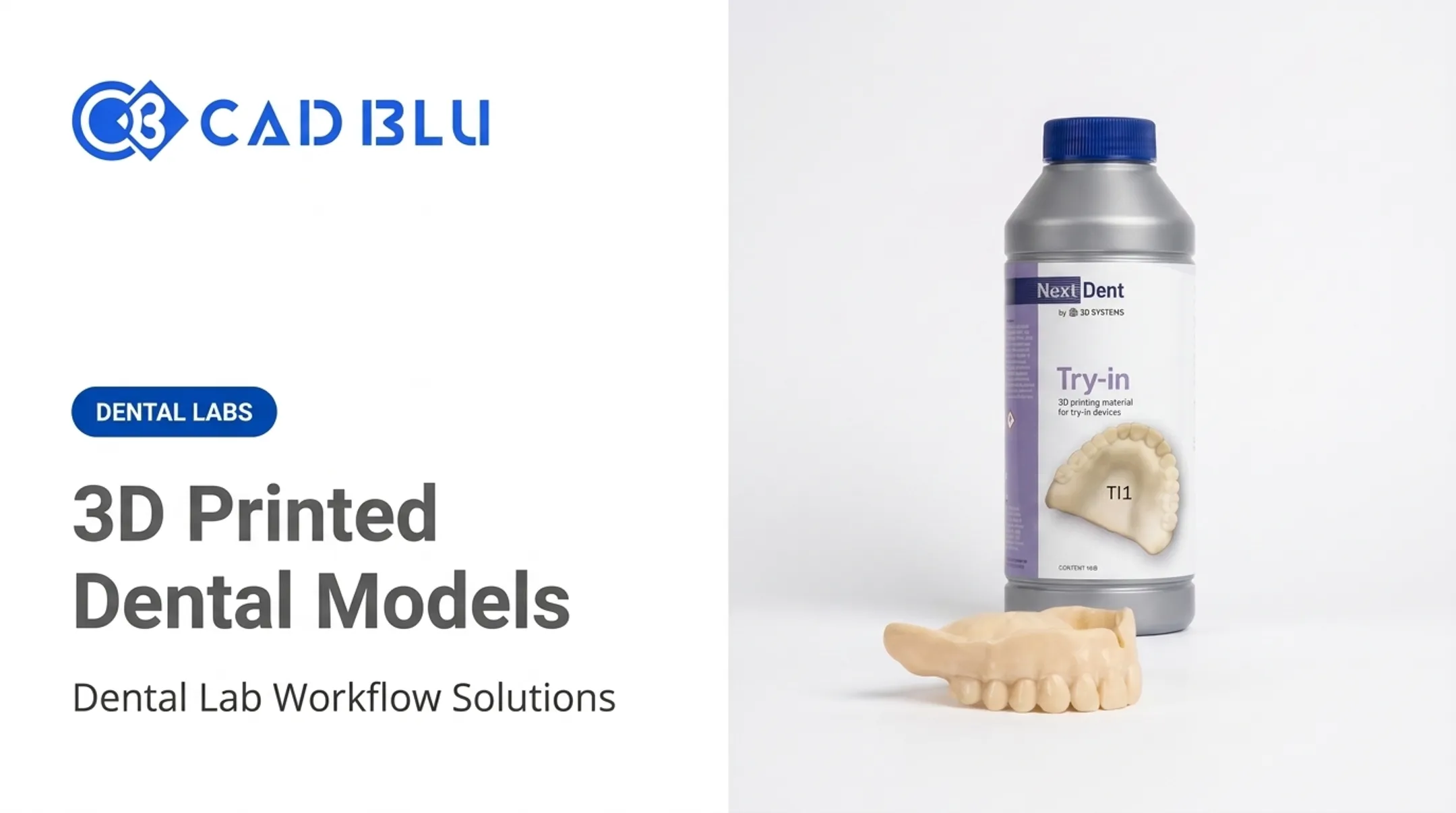
Printed materials, whether ceramic-filled or true ceramic, work well for provisional restorations, fit checks, and design validation. Try-in resins like NextDent's Try-In Resin (around $341.06) support bite and occlusion checks before committing to a definitive restoration. The tradeoff is speed versus the mechanical and aesthetic requirements a final restoration demands.
Surgical Planning and Research Applications
Anatomical models and custom devices for education and surgical planning often don't need ceramic's biocompatibility or wear resistance. A lower-cost resin process usually makes more sense. Where research does focus on ceramics, it's mostly in porous structures and bioactive scaffolds. Extruded hydroxyapatite-zirconia scaffolds have shown around 65% porosity with apatite formation and cell proliferation in lab testing. That is promising for bone-substitute research, but it is far from a cleared restorative product.

The FDA lists dental crowns among examples of 3D-printed medical devices and expects manufacturers to meet applicable quality-system requirements. A porcelain-teeth device classification does not mean a specific printed material or workflow is cleared.
How Does the Dental Ceramic 3D Printing Workflow Work?
Ceramic printing isn't just "load slurry, press print." Every stage from scan to sintering shapes the final part's fit and strength.
Digital Capture and Design
Intraoral scans, lab scans, and sometimes CBCT data feed into CAD software to build the printable file. Design choices at this stage decide whether the sintered part fits:
- Minimum wall thickness
- Support placement and build orientation
- Shrinkage compensation
- Connector dimensions
Printing and Process Control
Outcome quality depends on disciplined process control:
- Material preparation
- Printer calibration
- Layer exposure settings
- Build orientation
Manufacturer-validated profiles exist for good reason. Changing settings without testing can shift density, accuracy, and porosity in ways that only show up after sintering.
Debinding, Sintering, and Finishing
This stage turns a green body into dense ceramic. In one documented DLP zirconia process, staged debinding ran from 20°C to 490°C, sintering reached 1500°C, and the full cycle lasted roughly 97 hours. Shrinkage exceeded 22% in two axes and 25% in the build direction—so compensation belongs in the design file, not as a post-sinter guess.
Rushed thermal processing or finishing can introduce:
- Distortion or warping
- Cracks and residual porosity
- Excess surface roughness
- Poor marginal fit
Inspection and Clinical Quality Assurance
Before any printed ceramic component reaches a patient, dimensional inspection, marginal and internal fit checks, occlusal contact verification, and batch documentation all need to happen. Final clinical use must follow the applicable device labeling, laboratory procedures, and infection-control requirements, along with U.S. regulatory obligations for the specific material used.

Selecting a Complete Solution
Before adopting ceramic printing, a lab or practice should evaluate:
- Which applications you need first—crowns, dentures, models, or a mix
- Which ceramic materials are validated for that intended use
- Whether printer resolution and furnace capacity match the material spec
- How well scanning, CAD, and printer software work as one stack
- Total cost of ownership across equipment, consumables, training, and maintenance
- Who owns validation for fit, strength, and documentation
A full-service partner can shorten that evaluation. CAD BLU works with dental labs and practices across the U.S. on printers, materials, scanning and CAD tools, installation, and ongoing technical support—always within the verified indications of each material and system.
What Are the Benefits, Limitations, and Future Outlook?
Benefits
Ceramic printing's appeal comes down to geometric freedom and material efficiency. A 2025 prosthodontic scoping review reported material waste under 5% for 3D printing compared to more than 30–40% for milling—a substantial difference when working with expensive zirconia blanks.
The same review found marginal gaps between milled and optimized printed crowns nearly identical, around 124 µm for both.
- Complex, patient-specific geometries in a single build
- Reduced tool wear compared to subtractive milling
- Repeatable digital files across multiple parts
- Integration with existing CAD/CAM workflows
Limitations and Risks
Printing isn't automatically faster or cheaper once the full process is counted. A 97-hour sintering cycle is a real cost center. Furnace equipment, shrinkage management, defect control, and operator training add up quickly.
- High equipment and furnace costs beyond the printer itself
- Shrinkage that must be compensated for at the design stage
- Limited validated material options compared to milling
- Product-specific regulatory clearances that vary by material
Future Developments
Research is pushing toward faster ceramic photopolymerization and tighter sintering control. AI-assisted design tools are already in the mix—a 2024 review found them improving accuracy in tooth design and occlusal optimization.
Bioactive ceramics and multi-material printing remain promising, but they are still confined to research settings, not validated clinical benchmarks. Treat near-term claims about definitive-restoration adoption as projections, not demonstrated capability.
Frequently Asked Questions
Can a 3D printer print ceramic?
Specialized ceramic printers shape ceramic-loaded slurries or feedstocks into a green body that still needs debinding and sintering. That differs from ceramic-filled resin, and clinical use depends on each material's regulatory clearance.
How long do 3D printed dentures last?
Lifespan depends on component type, occlusal forces, fit, hygiene, and manufacturer guidance. Published follow-up data ranges from one week to 2.5 years, mostly for resin-based systems rather than ceramic.
What dental ceramics can be 3D printed?
Zirconia, alumina, and ceramic-reinforced materials are the most established options. Lithium disilicate, glass-ceramics, and bioactive materials are emerging in research, with availability and clearance varying by product.
Are 3D printed ceramic crowns safe?
Safety depends on the exact material, manufacturing controls, finishing steps, and U.S. regulatory authorization for that product. Follow the dentist's, lab's, and manufacturer's documented guidance.
Is 3D printing ceramic better than milling?
Printing offers more geometric freedom and less waste; milling has a longer clinical track record for many ceramics. The better choice depends on restoration type, material, volume, and quality requirements.