Introduction
The resin loaded into your SLA printer determines almost everything about the final part: detail level, strength, flexibility, heat resistance, surface finish, and how much post-processing you'll do afterward.
Pick wrong, and you'll end up with brittle prototypes, failed support structures, or parts that simply can't survive their intended job.
For US businesses producing prototypes, casting patterns, dental models, medical models, or functional parts, resin selection isn't a minor spec. It's the difference between a part that performs and one that gets scrapped.
Resin chemistry directly affects dimensional accuracy and cure behavior, which is why manufacturers publish detailed technical data sheets rather than relying on marketing claims alone.
This guide breaks SLA resins into three practical families, general-purpose, engineering, and specialty, and walks through the checks you should run before committing a material to a professional workflow.
Key Takeaways
- SLA resin performance depends on the part's job, not the label on the bottle
- General-purpose, engineering, and specialty resins each address detail, toughness, flexibility, or heat resistance
- Always confirm printer compatibility and curing wavelength before switching materials
- Uncured resin requires proper PPE, ventilation, and disposal regardless of "eco" claims
- Test every new resin with a calibration part before using it in production
What Are SLA Resin Types and Why Do They Matter?
SLA resin is a liquid photopolymer that solidifies when exposed to a specific wavelength of light. In traditional stereolithography, a laser traces each cross-section directly into the vat. DLP printers cure an entire layer at once using a projector, and MSLA/LCD systems use an LED array behind an LCD mask to expose the layer nearly simultaneously.
These are three different exposure architectures, not three different resin categories. That's an important distinction, because "SLA resin" gets used loosely across the industry to describe any vat-photopolymerization material. Not every resin works on every machine. A resin formulated for a laser-based SLA system may cure incorrectly, or not at all, on an LCD printer tuned to a different wavelength.

Why Resin Chemistry Drives Part Quality
Formlabs' own technical documentation notes that temperature, resin homogeneity, light scattering, and viscosity all affect print outcomes, and that dimensional deviations can run into the hundreds of micrometers when these variables shift. A resin optimized for fast, low-viscosity cure may sacrifice the toughness a snap-fit enclosure needs, while a resin built for rigidity can print too slowly for high-volume casting patterns. Engineers choosing resin for load-bearing brackets face different trade-offs than those printing dental models or display parts. Resin chemistry, in other words, shapes:
- Cure depth and edge definition
- Shrinkage and warping behavior
- Surface smoothness and layer adhesion
- Impact resistance and elongation
- Thermal performance and long-term stability
What Goes Wrong With Poor Selection
Choosing a resin based only on price or advertised resolution creates predictable failure modes:
- Brittle parts that crack under normal handling
- Failed supports from under-cured or over-cured layers
- Tacky surfaces that never fully harden
- Deformation during post-cure or in service
- Performance mismatches, like using a display resin for a load-bearing bracket
Always cross-check a manufacturer's technical data sheet before assuming a resin will behave the way its category name implies.
Types of SLA Resin
Most SLA resins fall into three practical families. Some products blur the lines, a tough clear resin or a flexible biocompatible resin, for example, so treat these as starting points rather than rigid boxes.
General-Purpose and Model Resins
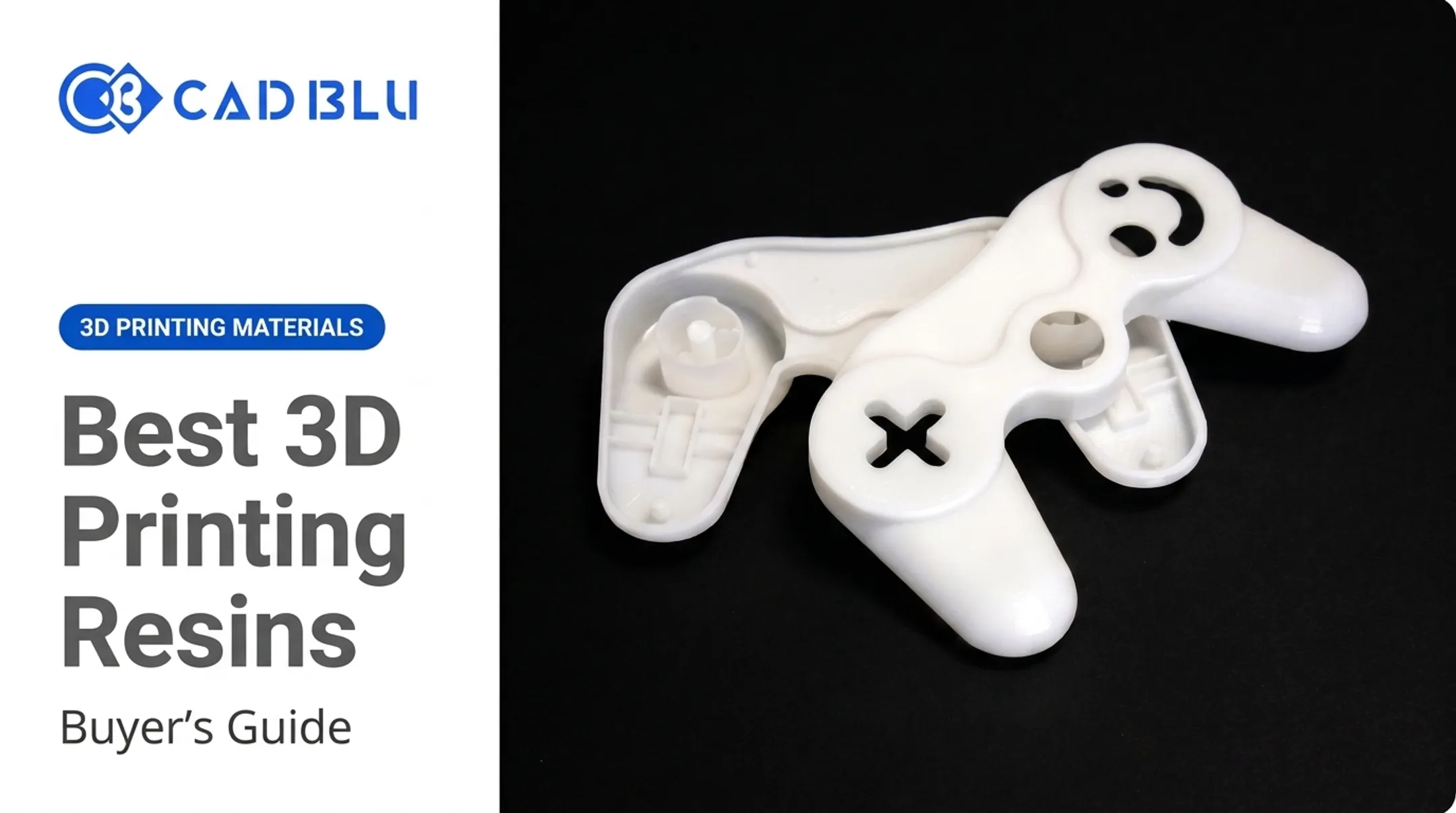
Standard or rigid resin is the everyday choice for visual prototypes, concept models, display parts, and educational projects where sharp detail and a clean finish matter more than impact resistance. Within this family, you'll find several sub-variants:
- Draft/high-speed resin – prints faster at thicker layers, trading some surface refinement for turnaround time
- High-detail resin – finer layer settings for models with intricate features, like 100-micron print modes documented on some product lines
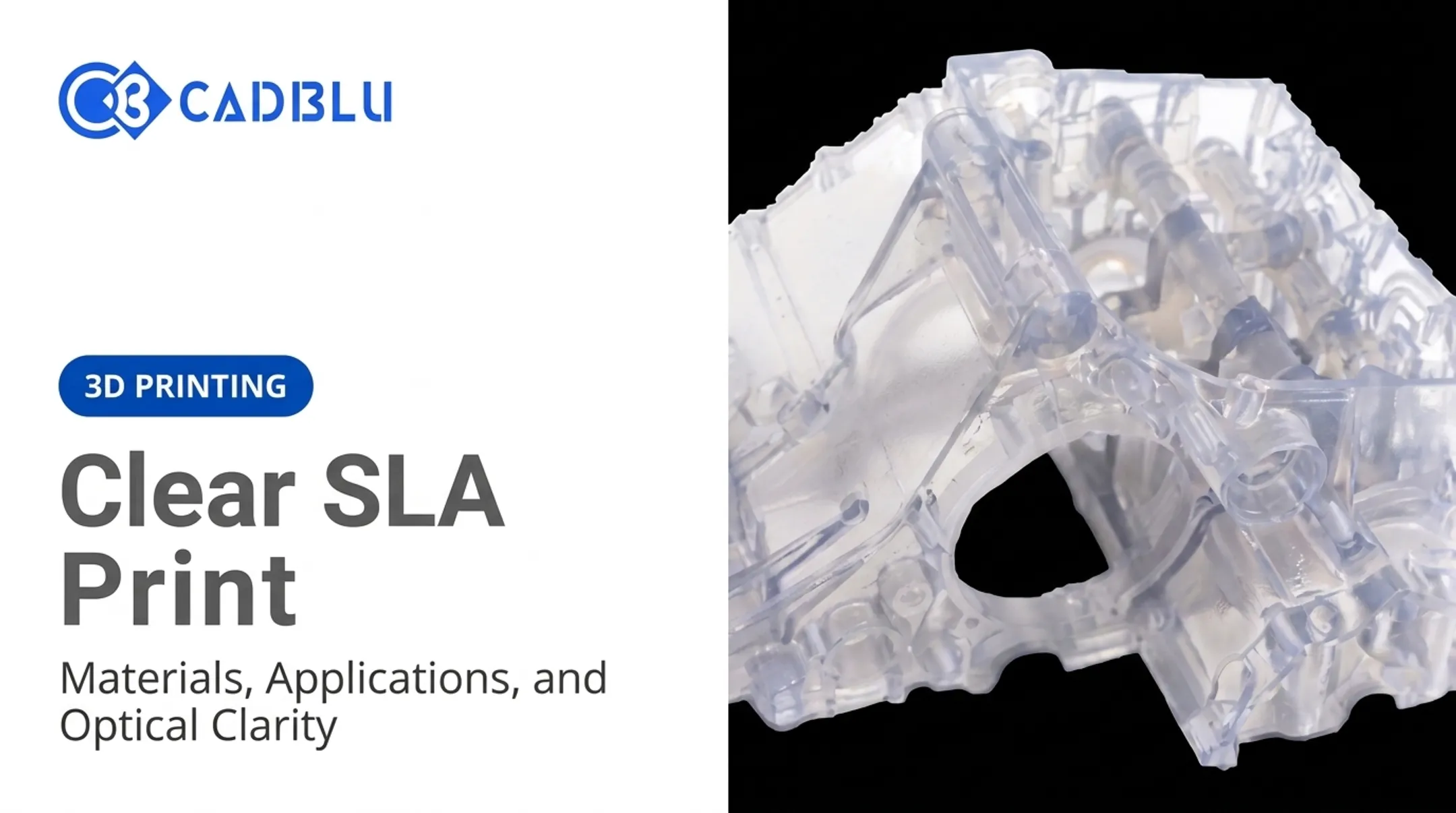
- Clear/transparent resin – used for bottles, light covers, and housings where optical appearance matters
- Water-washable resin – simplifies cleanup by skipping isopropyl alcohol, though moisture sensitivity and mechanical properties vary by formulation
Standard resin is typically the most economical and easiest to print. That doesn't make it appropriate for load-bearing, outdoor, high-temperature, or repeated-impact use. It's a display and communication material first.
Engineering and Performance Resins
When a part needs to survive handling, snap together, or hold up under mechanical stress, engineering resins take over. Tough or ABS-like resins are designed for housings, clips, and functional prototypes that need more ductility than standard resin offers. "ABS-like" describes behavior under test conditions, not a chemical match to molded ABS.
Other engineering options include:
- Rigid and ceramic-filled resins for stiffness and dimensional stability, though these can be more brittle and harder on vats
- Nylon-like resins for lower moisture uptake and improved chemical resistance
- High-temperature and flame-retardant formulations for tooling, fixtures, and industrial applications
3D Systems' Accura line illustrates the range well. Accura 48HTR is rated for testing up to 130°C, while Accura ABS Black targets functional prototypes and short-run production parts that mimic injection-molded ABS. Heat-deflection temperatures across various Accura high-temperature and composite resins span roughly 65°C to over 215°C, depending on the formulation and post-cure schedule.

That last part matters: engineering resins often need controlled exposure and a specific thermal post-cure cycle to hit their published numbers. Skip the post-cure, and you'll get a fraction of the advertised performance.
Specialty and Application-Specific Resins
This family covers materials built for a specific job rather than general use:
- Flexible and elastic resins for grips, seals, gaskets, and wearable concepts, with trade-offs between elongation, fine detail retention, and support removal
- Castable/burnout resins for jewelry and investment casting, requiring low-ash burnout, investment compatibility, and parts free of surface tack before casting
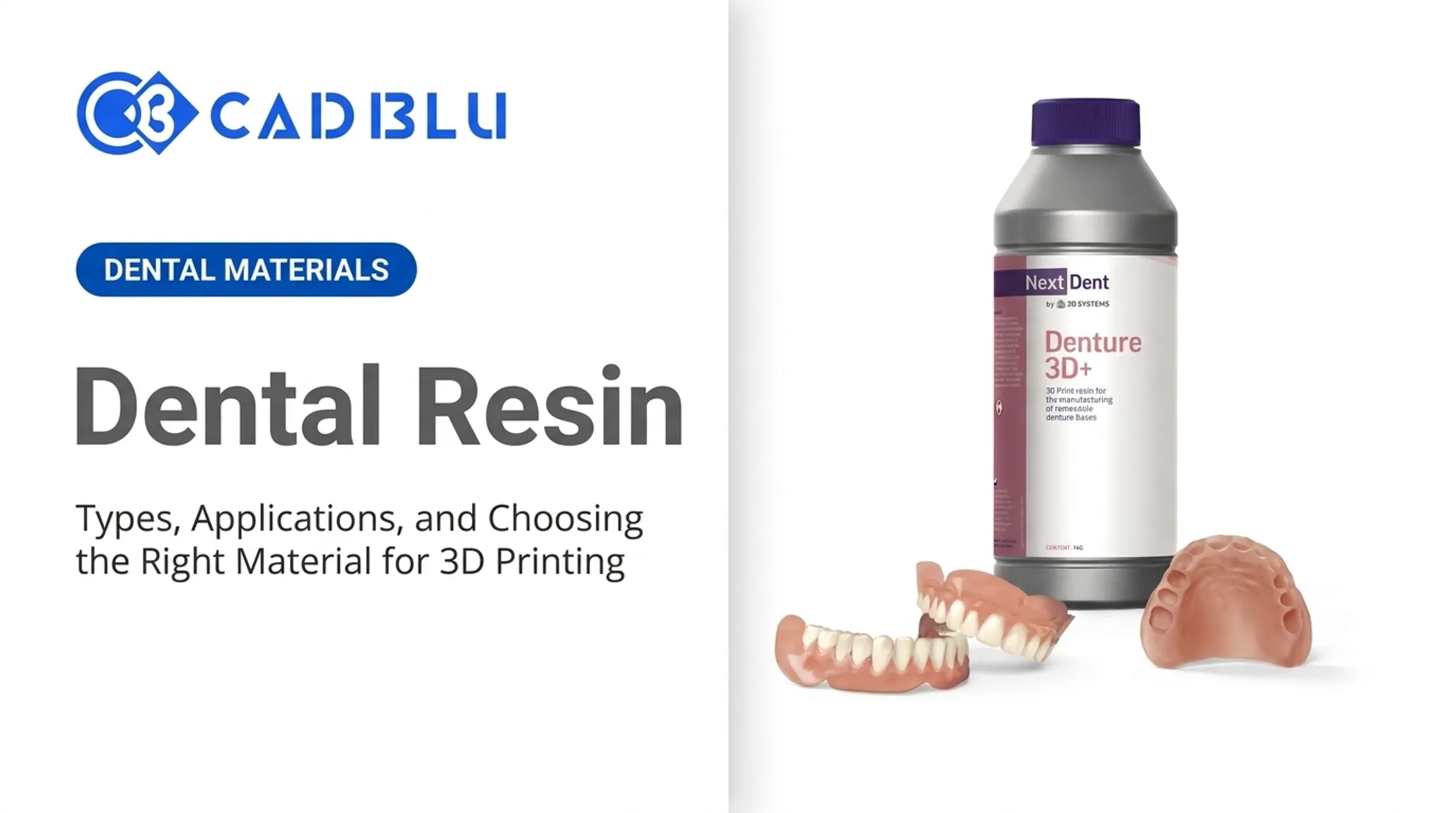
- Dental, medical, and biocompatible resins, which are regulated or application-controlled; a model resin should never be substituted for one validated for intraoral or surgical use
- PMMA-like, ceramic-filled, ESD-safe, and large-format resins, each requiring its own manufacturer documentation for certification and performance claims
CAD BLU's materials catalog reflects this specificity. TDS Daylight Castable, for instance, lists ash content below 0.18% and requires storage between 10–50°C away from UV light, while dental casting resins support crown, bridge, and partial denture base production.
Quick Comparison
| Family | Best For | Key Strength | Main Limitation |
|---|---|---|---|
| General-purpose | Visual models, concept prototypes | Fine detail, smooth finish, low cost | Weak under impact, heat, or repeated load |
| Engineering | Functional prototypes, tooling, snap-fits | Toughness, stiffness, or heat resistance | Often needs precise post-cure to perform |
| Specialty | Casting, dental, flexible parts | Purpose-built performance | Requires validated workflow, not general use |
How to Choose the Right SLA Resin
Start with the part's actual job, not the resin aisle. Classify it honestly: visual model, fit-check prototype, functional prototype, casting pattern, dental or medical model, tooling aid, or end-use component. That classification narrows your options fast.
Match Mechanical and Thermal Needs
Compare tensile and flexural strength, elongation, and impact resistance against how the part will actually be loaded. Geometry and print orientation change real-world performance just as much as the resin datasheet does. A snap-fit clip printed flat behaves differently than one printed on edge.
For thermal and environmental exposure, check:
- Heat-deflection temperature at the pressure relevant to your application
- Moisture uptake, especially for dental, outdoor, or humid-environment parts
- UV exposure and expected service life
- Chemical contact during use or cleaning
Evaluate Appearance and Confirm Compatibility
If the part needs to look presentation-ready or optically clear, compare surface finish, minimum feature size, and support-mark visibility across candidate resins. Then confirm the practical side:
- Verify printer technology – laser SLA, DLP, or MSLA/LCD
- Check curing wavelength – resins are tuned to specific light sources
- Confirm resin tank/vat requirements – and note the recommended layer height
- Review the approved material list – specific to your printer model

Calculate the Real Workflow Cost
Bottle price is only part of the equation. Factor in failed prints, wash materials, PPE, curing equipment, support removal time, replacement films or vats, and ventilation setup. A cheaper resin that fails 20% of prints often costs more than a premium material that prints reliably.
Pricing varies by material class and packaging. As reference points, a 2-liter cartridge of a rigid high-temperature resin runs around $880, while a 10 kg cartridge of a general-purpose material can run $2,870. Consumables like wash fluid and waste trays add smaller but recurring costs.
Running these calculations for every resin candidate takes time most shops don't have. Working with a solutions provider like CAD BLU can shortcut that process, matching hardware, resin, software, and support to your specific application instead of testing blind.
What to Check Before Finalising an SLA Resin
What to Check Before Finalizing an SLA Resin
Before committing to a resin for a production workflow, run through these checks:
- Set your minimum bar first. Don't reach for the most advanced or expensive resin if a standard or tough formulation already meets the requirement.
- Read the current technical and safety data sheets. Check test methods, cure conditions, wavelength, storage instructions, and shelf life, not just the marketing name.
- Demand documentation for regulated claims. Biocompatibility, sterilization, flame resistance, ESD behavior, and medical suitability all require specific evidence, not a category label.
- Print a calibration coupon first. Log the resin lot, printer, orientation, exposure settings, wash process, and cure cycle before scaling to a full batch.
Safe handling deserves its own attention. Uncured resin acrylates and related chemicals can cause skin irritation or respiratory sensitization, according to NIOSH guidance published in 2025. Standard precautions include:
- Chemical-resistant nitrile or neoprene gloves (not latex)
- UV-rated eye protection
- Adequate ventilation or filtration during printing and curing
- Sealed storage away from unintended light or heat
- Disposal per the SDS and applicable state hazardous-waste rules
"Water-washable" or plant-based labeling doesn't mean a resin is harmless in its uncured state. Follow the SDS regardless of what the bottle promises.
Conclusion
Choosing an SLA resin is a performance and workflow decision that has little to do with brand names or bottle colors. General-purpose, engineering, and specialty resins each solve a different problem, and every one of them involves trade-offs in detail, strength, flexibility, heat resistance, cost, or post-processing effort.
Before scaling any resin into a professional workflow, confirm printer compatibility, read the current datasheets, and print a representative test part. If you need help matching materials to printers, software, and support for jewelry casting, dental production, medical models, or industrial applications, CAD BLU can help. As a full-service additive manufacturing partner, the company works with businesses across these production workflows every day.
Frequently Asked Questions
Which SLA resin is the strongest?
It depends on what "strong" means for your part. Tensile strength, impact resistance, stiffness, and heat resistance don't move together. Compare engineering resin datasheets against your actual load conditions, then validate with a test print.
Is SLA resin toxic?
Uncured resin can pose health hazards and requires PPE, ventilation, and storage precautions listed in its safety data sheet. Fully cured parts and different formulations still need product-specific guidance rather than blanket assumptions.
Which is better, SLS or SLA?
SLA typically produces smoother, more detailed cosmetic parts, while SLS tends to yield more durable functional parts using actual sintered thermoplastic powder. The better process depends on your application, volume, and finish requirements.
What are the three types of resin?
SLA resins generally fall into general-purpose/model, engineering/performance, and specialty/application-specific families. Many products overlap categories, so treat these as starting points, not rigid boxes.
What are the different types of resin printing?
Laser-based SLA, DLP, and MSLA/LCD are the three main vat-photopolymerization technologies. Printer technology, curing wavelength, and validated material profiles all determine which resins are compatible with which machine.